
LSA-635
Base for statue of emperor, probably Julian. Myra (Lycia). 361-363
Record details
Photographs
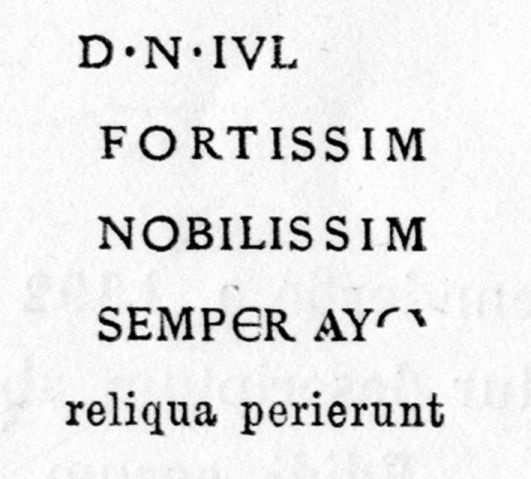
Inscription
D(omino) n(ostro) Iuli(ano ?), / fortissim(o), / nobilissim(o), / semper Augu(sto) /[--
Inscription translation
To our lord Julianus...bravest, most noble, eternal Augustus...
Bibliography
- Corpus Inscriptionum Latinarum; , III no. 12128
Discussion
INSCRIPTION
In four preserved lines:
D(omino) n(ostro) Iuli(ano ?), / fortissim(o), / nobilissim(o), / semper Augu(sto) /[--
'To our lord Julianus, bravest, most noble, eternal Augustus.'
Letter height not recorded.
CIL, the only editor of the inscription so far, noted that the final lines of our inscription were missing.
DESCRIPTION (from CIL III)
Rectangular base, H 125 cm. There is no published image.
PROVENANCE AND CURRENT LOCATION
The inscription was recorded in Andriake, the harbour city of Myra, by the authors of CIL in 1902. There is no recent record of its location.
HONORAND AND DATE
The honorand was an Augustus (line 4) of the late antique period ('D(omino) n(ostro)', line 1). Of the emperors of the Constantinian dynasty, Constans (Augustus 337-50) and Constantius II (Augustus 337-61) both had the nomen 'Iulius'; dedications to them, however, would also include the nomen of the dynasty ('Flavius Iulius...'). Our honorand is therefore probably Julian (full name Flavius Claudius Iulianus), Augustus in the East 361-3.
The name of the awarder is lost.
Cite: Last Statues of Antiquity, LSA-635 (Ulrich Gehn).