
LSA-636
Base for statue of Gratian, emperor. From Hierapolis Castabala (Cilicia I). 367-378
Record details
Photographs
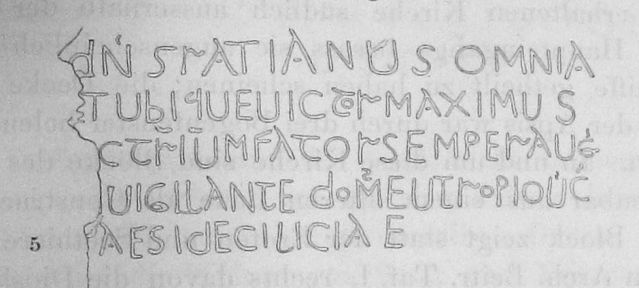
Inscription
D(ominus) n(oster) Gratianus, omnia / e]t ubique victor maximus / a]c triumfator, semper Aug(ustus), / in]vigilante Dom(etio) Eutropio v(iro) c(larissimo) /(5) pr]aeside Ciliciae.
Inscription translation
Our lord, Gratianus, victorious and triumphant over all things everywhere, eternal Augustus [was set up], with Dometius Eutropius, of clarissimus rank, governor (praeses) of Cilicia, watching over.
Bibliography
- Corpus Inscriptionum Latinarum; , III no. 13621
- Heberdey, R. and A. Wilhelm, Reisen in Kilikien, ausgeführt 1891 und 1892 im Auftrage der Kaiserlichen Akademie der Wissenschaften Denkschriften der Kaiserlichen Akademie der Wissenschaften, Philosophisch-Historische Classe ; 44. Bd., 6. Abhandlung., Vienna 1896, 25, no. 56
Discussion
INSCRIPTION
In five lines:
D(ominus) n(oster) Gratianus, omnia / [e]t ubique victor maximus / a]c triumfator, semper Aug(ustus), / [in]vigilante Dom(etio) Eutropio, v(iro) c(larissimo), / [pr]aeside Ciliciae.
'Our lord, Gratian, victorious and triumphant over all things everywhere, eternal Augustus [was set up], with Dometius Eutropius, of clarissimus rank, governor (praeses) of Cilicia, watching over.'
Letter height not recorded.
The emperor's name and titles, anomalously, are in the nominative, not the normal dative of Latin statue inscriptions.
DESCRIPTION (from Heberdey & Wilhelm 1896, and the published drawing)
Rectangular limestone base with mouldings at top and bottom: H 113, W 54, D64 cm. The left edge is broken damaging the initial letters of lines 2-5; on the top face are the traces of the fixings for a bronze statue. There is no published image of the base, other than the detailed drawing of the inscription.
PROVENANCE AND CURRENT LOCATION
The inscription was recorded by Heberdey & Wilhelm 1896 in the ruins of a Roman military camp (Eski-Schehr) near Osmaniye, south of Hierapolis Castabala. Its very close similarity to two bases still in Hierapolis (LSA-637, LSA-638), dedicated by the same awarder to contemporary emperors, very strongly suggests that it was originally erected within the city, a much more likely setting than a military camp. There is no recent record of its location.
HONORAND, AWARDER AND DATE
Gratian, the honorand, was Augustus 367-83.
Dometius Eutropius, the awarder, was governor (praeses) of the province of Cilicia I. Besides on our inscription, he is known from the two others to Valentinian and Valens mentioned below, and from an undated inscription in Tarsus (PLRE I, 318, Domitius Eutropius 5).
With LSA-637 and LSA-638, our base formed a group-dedication to three emperors of the Valentianic dynasty: Gratian, Augustus 367-83; Valens, Augustus 364-78; and either Valentinian I, Augustus 364-75, or Valentinian II, Augustus 375-92. Depending on the identity of the 'Valentinian' honoured on LSA-637, the whole group either dates to 367-75, or to 375-8.
FURTHER DISCUSSION
The words used to describe Eutropius' role in setting up these three statues - 'invigilante, watching over' (on our base), 'curante, taking care' (on LSA-637), and 'insistente, following attentively' (on LSA-638) - are not explicit that he paid for the statues (an awarder's name is normally expressed straightforwardly in the nominative). The statues may have been commissioned by the city of Hierapolis Castabala, and the inscriptions worded in a way designed to please not just the emperors, but also the governor. Whatever the intention, whoever composed the wording clearly enjoyed finding three different verbs to describe the actions of the governor, and subtle variants to the way in which he described the military triumphs of each emperor.
Discussion references
- Jones, A. H. M. et al., The Prosopography of the Later Roman Empire. Vol. I 260-395, Cambridge et al. 1971 (1975)
Cite: Last Statues of Antiquity, LSA-636 (Ulrich Gehn).