
LSA-638
Base for statue of Valens, emperor. Hierapolis Castabala (Cilicia I). 364-78.
Record details
Photographs
Inscription
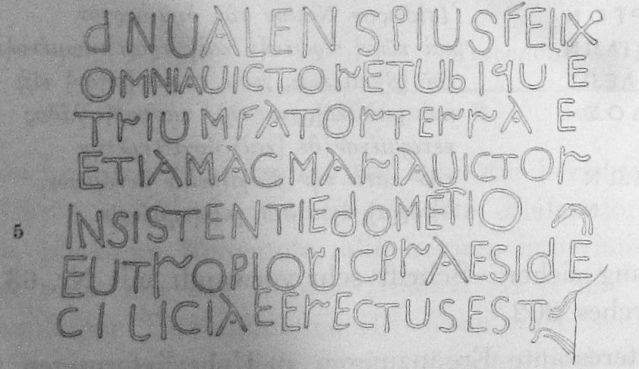
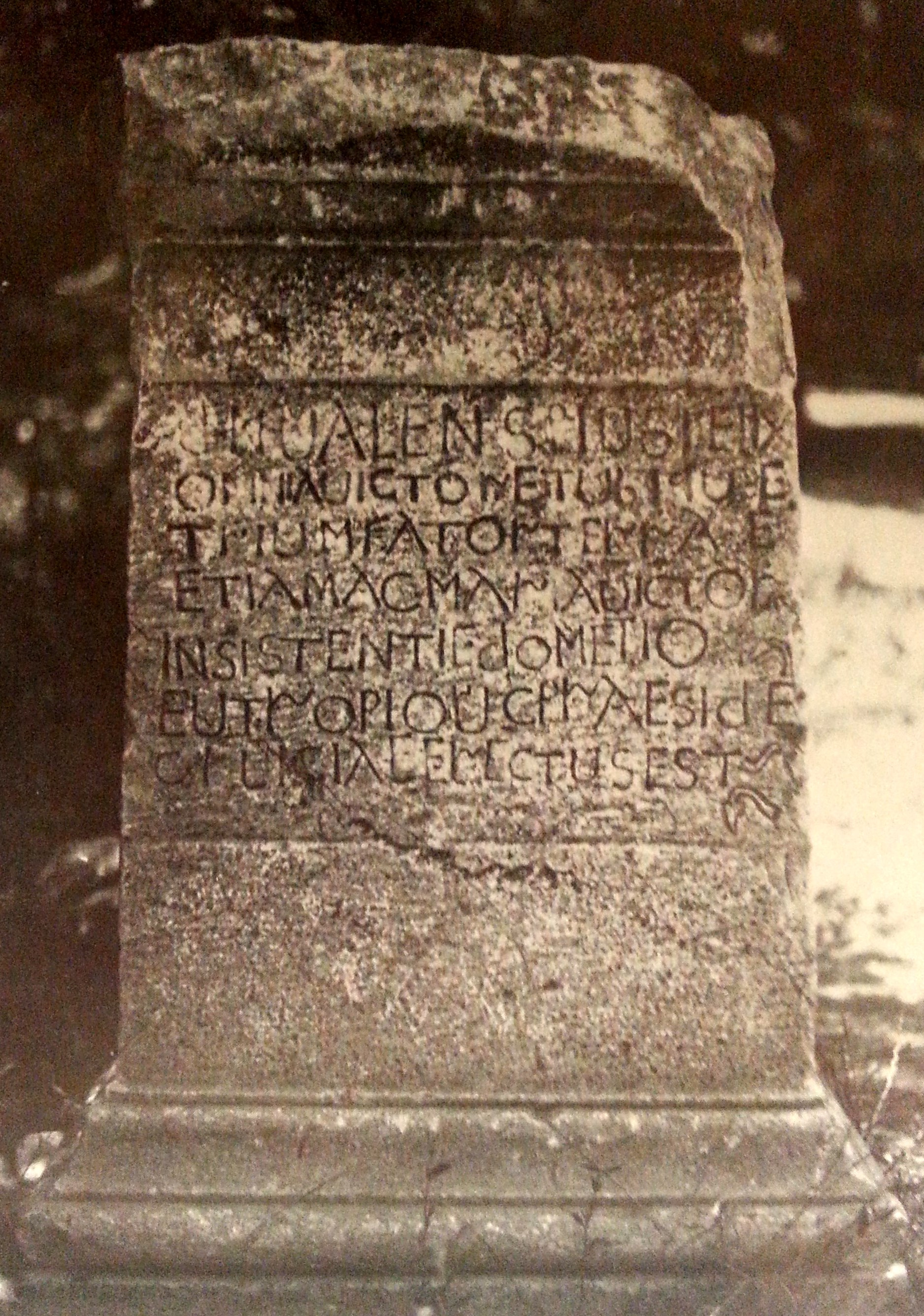
D(ominus) n(oster) Valens, pius, felix, / omnia victor et ubique / triumfator, terrae / etiam ac maria (sic) victor, /(5) insistentie (sic) Dometio / Eutropio, v(iro) c(larissimo), praeside / Ciliciae, erectus est.
Inscription translation
Our lord, Valens, pious, fortunate, victor over everything and triumphant everywhere, on land and even on the sea, was set up, with Dometius Eutropius, of clarissimus rank, governor (praeses) of Cilicia, following attentively.
Bibliography
- Corpus Inscriptionum Latinarum; , III, no. 13620
- Dagron, G. & D. Feissel, Inscriptions de Cilicie (Travaux et Mémoires du Centre de Recherche d'Histoire et Civilisation de Byzance, 4), Paris 1987, 207-8 no. 123 pl. L
- Heberdey, R. and A. Wilhelm, Reisen in Kilikien, ausgeführt 1891 und 1892 im Auftrage der Kaiserlichen Akademie der Wissenschaften Denkschriften der Kaiserlichen Akademie der Wissenschaften, Philosophisch-Historische Classe ; 44. Bd., 6. Abhandlung., Vienna 1896, 27-8, no. 62
Discussion
INSCRIPTION
In seven lines:
D(ominus) n(oster) Valens, pius, felix, / omnia victor et ubique / triumfator, terrae / etiam ac maria (sic) victor, /(5) insistentie (sic) Dometio / Eutropio, v(iro) c(larissimo), praeside / Ciliciae, erectus est.
'Our lord, Valens, pious, fortunate, victor over everything and triumphant everywhere, on land and even on the sea, was set up, with Dometius Eutropius, of clarissimus rank, governor (praeses) of Cilicia, following attentively.'
Letter height 2.5 - 4.5 cm.
The emperor's name and titles, anomalously, are in the nominative, not the normal dative of Latin statue inscriptions.
DESCRIPTION (from Dagron and Feissel 1987, and Heberdey and Wilhelm 1896)
Rectangular white marble base with mouldings at top and bottom; H 109, W 53.5, D 59 cm. On the top face, there are traces of the fixings for a bronze statue.
PROVENANCE AND CURRENT LOCATION
The inscription was recorded by Heberdey & Wilhelm 1896 between two columns on the southern colonnaded street at Hierapolis Castabala, close to LSA-637 (city map in Krinzinger & Reiter 1993, end of volume, no. 16; on the southern colonnaded street Heberdey & Wilhelm 1896, 25-6; Krinzinger & Reiter 1993, 278-81). This was probably its original location.
The inscription was last recorded in the village of Kesmeburun in a private house by Dagron and Feissel 1987 (maison Battal Poyraz).
HONORAND, AWARDER, AND DATE
Valens, the honorand, was Augustus 364-78.
Dometius Eutropius, the awarder, was governor (praeses) of the province of Cilicia I. Besides on our inscription, he is known from the two others to Gratian and Valentinian mentioned below, and from an undated inscription in Tarsus (PLRE I, 318, Domitius Eutropius 5).
With LSA-636 and LSA-637, our base formed a group-dedication to three emperors of the Valentianic dynasty: Gratian, Augustus 367-83; Valens, Augustus 364-78; and either Valentinian I, Augustus 364-75, or Valentinian II, Augustus 375-92. Depending on the identity of the 'Valentinian' honoured on LSA-637, the whole group either dates to 367-75, or to 375-8.
FURTHER DISCUSSION
The words used to describe Eutropius' role in setting up these three statues - 'insistente, following attentively' (on our base), 'invigilante, watching over' (on LSA-636), and 'curante, taking care' (on LSA-637) - are not explicit that he paid for the statues (an awarder's name is normally expressed straightforwardly in the nominative). The statues may have been commissioned by the city of Hierapolis Castabala, and the inscriptions worded in a way designed to please not just the emperors, but also the governor. Whatever the intention, whoever composed the wording of these inscriptions clearly enjoyed finding three different verbs to describe the actions of the governor, and subtle variants to the way in which he described the military triumphs of each emperor.
Discussion references
- Jones, A. H. M. et al., The Prosopography of the Later Roman Empire. Vol. I 260-395, Cambridge et al. 1971 (1975)
- Krinzinger, F. & W. Reiter, Archäologische Forschungen in Hierapolis-Kastabala, Die epigraphische und altertumskundliche Erforschung Kleinasiens: Hundert Jahre kleinasiatische Kommission der österreichischen Akademie der Wissenschaften (Tituli Asiae Minoris, Erg.-Bd. 14), ed. by G. Dobesch and G. Rehrenböck, 269-81, Wien 1993
Cite: Last Statues of Antiquity, LSA-638 (Ulrich Gehn).