
LSA-639
Base for statue of Zeno, master of both soldieries (magister utriusque militiae). Sagalassus (Pisidia). 447-451
Record details
Photographs
Inscription
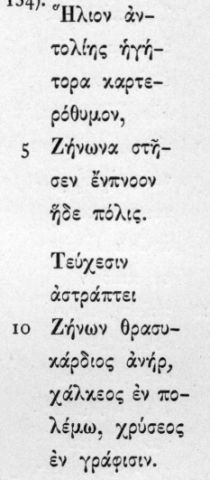
Ἥλιον ἀν/τολίης ἡγή/τορα καρτε/ρόθυμον, /
(5) Ζήνωνα στῆ/σεν ἔνπνοον / ἥδε πόλις. /
τεύχεσιν / ἀστράπτει /(10) Ζήνων θρασυ/κάρδιος ἄνηρ, /
χάλκεος ἐν πο/λέμῳ, χρύσεος / ἐν γράφισιν.
Inscription translation
The sun of the East, the strong-spirited commander, Zeno, the city has set up as if breathing. Zeno, a bold-hearted man, flashes in arms, bronze in war, [here] golden by painting.
Bibliography
- Lanckoronski, K., Städte Pamphyliens und Pisidiens. II. Band. Pisidien. Unter Mitwirkung von G. Niemann und E. Petersen, Wien 1892, p. 228 no. 208 (Petersen)
- Merkelbach, R. and J. Stauber (eds.), Steinepigramme aus dem griechischen Osten. Bd. 4. Die Südküste Kleinasiens, Syrien und Palaestina, Munich 2002, 118, no.18/8/2
Discussion
INSCRIPTION
Verse inscription of two distichs, laid out in 14 lines (four lines for each hexameter; three for each pentameter):
Ἥλιον ἀν/τολίης ἡγή/τορα καρτε/ρόθυμον, /
(5) Ζήνωνα στῆ/σεν ἔνπνοον / ἥδε πόλις. /
τεύχεσιν / ἀστράπτει /(10) Ζήνων θρασυ/κάρδιος ἄνηρ, /
χάλκεος ἐν πο/λέμῳ, χρύσεος / ἐν γράφισιν.
'The sun of the East, the strong-spirited commander, Zeno, the city has set up as if breathing. Zeno, a bold-hearted man, flashes in arms, bronze in war, [here] golden by painting.'
Letter height not recorded.
Our translation follows Merkelbach 2002 who translated 'χρύσεος ἐν γράφισιν' (in line 14) as 'golden by painting', referring to the gilt coating of the statue. Petersen (in Lanckoronski 1892) had translated it as 'golden in his writings ('in seinen Schriftstücken')', referring to literary achievements, which is entirely possible from the words, but highly unlikely if the association with Zeno, the military commander, is accepted (see below, 'Honorand, Awarder and Date').
DESCRIPTION (from Lanckoronski 1892 and Merkelbach 2002)
Hexagonal shaft of a base. No measurements and no image of the base have been published.
PROVENANCE AND CURRENT LOCATION
The inscription was recorded by Petersen (in Lanckoronski 1892) at the 'large gate' (Große Tür) north of the Roman baths in Sagalassus, where the street leading from the lower Agora and the Nymphaeum to the upper city turns north (map in Lanckoronski 1892 opposite p. 127, K, p. 128-9). There is no recent record of its location.
HONORAND, AWARDER AND DATE
Petersen (in Lanckoronski 1892) attributed the inscription to the emperor Zeno 'the Isaurian', Augustus 474-91. Horsley & Mitchell 2000 preferred Flavius Zeno, master of both soldieries (magister utriusque militiae) 447-51 and consul in 448, who defended Constantinople in 447 against the Huns (PLRE II, 1199-2000, Fl. Zenon 6). Their proposal was followed by Merkelbach 2002. Given the extensive allusions to military command (in lines 3-4 and 12-13), and the total absence of an imperial title such as βασιλεύς or ἄναξ, we agree with the recent consensus.
Discussion references
- Horsley, G. H. R. & S. Mitchell, The Inscriptions of Central Pisidia (Inschriften griechischer Städte in Kleinasien Bd. 57), Bonn 2000, p. 128
- Martindale, J. R., The Prosopography of the Later Roman Empire. Vol. II A.D. 395-527, Cambridge 1980
Cite: Last Statues of Antiquity, LSA-639 (Ulrich Gehn).