
LSA-64
Portrait bust of long-haired, bearded intellectual in 'Malibu-Vatican' type. From Italy. Fourth to fifth century.
Record details
Photographs
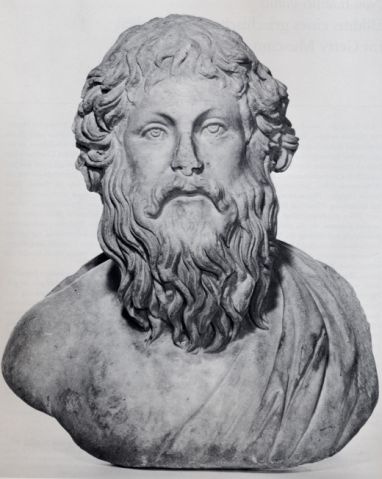
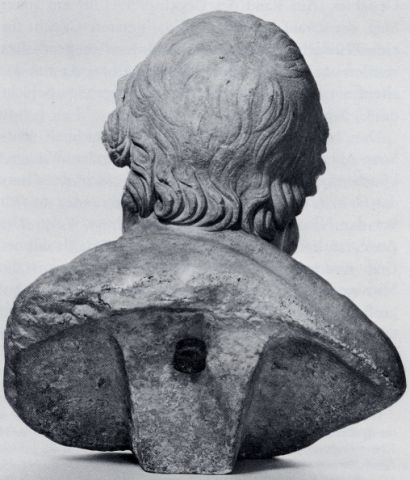
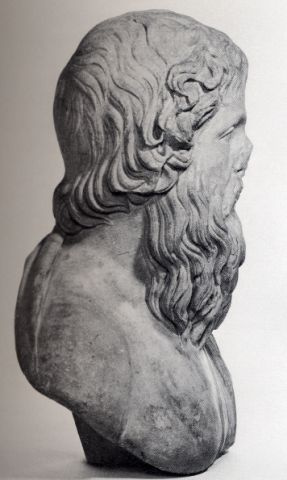
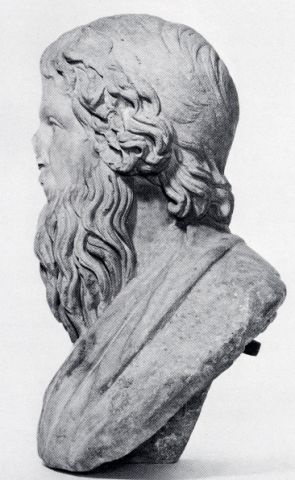
Bibliography
- Frel, J., Greek Portraits in the J. Paul Getty Museum, Los Angeles 1981, 94-5, 116, no. 44 (Krates, later Roman)
- Raeder, J. 'Non traditus vultus: Bildnis eines griechischen Philosophen im Getty Museum', Ancient Portraits in the J. Paul Getty Museum, I. Occasional Papers on Antiquities, 4., Malibu 1987, 5-16, figs. 1a-d (early fifth c.)
Discussion
DESCRIPTION (Object)
Life-size bust. H: 53 cm. ‘Crystalline marble, perhaps Thasian’ (Frel).
The bottom of the spine and the support are missing. The nose is broken.
According to Raeder parts of the bust and the face have been re-worked. The left shoulder has been cut back; this is visible best in the back view. The diagonal folds on the right breast have been worked over.
The face is set back and separated from the beard and hair by a channel. The nose has been thinned, and the eyebrows have been given a higher arch. The pupils and irises are indicated by concentric semi-circles engraved into the surface with a flat chisel.
The iron dowel and ring inserted into the spine of the bust were added in the modern era to attach it to a wall.
PROVENANCE
Purchased in 1971 by the Getty Museum from a New York art dealer who had in turn purchased it from an art dealer in Rome.
DESCRIPTION (Subject)
The bust depicts a long-haired and long-bearded man who wears a himation over a bare chest. The portrait is a replica of a type known in one other copy. The other copy, now in the Vatican, was found in the Villa of Hadrian Tivoli in 1769.
The full hair falls forward and down from the top of the head. Around the brow and below the base of the skull the hair curls gently and builds in volume, forming a wreath around the face. It covers the ears. The moustache and beard are long. The beard hair has a slight wave and reaches below the clavicle.
The face is broad with high-arching eyebrows. The eyes are small but emphatically marked. The nose seems short and thin.
The bust wears a himation that passes over the left shoulder, behind the back, around the back of the right shoulder, and reappears over the right side of the chest. The folds are flatly worked.
HONORAND AND DATE
The portrait follows a type, possibly created in the late Hellenistic period, which presumably represented a philosopher. It is similar both to the Antithesnes and Krates types.
This particular replica of the type has been worked over, probably in late antiquity when such portraits had a renewed popularity. The rendering of the eyes (compare, for example, LSA-906) suggests a date for the re-working in the later fourth or early fifth century. A portrait of Plato LSA-710 merits mention since it is very similar stylistically and thematically.
Cite: Last Statues of Antiquity, LSA-64 (J. Lenaghan).