
LSA-642
Columnar block with dedication to Diocletian, just possibly base for statue. Aezanis (Aizanoi) (Phrygia Pacatiana). 284-305
Record details
Photographs
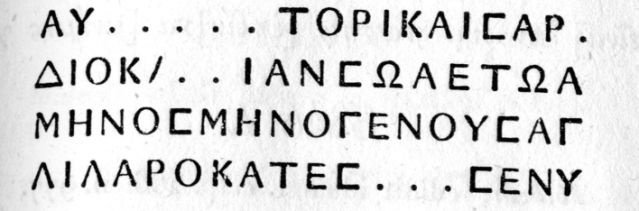

Inscription
[Αὐτοκρά]τορι Καίσαρ[ι] / Διοκ[λητ]ιαν[ῷ] Σ[εβ]α[σ]τῷ, Α[υρ(ήλιος) Εὔ]/μηνος Μηνογένους Ἀ[πολ]/λι[ν]αρ[ί]ο[υ] κατες[κεύα]σεν, ὑ/---
Inscription translation
To the emperor Caesar Diocletianus Augustus. Aurelius Eumenus, son of Menogenes Apollinarius, dedicated [this]...
Bibliography
- Corpus Inscriptionum Graecarum; , vol. III addenda no. 3841 l
- Cagnat, R. (ed.), Inscriptiones Graecae ad res Romanas pertinentes, Paris 1906-, vol. IV no. 568
Discussion
In five preserved lines:
[Αὐτοκρά]τορι Καίσαρ[ι] / Διοκ[λητ]ιαν[ῷ] Σ[εβ]α[σ]τῷ, Α[υρ(ήλιος) Εὔ]/μηνος Μηνογένους Ἀ[πολ]/λι[ν]αρ[ί]ο[υ] κατες[κεύα]σεν,
'To the emperor Caesar Diocletianus Augustus, Aurelius Eumenus, son of Menogenes Apollinarius, dedicated [this] ...'
Letter height not recorded.
The unusual formula, with the awarder dedicating this 'for his own safety' (line 5), to an emperor in the dative (rather than the accusative usual on Greek-language statue dedications), fits an ex-voto much better than a statue base (see also below, 'Further Discussion'). Cagnat in the Inscriptiones Graecae ad res Romanas pertinentes proposed as a completion after line 5 ὑ/[πὲρ τῆς σωτηρίας αὐτου ...] - 'for his own safety'.
DESCRIPTION (from CIG)
Columnar block; no measurements and no image have been published.
PROVENANCE AND CURRENT LOCATION
The inscription was first recorded by Böckh and Franz (for CIG III) in 1853 in a cemetery on the road from Aezanoi to Gediz ('in coemeterio sito ad viam, quae ducit Gediz versus, in columna'). There is no recent record of its location.
For Aizanoi see http://www.trismegistos.org/place/16122.
HONORAND, AWARDER AND DATE
Diocletian, the honorand, was Augustus 284-305.
Aurelius Eumenus, the awarder, is known only from this inscription. He does not appear to have held an imperial or civic office.
FURTHER DISCUSSION
Although the form of the block might suit a statue base, we think it is very unlikely to have been one. Firstly, the formula of the inscription would be highly unusual; and secondly statues to emperors, if not set up by the city authorities, were almost invariably erected by imperial officials, above all provincial governors.
Cite: Last Statues of Antiquity, LSA-642 (Ulrich Gehn).