
LSA-645
Dedicatory inscription to Julian, emperor, possibly on base for statue. Nacolia (Phrygia Pacatiana). 361-363.
Record details
Photographs
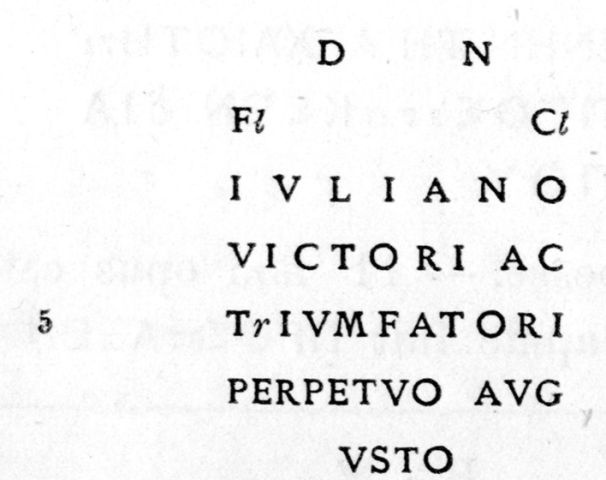
Inscription
D(omino) n(ostro), / Fl(avio) Cl(audio) / Iuliano, / victori ac / triumfatori, / perpetuo / Augusto.
Inscription translation
To our lord, Flavius Claudius Julianus, victorious and triumphant, forever Augustus.
Bibliography
- Corpus Inscriptionum Latinarum; , III, no. 350
Discussion
INSCRIPTION
In seven lines:
D(omino) n(ostro), / Fl(avio) Cl(audio) / Iuliano, / victori ac /(5) triumfatori, / perpetuo / Augusto
'To our lord, Flavius Claudius Julianus, victorious and triumphant, forever Augustus.'
Letter height not recorded.
The formula, with the honorand in the Latin dative, is the usual one for a statue base, though it is unusual not to have a named awarder.
DESCRIPTION
No description of the block, and no measurements or image have been published. From the epigraphic formula, this may well be a statue base, but a milestone is also possible.
PROVENANCE AND CURRENT LOCATION
The inscription was recorded by Mommsen in 1873 (for CIL III) in the Dervish monastery Hadji Bektash in Sidi Ghazi (Seyitgazi); this is the area of ancient Nacolia http://www.trismegistos.org/place/16157). There is no recent record of its location.
HONORAND AND DATE
Julian, the honorand (full name Flavius Claudius Julianus, as in our inscription) was Augustus 360-3, but not recognised in the East until the death of Constantius II in 361.
Cite: Last Statues of Antiquity, LSA-645 (Ulrich Gehn).