
LSA-649
Base with dedication to Constantius I, emperor, and another tetrarch. Colossae (Phrygia Pacatiana). 305-306
Record details
Photographs
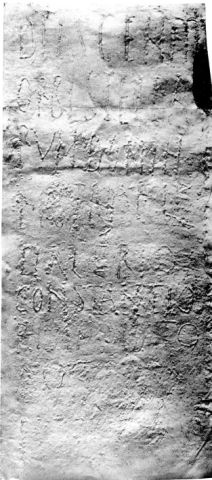
Inscription
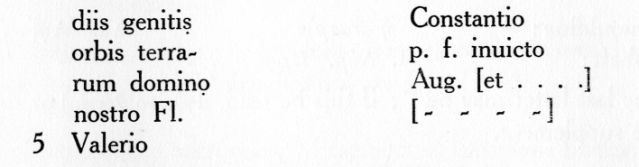
Diis genitis / orbis terra/rum, domino / nostro Fl(avio) / Valerio / Constantio, / p(io), f(elici), invicto / Aug(usto), [ et ....] / [----]
Inscription translation
To the born gods of the lands of the world, our lord Fl(avius) Valerius Constantius, pious, fortunate, unconquered Augustus, and ...
Bibliography
- Buckler, W.H. and W.M. Calder (eds.), Monuments and documents from Phrygia and Caria. Monumenta Asiae Minoris antiqua, v. 6, Manchester 1939, p. 15 no. 38
Discussion
INSCRIPTION
In eight preserved lines:
Diis genitis / orbis terra/rum, domino / nostro Fl(avio) /(5) Valerio / Constantio, / p(io), f(elici), invicto /(8) Aug(usto) / [----] .
'To the born gods of the lands of the world, our lord Fl(avius) Valerius Constantius, pious, fortunate, unconquered Augustus, ...'
Letter height 3 - 6.5 cm.
The opening dedication, referring to the emperors ('To the born gods of the lands of the world, Diis genitis orbis terrarum'), is unusual. However, a similar opening formula occurs on a block, probably a milestone, in Macedonia, to Diocletian and Maximian (CIL III, 710: 'diis genitis et deorum creatoribus dd(ominis) nn(ostris) Diocletiano et [Maximiano invict]is Augg(ustis)').
DESCRIPTION (from Buckler & Calder 1939)
Rectangular marble block without mouldings: H 102, W 33.5, D 34.5 cm. The block is a re-used piece, with the earlier, original, inscription on the right side to ours (Buckler & Calder 1939 no. 42).
PROVENANCE AND CURRENT LOCATION
The inscription was recorded by Buckler & Calder in 1939 in Honaz, the area of ancient Colossae, under the stairs of a modern house. There is no recent record of its location.
HONORAND AND DATE
Constantius I, the honorand (full name Flavius Valerius Constantius, as in our inscription), was Augustus 305-6.
Since the inscription opens with a dedication to 'the born gods' in the plural, it must once have honoured at least one further emperor, most probably Constantius I’s co-Augustus Galerius. The naming of more than one emperor, suggests the existence originally of a paired statue base.
Discussion references
- Corpus Inscriptionum Latinarum; , III, 710
Cite: Last Statues of Antiquity, LSA-649 (Ulrich Gehn).