
LSA-651
Base for statue of Constantine II, emperor. Ancyra Sidera (Phrygia Pacatiana). 317-337.
Record details
Photographs
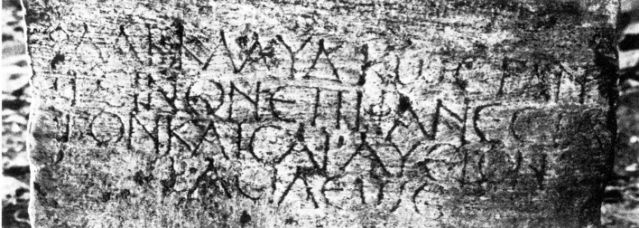
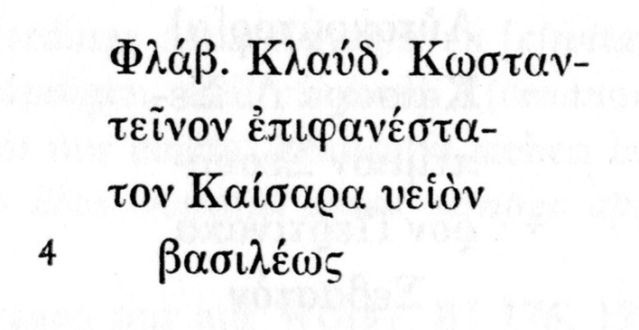
Inscription
Φλάβ(ιον) Κλαύδ(ιον) Κωσταν/τεῖνον, ἐπιφανέστα/τον Καίσαρα, υεἱὸν / βασιλέως.
Inscription translation
To Flavius Claudius Constantinus, most noble Caesar, son of the emperor.
Bibliography
- Supplementum Epigraphicum Graecum, , XXVI no. 1363
- Drew-Bear, T. & W. Eck, Kaiser-, Militär- und Steinbruchinschriften, Chiron 6, 1976, 289-318, p. 290 no. 2
Discussion
INSCRIPTION
In four lines
Φλάβ(ιον) Κλαύδ(ιον) Κωσταν/τεῖνον, ἐπιφανέστα/τον Καίσαρα, υεἱὸν / βασιλέως.
'To Flavius Claudius Constantinus, most noble Caesar, son of the emperor.'
Letter height 2.9 cm.
DESCRIPTION (from Drew-Bear & Eck 1976)
Statue base made from a re-used grave altar: H (visible) 81, W 41, D 41 cm. The altar had a moulding, above which only a portion of the right side is preserved. The original front face carries a metrical funerary inscription; our inscription is on the original back face.
PROVENANCE AND CURRENT LOCATION
The inscription was first recorded in 1968 by Drew-Bear in the courtyard of a house in the village of Bahtıllı, published in Drew-Bear & Eck 1976. There is no more recent record of its location.
HONORAND AND DATE
Constantine II, the honorand (full name Flavius Claudius Constantinus, as in our inscription) was a son of Constantine I, born in February 317. He was Caesar 317-37.
As Drew-Bear & Eck 1976, 291 point out, the inscription was probably set up after 324, the year when Constantine became sole ruler after the defeat of Licinius; otherwise Constantine’s name would probably have been mentioned, instead of the simple reference to 'the emperor, βασιλέως' in line 4.
A similar inscription to Constans, another son of Constantine I, was also found in Ancyra Sidera (LSA-652). Despite the striking similarities in their wording, Eck & Drew-Bear 1976, their first editors, argued against a contemporary erection of both bases, because of an orthographic difference - βασιλέως (line 4) in our inscription, as against βασιλαίος in the other – and a difference in lettering. These differences, however, can be explained by different sculptors executing the inscriptions. If they are contemporaneous, the inscription to Constans (LSA-652) shrinks the outer dates of our dedication to 333-7
It is likely that statues were set up, alongside those to Constans and Constantine II, to the third brother and Caesar, Constantius II, as well as to their father and Augustus, Constantine I.
Cite: Last Statues of Antiquity, LSA-651 (Ulrich Gehn).