
LSA-652
Base for statue of Constans, emperor. Ancyra Sidera (Phrygia Pacatiana). 333-337.
Record details
Photographs
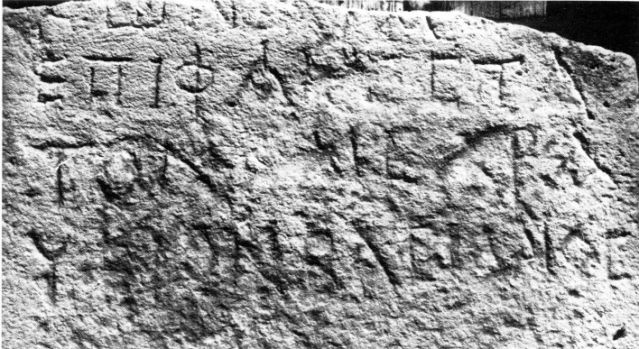
Inscription
[Φλάβ(ιον) Ἰούλ(ιον)] / Κώστα[ντα], / ἐπιφανέστα/τον Καίσαρα, / υεἱὸν βασιλαίος.
Inscription translation
To Flavius Iulius Constans, most noble Caesar, son of the emperor.
Bibliography
- Supplementum Epigraphicum Graecum, , XXVI no. 1364
- Drew-Bear, T. and W. Eck, ‘Kaiser-, Militär-, und Steinbruchinschriften aus Phrygien’, Chiron. Mitteilungen der Kommission für Alte Geschichte und Epigraphik des Deutschen Archäologischen Instituts, 6., Munich 1976, 291-2, no. 3
Discussion
INSCRIPTION
In 5 lines:
[Φλάβ(ιον) Ἰούλ(ιον)] / Κώστα[ντα], / ἐπιφανέστα/τον Καίσαρα, / υεἱὸν βασιλαίος.
'To Flavius Iulius Constans, most noble Caesar, son of the emperor.'
Letter height 3.6 cm.
DESCRIPTION (from Drew-Bear & Eck 1976)
Rectangular base of local stone, with mouldings at top and bottom, the upper mouldings are broken: H 62, W 48.5, D 43.5 cm.
PROVENANCE AND CURRENT LOCATION
The inscription was first recorded by Drew-Bear in 1968 (and published by Drew-Bear & Eck 1976) in the courtyard of a house in the village of Bahtıllı where it served as the support for a wooden pillar. There is no recent record of its location.
HONORAND AND DATE
Constans, the honorand (full name Flavius Iulius Constans) was the youngest son of Constantine I; he was Caesar 333-37.
FURTHER DISCUSSION
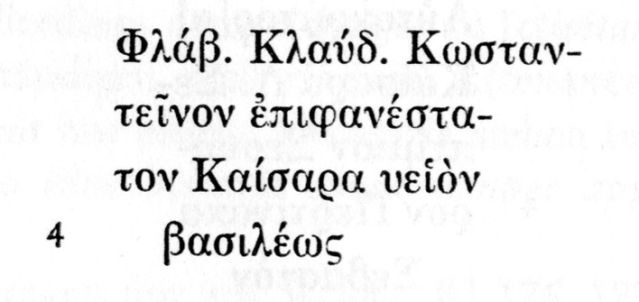
A very similar inscription to Constantine II, another son of Constantine I, is known from Ancyra Sidera (LSA-651). Despite the striking similarities in the wording of the two inscriptions, Eck & Drew-Bear 1976, their first editors, argued against a contemporary erection of both bases because of an orthographic difference - βασιλαίος (line 5) in our inscription, as against βασιλέως in the other – and a difference in the lettering. These differences, however, can be explained by different sculptors executing the inscriptions.
It is likely that statues were set up, alongside those to Constans and Constantine II, to the third brother and Caesar, Constantius II, as well as to their father and Augustus, Constantine I.
Cite: Last Statues of Antiquity, LSA-652 (Ulrich Gehn).