
LSA-653
Plaque from base for statue of Constantius Gallus, emperor. Acmonia (Phrygia Pacatiana). 351-354
Record details
Photographs
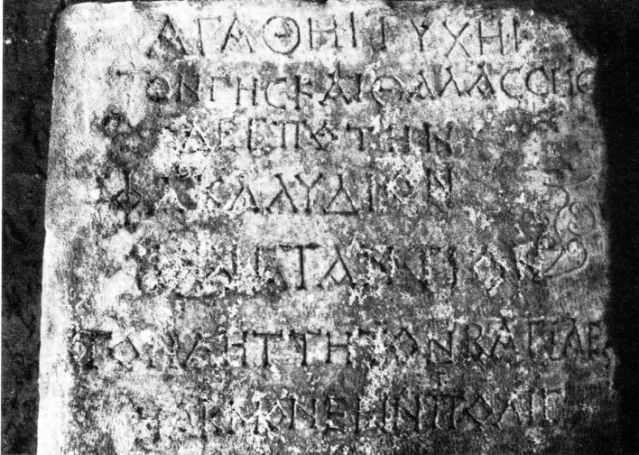
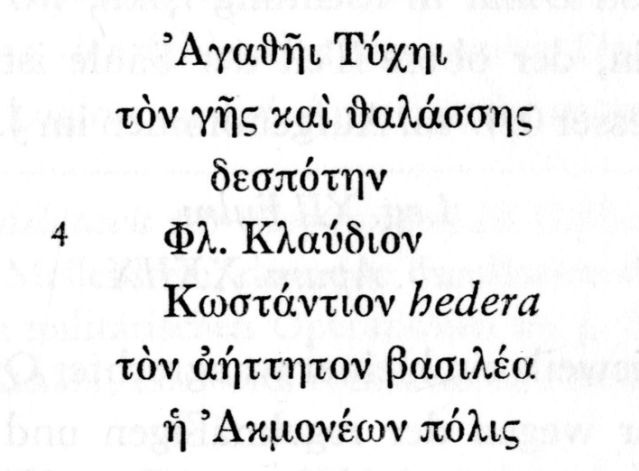
Inscription
Ἀγαθῆι Τύχηι. / τόν γῆς καὶ θαλάσσης / δεσπότην, / Φλ(άβιον) Κλαύδιον / (5) Κωστάντιον, (ivy leaf) / τὸν ἀήττητον βασιλέα, / ἡ Ἀκμονέων πόλις.
Inscription translation
To Good Fortune. The ruler of earth and sea, Fl(avius) Claudius Constantius, invincible emperor; the city of the Acmonians [honours him].
Bibliography
- Drew-Bear, T. and W. Eck, ‘Kaiser-, Militär-, und Steinbruchinschriften aus Phrygien’, Chiron. Mitteilungen der Kommission für Alte Geschichte und Epigraphik des Deutschen Archäologischen Instituts, 6., Munich 1976, pp. 293-4 no. 4 pl. 38, 3
Discussion
INSCRIPTION
In seven lines:
Ἀγαθῆι Τύχηι. / τόν γῆς καὶ θαλάσσης / δεσπότην, / Φλ(άβιον) Κλαύδιον / (5) Κωστάντιον, (ivy leaf) / τὸν ἀήττητον βασιλέα, / ἡ Ἀκμονέων πόλις.
'To Good Fortune. The ruler of earth and sea, Fl(avius) Claudius Constantius, invincible emperor; the city of the Acmonians [honours him].'
Letter height 3.5 cm.
The epigraphic formula, with the honorand in the Greek accusative and a named awarder, is typical of Greek-language statue dedications.
DESCRIPTION (from Drew-Bear & Eck 1976)
Marble plaque, H 137, W 62, W 17.5 cm. The plaque must once have covered a base in some other material (see above 'Inscription').
PROVENANCE AND CURRENT LOCATION
The inscription was first recorded by Drew-Bear in 1968 in the village of Kaylı in the area of the ancient city of Acmonia (published by.Drew-Bear & Eck 1976). It had been brought there by peasants who had found it in the village of Kemer where it had been used as the cover of a grave. There is no published record of its present location.
HONORAND, AWARDER AND DATE
Constantius Gallus, the honorand (full name in epigraphic sources Flavius Claudius Constantius, as in our inscription; in literary sources always with the additional name of Gallus, after his mother Galla) was Caesar 351-4. He was a nephew of Constantine I.
The inscription was set up by the city of Acmonia (line 7).
Cite: Last Statues of Antiquity, LSA-653 (Ulrich Gehn).