
LSA-654
Base for statue of Acholius, vicar of Asiana. Sardis (Lydia). Fourth to earlier fifth century.
Record details
Photographs
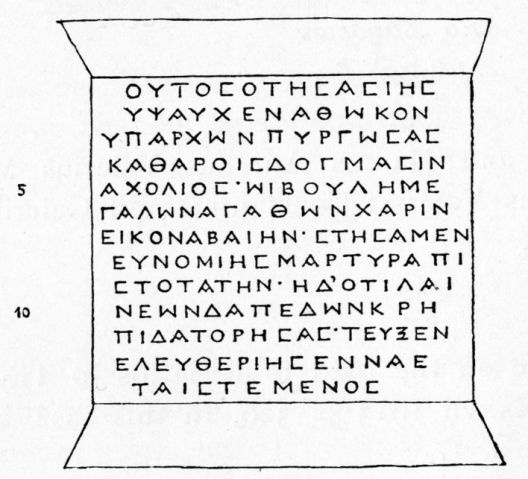
Inscription
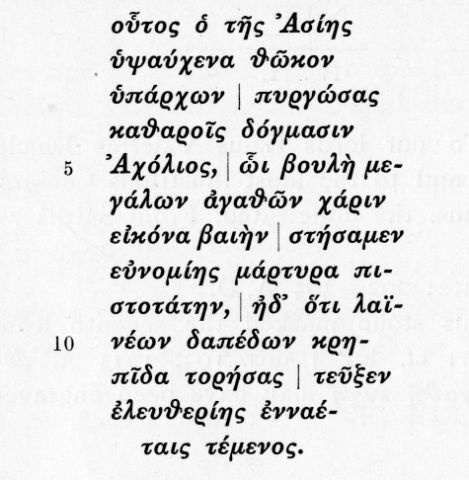
Οὖτος ὁ τῆς Ἀσίης / ὑψαχένα θῶκον / ὑπάρχων πυρώσας / καθαροῖς δόγμασιν /(5) Ἀχόλιος, ὧι βουλὴ με/γάλων ἀγαθῶν χάριν / εἰκόνα βαιὴν στήσαμεν, / εὐνομίης μάρτυρα πι/στοτάτην, ἠδ’ ὅτι λαϊ/νέων δαπέδων κρη/πῖδα τορήσας τεῦξεν /(12) Ἐλευθερίης ἐνναέ/ταις τέμενος.
Inscription translation
This man Acholius who having elevated the lofty chair of the vicars of Asia with spotless ordinances, to whom the council (boule) erected on account of his great goodness a humble statue, a most faithful witness of his good order, and when the foundations of stony surfaces were pierced, he built the sanctuary (temenos) of Eleutheria for the inhabitants.
Bibliography
- Buckler, W. H. & D. M. Robinson, Sardis Vol. VII. Greek and Latin Inscriptions. Part I, Leyden 1932, pp. 89-90 no. 83
- Foss, C., Byzantine and Turkish Sardis, Cambridge (Mass.) 1976, pp. 5, 22, 115 no. 20
Discussion
INSCRIPTION
Verse inscription of three elegiac distichs, laid out over 13 lines:
Οὖτος ὁ τῆς Ἀσίης / ὑψαχένα θῶκον / ὑπάρχων
πυρώσας / καθαροῖς δόγμασιν /(5) Ἀχόλιος,
ὧι βουλὴ με/γάλων ἀγαθῶν χάριν / εἰκόνα βαιὴν
στήσαμεν, / εὐνομίης μάρτυρα πι/στοτάτην,
ἠδ’ ὅτι λαϊ/νέων δαπέδων κρη/πῖδα τορήσας
τεῦξεν /(12) Ἐλευθερίης ἐνναέ/ταις τέμενος.
'This man Acholius who having elevated the lofty chair of the vicars of Asia with spotless ordinances, to whom the council (boule) erected on account of his great goodness a humble statue, a most faithful witness of his good order, and when the foundations of stony surfaces were pierced, he built the sanctuary (temenos) of Eleutheria for the inhabitants.'
Letter height not recorded.
DESCRIPTION (from Buckler & Robinson 1932, and the published image)
Rectangular marble base, with mouldings at top and bottom: H c.125, W c.100 cm.
PROVENANCE AND CURRENT LOCATION
The inscription is built into the southeast face of the southeast bastion of the 7th-century defences of the acropolis of Sardis, 'the fourth stone from the west corner' (Buckler & Robinson 1932). Originally it will have been set up in the lower town.
HONORAND, AWARDER AND DATE
Acholius, the honorand (PLRE I, 9-10 Acholius), was vicar (ὑπάρχων, line 3) of Asiana, since ὕπαρχος (or, alternatively, ἔπαρχος), usually the title of praetorian prefects, could also be used for vicars (Robert 1948,45-7; Feissel 1998, 92). He is praised for his good governance (καθαροῖς δόγμασιν, line 4; εὐνομίης μάρτυρα πιστοτάτην, lines 8-9) and for his building activities (λαϊνέων δαπέδων κρηπῖδα τορήσας τεῦξεν Ἐλευθερίης ἐνναέταις τέμενος, lines 9-13). The Ἐλευθερίης τέμενος ('sanctuary of Eleutheria') is probably a poetic reference to a fortification, rather than a sanctuary of Eleutheria (a goddess of Freedom). Acholius is known only from this inscription.
The inscription was set up by the city council of Sardis (line 5).
The verse form is typical of late antique statue dedications to imperial officials, and is likely to date from the fourth or earlier fifth centuries.
Discussion references
- Jones, A. H. M. et al., The Prosopography of the Later Roman Empire. Vol. I 260-395, Cambridge et al. 1971 (1975)
- Robert, L., Epigrammes du Bas-Empire (Hellenica IV), Paris 1948, pp. 35-47
Cite: Last Statues of Antiquity, LSA-654 (Ulrich Gehn).