
LSA-656
Architrave inscribed for Euthius, imperial official, perhaps associated with a statue. Stratonicea (Caria). Fourth to earlier sixth century.
Record details
Photographs
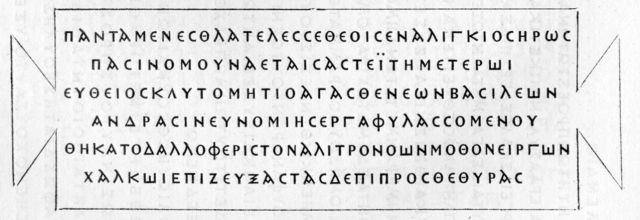
Inscription
πάντα μὲν ἐσθλὰ τέλεσσε θεοῖς ἐναλίγκιος ἥρως,
πᾶσι ὅμου ναέταις ἄστεϊ τ’ἡμετέρῳ,
Εὐθεῖος κλυτόμητι[ς], ἀγασθενέων βασιλήων,
ἀνδράσιν εὐνομίης ἔργα φυλασσόμενο[ς]·
θήκατο δ’ἄλλο φέριστον, ἀλιτρονόων μόθον εἴργων,
χαλκῷ ἐπιζεύξας τάσδ’ ἐπίπροσθε θύρας.
Inscription translation
In all respects the god-like hero accomplished good deeds, to the benefit of all inhabitants as well as of our city, Euthius, famous for his skill, who safeguards the works of justice of the mighty emperor. But another thing is the bravest he did; he barred the fight of the wicked-minded by providing these gates with bronze shelter.
Bibliography
- Merkelbach, R. and J. Stauber (eds.), Steinepigramme aus dem griechischen Osten. Bd. 1. Die Westküste Kleinasiens von Knidos bis Ilion , Stuttgart 1998, 218, no. 2/6/11
- Şahin, M. Ç., Die Inschriften von Stratonikeia. Teil II, 1: Lagina, Stratonikeia und Umgebung (Inschriften griechischer Städte aus Kleinasien Bd. 22, 1), Bonn 1982, pp. 132-3 no. 1018
Discussion
INSCRIPTION
Verse inscription of three distichs, laid out in six lines, one line per verse:
πάντα μὲν ἐσθλὰ τέλεσσε θεοῖς ἐναλίγκιος ἥρως,
πᾶσι ὅμου ναέταις ἄστεϊ τ’ἡμετέρῳ,
Εὐθεῖος κλυτόμητι[ς], ἀγασθενέων βασιλήων,
ἀνδράσιν εὐνομίης ἔργα φυλασσόμενο[ς]·
(5) θήκατο δ’ἄλλο φέριστον, ἀλιτρονόων μόθον εἴργων,
χαλκῷ ἐπιζεύξας τάσδ’ ἐπίπροσθε θύρας.
'In all respects the god-like hero accomplished good deeds, to the benefit of all inhabitants as well as of our city, Euthius, famous for his skill, who safeguards the works of justice of the mighty emperor. But another thing is the bravest he did; he barred the fight of the wicked-minded by providing these gates with bronze shelter.'
Letter height not recorded.
This epigram follows in style and motifs the honorific inscriptions to high imperial state officials in Late Antiquity in the Greek East (Robert 1948, Şahin 1982). It possibly refers to a statue to Euthius set up on or close to the building on which the inscription was carved (see below, 'Description', and 'Honorand, Awarder and Date').
DESCRIPTION (from Le Bas & Waddington 1870)
The inscription is carved on an architrave of rough workmanship ('sur un architrave grossièrement travaillée'); the drawing by Le Bas & Waddington sets it within a tabula ansata. No measurements have been published, and there is no published image besides that of Le Bas and Waddington.
PROVENANCE AND CURRENT LOCATION
The inscription was first recorded by Le Bas & Waddington in 1870 in the courtyard of the harem of the Ağa (local high magistrate) at Stratonicea. There is no recent record of its location.
HONORAND, AWARDER AND DATE
Euthius, the honorand, is praised for his administration of law and justice (verses 3-4). This, and his role in specifically imperial justice (verse 3), identify him as a high-ranking imperial magistrate, most probably a provincial governor, vicar, or praetorian prefect. The epithet 'κλυτόμητις (famous for his skills)', traditionally used for Hephaistus the metal-working god, is also used for a governor, Damocharis, in an inscription from Smyrna preserved in the Planudean Anthology 4, 43 and recently excavated on the agora of Smyrna (LSA-2588; Aubreton & Buffière 1980, 99 no. 43; PLRE II, 344 Damocharis).
Euthius is, however, known only from our inscription. A man with the same name was the addressee of a letter from the monk Nilus in the early to mid 5th century (PLRE II, 439, Euthius; Merkelbach 1998, 218); but this Euthius was addressed as 'praefectianus', member of staff of a prefect, and therefore very unlikely to have been our honorand.
The inscription was almost certainly set up by the city of Stratonicea (line 2), and explicitly in gratitude, both for Euthius' good governance, and for a specific act of building. This latter was interpreted by Merkelbach 1998 as the strengthening of the entrance-gates to an administrative building ('hat den Zugang zu einem Amtsgebäude durch ein Gitter gesichert'). However the 'θύρας, gates' of verse 6 are more likely to have been the city gates, than the gates of a building within the town, and the 'wicked-minded, ἀλιτρονόων' of verse 5, who were thereby excluded, a more severe menace than a group of protesters among the citizens.
The inscription cannot be dated with any precision, since verse epigrams to high imerial officials occur from the 4th through to the 6th century.
FURTHER DISCUSSION
The shape of the block is not that of a statue base, and the inscription does not specifically refer to a statue. However, the wording of the inscription, and the deeds that Euthius is thanked for, are very similar to those associated with statue dedications, and it is very possible that our inscription stood near a statue to this man.
Discussion references
- Aubreton,R. & F. Buffière, Anthologie Grecque XIII : Anthologie de Planude, Paris 1980, p. 99 no. 43
- Le Bas, P. and W.H. Waddington, Inscriptions grecques et latines recueillies en Grèce et en Asie Mineure, vol. III, Paris 1870, no. 524
- Martindale, J. R., The Prosopography of the Later Roman Empire. Vol. II A.D. 395-527, Cambridge 1980
- Robert, L., Epigrammes du Bas-Empire (Hellenica IV), Paris 1948
Cite: Last Statues of Antiquity, LSA-656 (Ulrich Gehn).