
LSA-657
Base for statue of Maximus, local benefactor. Stratonicea (Caria). Fifth century.
Record details
Photographs
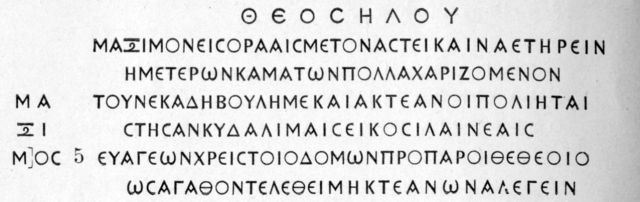
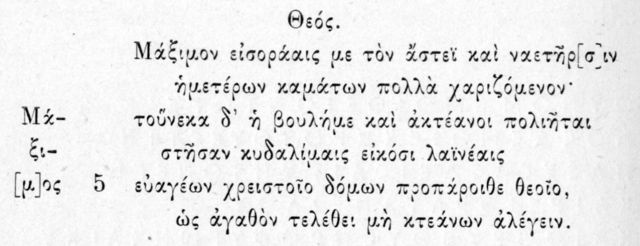
Inscription
Μά/ξι/[μ]ος.
Θεός. / Μάξιμον εἰσοράαις με τὸν ἄστεϊ καὶ ναετῆρσιν / ἡμετέρων καμάτων πολλὰ χαριζόμενον· / τούνεκα δ’ ἡ βουλή με καὶ ἀκτέανοι πολιῆται / (5) στῆσαν κυδαλίμαις εἰκόσι λαϊνέαις / εὐαγέων Χρειστοῖο δόμων προπάροιθε θεοῖο, / ὡς ἀγαθὸν τελέθει μὴ κτεάνων ἀλέγειν.
Inscription translation
Maximus. God. You see me, Maximus who through our toils have given much to the city and its inhabitants. Therefore, the council (boule) and the citizens without wealth (akteanoi polietai) set me up in glorious images of stone in front of the sacred houses of Christ God. How good it is not to care for wealth!
Bibliography
- Merkelbach, R. and J. Stauber (eds.), Steinepigramme aus dem griechischen Osten. Bd. 1. Die Westküste Kleinasiens von Knidos bis Ilion , Stuttgart 1998, 221, no. 2/6/15
- Şahin, M. Ç., Die Inschriften von Stratonikeia. Teil II, 1: Lagina, Stratonikeia und Umgebung (Inschriften griechischer Städte aus Kleinasien Bd. 22, 1), Bonn 1982
Discussion
INSCRIPTION
Verse inscription of three distichs laid out in six lines, one line for each verse. The inscription is preceded by an invocation to God; it has seven lines in all. At the left margin of the inscription the name Μά/ξι/[μ]ος is carved over three lines (lines 4-6; Cousin 1891). Θεός (line 1) is followed by smaller letters ΗΛΟΥ, which apparently belong to a different inscription of undetermined age (Cousin 1891, 430; Şahin 1982, 167):
On the left margin:
Μά/ξι/[μ]ος.
Θεός.
Μάξιμον εἰσοράαις με τὸν ἄστεϊ καὶ ναετῆρσιν /
ἡμετέρων καμάτων πολλὰ χαριζόμενον· /
τούνεκα δ’ ἡ βουλή με καὶ ἀκτέανοι πολιῆται /
(5) στῆσαν κυδαλίμαις εἰκόσι λαϊνέαις /
εὐαγέων Χρειστοῖο δόμων προπάροιθε θεοῖο, /
ὡς ἀγαθὸν τελέθει μὴ κτεάνων ἀλέγειν.
'Maximus. God. You see me, Maximus who through our toils have given much to the city and its inhabitants. Therefore, the council (boule) and the citizens without wealth (akteanoi polietai) set me up in glorious images of stone in front of the sacred houses of Christ God. How good it is not to care for wealth!'
Letter height not recorded.
DESCRIPTION (from Cousin 1891)
According to Cousin 1891, 429, the inscription is carved on a 'cippus' (‘Cippe’). No further description and no measurements are published; there is no published image.
PROVENANCE AND CURRENT LOCATION
The inscription was first recorded by Cousin 1891 in the house of Tchillar-oglu Osman in Eskihisar (Stratonicea). There is no recent record of its location.
From the wording of the inscription (lines 5-6), it is evident that this base was originally set up in front of a church within Stratonicea.
HONORAND, AWARDER AND DATE
Maximus, the honorand, was a citizen of Stratonicea (lines 2-3), lauded in several inscriptions in the city (this one, LSA-1200, LSA-1201, and LSA-1202). He is here praised for his generosity. The 'toils, καμάτοι' of line 3 may allude to the liturgies of a civic office holder, that are explicitly described on another inscription (LSA-1200); or it may refer to Maximus' wealth which is the result of his toils (as Jones 2009 and Staab 2009, 35 n. 5 take it). He was clearly a devout Christian (lines 1, 6), and his benefactions are explicitly linked in our inscription to not caring for worldly wealth (line 7).
The inscription was set up by the council (boule) of Stratonicea and the 'citizens without wealth, ἀκτέανοι πολιῆται' (line 4). These ἀκτέανοι also appear, this time on their own, as the awarders of another statue to Maximus (LSA-1202). This may be a way of describing the demos of the city in a manner that would chime with the Christian virtue of aiding the poor, though, in one of the other inscriptions set up to Maximus (LSA-1201), the demos is termed in an entirely conventional manner (see also the mention of boule and demos on LSA-1200).
In one of the other inscriptions to Maximus (LSA-1201) he is praised for having paid, on behalf of poorer fellow citizens, the 'tetraeterikon', a tax demanded every fourth year. This tax was abolished by Anastasius in 498, thereby providing a reliable terminus ante quem for all the dedications to Maximus. The prominent Christian sentiments expressed in all these dedications are unlikely to predate the start of the fifth century, and thereby provide an approximate terminus post quem.
FURTHER DISCUSSION
This inscription and the other verse inscription to Maximus (LSA-1202) were found along with two statues, holding scrolls and with scroll bundles at their legs (Şahin 2008, 53; Şahin 2010, 67). These important, and very interesting, statues are unfortunately at present unpublished.
A strongly expressed Christian sentiment is the most striking feature of the inscriptions to Maximus in Stratonicea (LSA-1200, LSA-1201, LSA-1202, and our inscription), which sets this remarkable group apart from other honorific dedications. Here, this is supported by the location of the statue in front of a church.
Discussion references
- Cousin, G., Inscriptions d'Asie mineure, Bulletin de Correspondance Hellénique 15, 1891, 418-30, pp. 429-30 no. 20
- Jones, C. P., New Late Antique Epigrams from Stratonicea in Caria, Epigraphica Anatolica 42, 145-51, 2009, 148-9
- Staab, G., Zu zwei neuen Epigrammen aus Stratonikeia in Karien, Zeitschrift für Epigraphik 170, 35-42, 2009, 35-8
Cite: Last Statues of Antiquity, LSA-657 (Ulrich Gehn).