
LSA-659
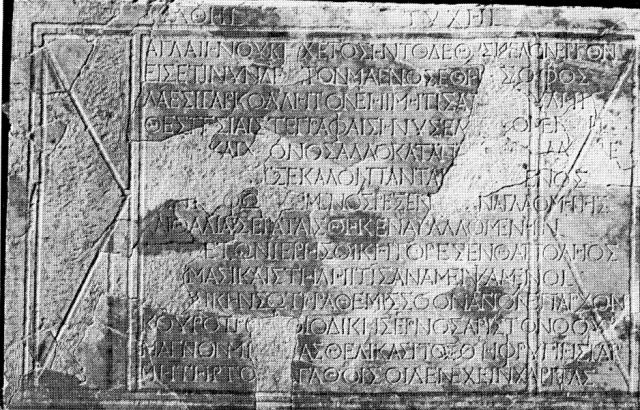
Plaque from base for statue of Flavius Magnus, vicar of Asiana. Hierapolis (Caria). Mid-fourth century.
Record details
Photographs
Inscription
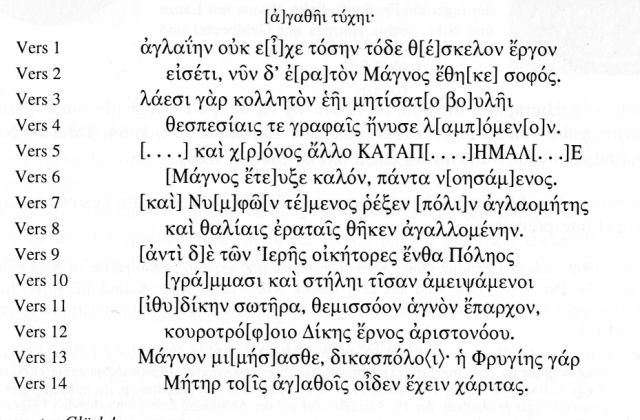
[ἀ]γαθῆι τύχηι. / ἀγλαΐην οὐκ ε[ἶ]χε τόσην τόδε θ[έ]σκελον ἔργον / εἰσέτι, νῦν δ’ ἐ[ρα]τὸν Μάγνος ἔθη[κε] σοφός. / λάεσι γὰρ κολλητὸν ἑῆι μητίσατ[ο βο]υλῆι /(5) θεσπεσίαις τε γραφαῖς ἤνυσε λ[αμπ]όμεν[ο]ν. / [...] καὶ χ[ρ]όνος ἄλλο ΚΑΤΑΠ[...]ΗΜΑΛ[...]Ε / [Μάγνος ἔτε]υξε καλόν, πάντα ν[οησάμ]ενος. / [καὶ] Νυ[μ]φῶ[ν τέ]μενος ῥέξεν [πόλι]ν ἀγλαομήτης / καὶ θαλίαις ἐραταῖς θῆκεν ἀγαλλομένην. /(10) [ἀντὶ δ]ὲ τῶν Ἱερῆς οἰκήτορες ἔνθα Πόληος / [γρά]μμασιν καὶ στήληι τῖσαν ἀμειψάμενοι / [ἰθυ]δίκην σωτῆρα, θεμισσόον ἁγνὸν ἔπαρχον, / κουροτρό[φ]οιο Δίκης ἔρνος ἀριστονόου. / Μάγνον μι[μήσ]ασθε, δικασπόλο<ι>· ἡ Φρυγίης γὰρ /(15) Μήτηρ το[ῖς ἀγ]αθοῖς οἶδεν ἔχειν χάριτας.
Inscription translation
'To Good Fortune. This marvellous building did not have such splendour hitherto, but now the wise Magnus has made it lovely. By his wisdom he wrought it with stones and made it shining with heavenly pictures. ...and [what] time [had destroyed?] Magnus made beautiful devising everything. And with brilliant purpose he made the city a shrine of the Nymphs, and set it rejoicing with lovely revelry. For these things the inhabitants of the Holy City (= Hierapolis) have honoured him in return, with writing and a statue, the right-judging saviour, the law-abiding, pure vicar, the high-minded offspring of Justice who nourishes men. Imitate Magnus, judges: for the Mother of Phrygia knows how to pay thanks to the good.
Bibliography
- Merkelbach, R. and J. Stauber (eds.), Steinepigramme aus dem griechischen Osten. Bd. 1. Die Westküste Kleinasiens von Knidos bis Ilion , Stuttgart 1998, 266-8, no. 02/12/06
- Ritti, T., Un epigramma del Tardo Impero da Hierapolis, Annali della Scuola normale superiore di Pisa, 3,16.1986, 691-716
Discussion
INSCRIPTION
Verse inscription of seven distichs laid out in 14 lines (one line per verse), with an introductory formula, 15 lines in all:
[ἀ]γαθῆι τύχηι. /
ἀγλαΐην οὐκ ε[ἶ]χε τόσην τόδε θ[έ]σκελον ἔργον /
εἰσέτι, νῦν δ’ ἐ[ρα]τὸν Μάγνος ἔθη[κε] σοφός. /
λάεσι γὰρ κολλητὸν ἑῆι μητίσατ[ο βο]υλῆι /
(5) θεσπεσίαις τε γραφαῖς ἤνυσε λ[αμπ]όμεν[ο]ν. /
[...] καὶ χ[ρ]όνος ἄλλο ΚΑΤΑΠ[...]ΗΜΑΛ[...]Ε /
[Μάγνος ἔτε]υξε καλόν, πάντα ν[οησάμ]ενος. /
[καὶ] Νυ[μ]φῶ[ν τέ]μενος ῥέξεν [πόλι]ν ἀγλαομήτης /
καὶ θαλίαις ἐραταῖς θῆκεν ἀγαλλομένην. /
(10) [ἀντὶ δ]ὲ τῶν Ἱερῆς οἰκήτορες ἔνθα Πόληος /
[γρά]μμασιν καὶ στήληι τῖσαν ἀμειψάμενοι /
[ἰθυ]δίκην σωτῆρα, θεμισσόον ἁγνὸν ἔπαρχον, /
κουροτρό[φ]οιο Δίκης ἔρνος ἀριστονόου. /
Μάγνον μι[μήσ]ασθε, δικασπόλο<ι>· ἡ Φρυγίης γὰρ /
(15) Μήτηρ το[ῖς ἀγ]αθοῖς οἶδεν ἔχειν χάριτας.
'To Good Fortune. This marvellous building did not have such splendour hitherto, but now the wise Magnus has made it lovely. By his wisdom he wrought it with stones and made it shining with heavenly pictures. ...and [what] time [had destroyed?] Magnus made beautiful devising everything. And with brilliant purpose he made the city a shrine of the Nymphs, and set it rejoicing with lovely revelry. For these things the inhabitants of the Holy City (= Hierapolis) have honoured him in return, with writing and a statue, the right-judging saviour, the law-abiding, pure vicar, the high-minded offspring of Justice who nourishes men. Imitate Magnus, judges: for the Mother of Phrygia knows how to pay thanks to the good.'
We reproduce the inscription with the completions proposed by Merkelbach 1998.
Letter height 3.6 cm.
DESCRIPTION (from Ritti 1986 and the published image)
Marble plaque recomposed from seven fragments, with several small pieces missing, particularly on the left side: H 94, W 143, D 2 cm. A tabula ansata is designed on the block by two parallel incised lines. The inscription observes the left side of the frame, but spills over the frame on the right. The introductory invocation is written above the tabula. A second frame in red colour is visible to the left of the epigraphic field, between the incised lines on top, and in the first incised line at the bottom; at the right edge there are no traces of this second frame. While the tabula ansata is the original decoration of the plaque, the inscription was added later, probably together with the painted frame.
The plaque was either once set on a statue base made up of a different material, or was located adjacent to the statue of Flavius Magnus.
PROVENANCE AND CURRENT LOCATION
The inscription was excavated in 1986 in the theatre of Hierapolis, in the central area of the frons scenae; there it was probably located in antiquity. It was recorded in the theatre by Ritti 1986, 691.
HONORAND, AWARDER AND DATE
Flavius Magnus, the honorand, was a high ranking state official ('right-judging, ἰθυδίκην', line 12); his office was that of eparchos (ἔπαρχον, line 12). This term usually refers to praetorian prefects, but it can also denote the office of vicar (Feissel 1998, 96). Jones 1997, 211-12 suggested that our Flavius Magnus should be identified with the proconsul of Asia of 354/9 (PLRE I, 535, Fl. Magnus 9). If so, the title ἔπαρχον (line 12) can not refer to the praetorian prefecture of the East, since all the holders of this office in this period are known (PLRE I, 1049-50; Ricci 1986, 712 n. 68). He was therefore almost certainly vicar of Asiana, an office which he must have held before he held the proconsulship of Asia, since the latter office was higher in rank (but see also Ritti 1986, 713-14 who suggests that he held both offices at the same time).
The inscription was set up by the city of Hierapolis (line 10), here styled a 'Metropolis' (line 15), in gratitude for building activities and further benefactions by Magnus. He provided the theatre (where the inscription was found) with decoration, probably a revetment in opus sectile ('with heavenly pictures, θεσπεσίαις.. γραφαῖς', line 5; see comment in Jones 1997, 206-7); he made the city a 'shrine of the Nymphs' (Νυμφῶν τέμενος ῥέξεν πόλιν, line 8), almost certainly an allusion to the repair or erection of buildings connected to the water-supply; moreover, he 'set it rejoicing with lovely revelry' (θαλίαις ἐραταῖς θῆκεν ἀγαλλομένην, line 9), possibly referring to games that he financed. Last but not least, he is praised for his justice (ἰθυ]δίκην, θεμισσόον ἁγνὸν ἔπαρχον, line 12; κουροτρό[φ]οιο Δίκης ἔρνος ἀριστονόου, line 13).
NOTE
Ritti 2011, 187 mentions a further, unpublished statue base, probably of the fourth century, to a Martinianus.
Discussion references
- Jones, A. H. M. et al., The Prosopography of the Later Roman Empire. Vol. I 260-395, Cambridge et al. 1971 (1975)
- Jones, C. 'Epigrams from Aphrodisias and Hierapolis', Hermes : Zeitschrift für klassische Philologie 125, Berlin 1997, 204-5
Cite: Last Statues of Antiquity, LSA-659 (Ulrich Gehn).