
LSA-663
Epigram for image, possibly statue, of Agathias, orator and poet. Probably Myrina (Asia). Probably later sixth century.
Record details
Photographs
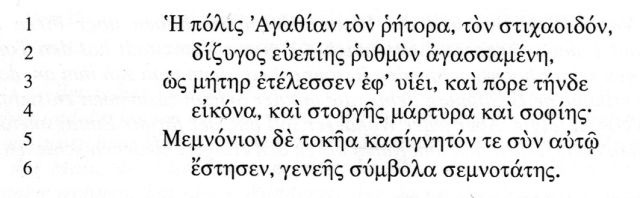
Inscription
ἡ πόλις Ἀγαθίαν τὸν ῥήτορα, τὸν στιχαοιδόν,
δίζυγος εὐεπίης ῥυθμὸν ἀγασσαμένη,
ὡς μήτηρ ἐτέλεσεν ἐφ’ υἱέι, καὶ πόρε τήνδε
εἰκόνα, καὶ στοργῆς μάρτυρα καὶ σοφίης·
Μεμνόνιον δὲ τοκῆα κασίγνηστόν τε σὺν αὐτὧ
ἔστησεν, γενεῆς σύμβολα σεμνοτάτης.
Inscription translation
The city [set this up to] Agathias, the orator, the poet, admiring the rhythm of his twofold eloquence. Like a mother she finished it for her son, and set up this image, a witness to his love [towards her] and to his skill. Memnonius the father, and his brother did she set up along with him, warrants of a most noble family.
Textual evidence
ἡ πόλις Ἀγαθίαν τὸν ῥήτορα, τὸν στιχαοιδόν,
δίζυγος εὐεπίης ῥυθμὸν ἀγασσαμένη,
ὡς μήτηρ ἐτέλεσσεν ἐφ’ υἱέι, καὶ πόρε τήνδε
εἰκόνα, καὶ στοργῆς μάρτυρα καὶ σοφίης·
Μεμνόνιον δὲ τοκῆα κασίγνηστόν τε σὺν αὐτὧ
ἔστησεν, γενεῆς σύμβολα σεμνοτάτης.
Translation
The city [set this up to] Agathias, the orator, the poet, admiring the rhythm of his twofold eloquence. Like a mother she finished it for her son, and set up this image, a witness to his love (scil.: towards her) and to his skill. Memnonius the father, and his brother did she set up along with him, warrants of a most noble family
Bibliography
- Aubreton, R. & F. Buffière, Anthologie Grecque XIII : Anthologie de Planude, Paris 1980, p. 198 no. 316
- Merkelbach, R. and J. Stauber (eds.), Steinepigramme aus dem griechischen Osten. Bd. 1. Die Westküste Kleinasiens von Knidos bis Ilion , Stuttgart 1998, 566, no. 05/04/01
Discussion
SOURCE (Anthologia Palatina 16 (= Planudean Anthology) no. 316)
Verse epigram in three distichs:
ἡ πόλις Ἀγαθίαν τὸν ῥήτορα, τὸν στιχαοιδόν,
δίζυγος εὐεπίης ῥυθμὸν ἀγασσαμένη,
ὡς μήτηρ ἐτέλεσσεν ἐφ’ υἱέι, καὶ πόρε τήνδε
εἰκόνα, καὶ στοργῆς μάρτυρα καὶ σοφίης·
(5) Μεμνόνιον δὲ τοκῆα κασίγνηστόν τε σὺν αὐτὧ
ἔστησεν, γενεῆς σύμβολα σεμνοτάτης.
'The city [set this up to] Agathias, the orator, the poet, admiring the rhythm of his twofold eloquence. Like a mother she finished it for her son, and set up this image [eikona], a witness to his love [towards her] and to his skill. Memnonius the father, and his brother did she set up along with him, warrants of a most noble family.'
LOCATION
The image was set up in Agathias' home town, since the city which honoured him is described as his mother (μήτηρ, line 3). If the honoured man was Agathias the 6th-century poet and historian (see below, 'Honorand, Awarder and Date'), then it was set up in Myrina, known to be his home town (http://www.trismegistos.org/place/16536).
HONORAND, AWARDER AND DATE
Agathias, the honorand, is praised for his rhethorical and poetical skills. Merkelbach 1998 therefore identified him with the poet and historian Agathias from Myrina (PLRE III, 1, 23-5 Agathias), who lived from c. 536-582, an identification which seems very likely. The name 'Agathias' is not a common one: the poet and historian is the only man listed under that name in all three volumes of PLRE.
FURTHER DISCUSSION
Whether this was a statue or a two-dimensional image (in mosaic or paint) is not clear; εἰκόνα (line 4) can refer to either. If the honorand was the historian Agathias, and the image therefore of the later 6th century, a two-dimensional representation is perhaps more likely (Mango 1986), though the wording of the epigram would also be entirely appropriate for a statue.
Discussion references
- Mango, C., Epigrammes honorifiques, statues et portraits a Byzance, Αφιέρωμα στον Νίκο Σβορώνο, 23-35, Rethymno 1986
- Martindale, J. R., The Prosopography of the Later Roman Empire. Volume III A. D. 527-641, Cambridge 1992
Cite: Last Statues of Antiquity, LSA-663 (Ulrich Gehn).