
LSA-667
Base for statue of Epinicus, praetorian prefect of the East. Metropolis (Phrygia Salutaris). 475-478
Record details
Photographs
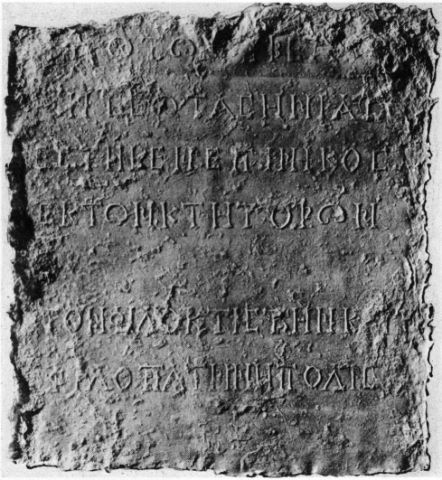
Inscription
πρ]ώτως κυβερνῶν / τῆς ἕω τὰς ἡνίας /
ἕστηκεν Ἐπίνικος /(4) ἐκ τῶν Κτητόρων /
(space)
τὸν φιλοκτίστην καὶ / φιλόπατριν ἡ πόλις
Inscription translation
Here stands Epinicus, the first of (our) landowners who holds the reins of the East. The city [honours] him who loves to build and loves his fatherland.
Bibliography
- Merkelbach, R. and J. Stauber (eds.), Steinepigramme aus dem griechischen Osten. Bd. 3. Der "Ferne Osten" und das Landesinnere bis zum Tauros, Munich 2001, no. 16/41/01
Discussion
INSCRIPTION
Iambic verse inscription laid out in six lines:
[πρ]ώτως κυβερνῶν / τῆς ἕω τὰς ἡνίας /
ἕστηκεν Ἐπίνικος /(4) ἐκ τῶν Κτητόρων /
(space)
τὸν φιλοκτίστην καὶ / φιλόπατριν ἡ πόλις
'Here stands Epinicus, the first of [our] landowners who holds the reins of the East. The city [honours] him who loves to build and loves his fatherland.'
Letter height 2.5 - 3.6 cm.
DESCRIPTION (from Haspels 1971)
Rectangular plain block of bluish veined marble: H 112.5, W 60.5, D 53 cm. Top and upper edges are worn away; there is a round hole on the top face (diameter 4.5, depth 6 cm).
PROVENANCE AND CURRENT LOCATION
The inscription was first recorded by W. M. Ramsay in 1884, who gave the information to Mommsen for publication (Mommsen 1897). Ramsay saw it in the area of the village of Kümbet, where it was re-discovered by Haspels, on the hill of Oineş, in 1958. Mommsen still thought Kümbet was the site of the Phrygian city of Meros, whereas in recent scholarship it is widely accepted that it was the location of Phrygian Metropolis (Mommsen 1897, 660; Haspels 1971, 210-11; http://www.trismegistos.org/place/16123).
There is no published record of the inscription’s present location; it is perhaps still where Haspels saw it.
HONORAND, AWARDER AND DATE
The honorand, Epinicus, whose wife was also honoured here (LSA-668), was praetorian prefect of the East in 475-8 (PLRE II, 397, Epinicus, which dates his prefecture to 475 only; Haspels 1971, 209). The inscription alludes to this office in a poetic form ('who holds the reins of the East, κυβερνῶν τῆς ἕω τὰς ἡνίας', lines 1-2). He was evidently still in office when our inscription was set up (whereas he is styled 'former prefect’ in the inscription to his wife).
The awarder of the honour to Epinicus was his native city (almost certainly Phrygian Metropolis; see above, 'Provenance and Current Location’). This was still a village in the later 3rd century (Haspels 1971, 211 and 308 no. 31, an inscription from the reign of Gallienus recording a Κώμαρχος, a village headman). The date of its elevation to city status is unknown; Haspels 1971, 210-11. In our inscription, the city takes pride in Epinicus, the first of her sons to reach the praetorian prefecture, the highest office of state (line 1), and also thanks him for his building activities and his love towards his fatherland (lines 5-6). Whether these benefits were provided from Epinicus' private fortune, or through the exercise of his high office, is unstated.
Discussion references
- Haspels, C. H. E., The Highlands of Phrygia, Princeton 1971, pp. 199, 208-11, 306-7 no. 28 pl. 614
- Martindale, J. R., The Prosopography of the Later Roman Empire. Volume III A. D. 527-641, Cambridge 1992
- Mommsen, T., Epinikos, Hermes 32, 660-3 (reprint in Mommsen, T., Gesammelte Schriften Bd. 4 (Historische Schriften Band 1), Berlin 1906, 561-4), 1897
Cite: Last Statues of Antiquity, LSA-667 (Ulrich Gehn).