
LSA-668
Base for statue of Dikaia (?), benefactress and wife of Epinicus, praetorian prefect . Metropolis (Phrygia Salutaris). 478-480
Record details
Photographs
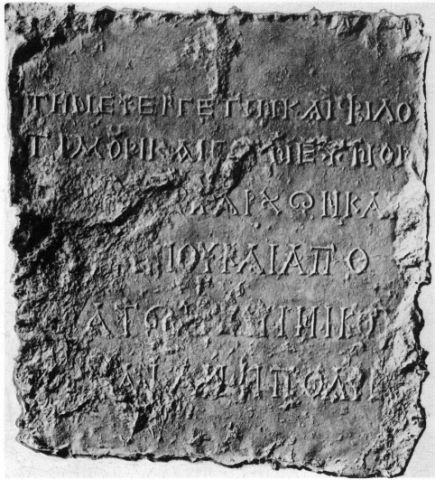
Inscription
(cross) τὴν εὐεργέτιν καὶ φιλό/τιμον, καὶ σύ̣νευνον / [τοῦ ἀπὸ] ἐ̣π̣άρχων καὶ /(4) [πατρ]ι̣κ̣ίου καὶ ἀπὸ vv/ [ὑπ]άτων̣ Ἐ̣π̣ινίκου, / [Δ]ι̣̣[κ]αίαν ἡ πόλις
Inscription translation
Dikaia, the benefactress and honour-loving woman, and wife of the former prefect, patricius and former consul Epinicus; the city [honours her].
Bibliography
- Dessau, H., Inscriptiones latinae selectae, Berlin 3rd ed. 1962, no. 8845b
- Haspels, C. H. E., The Highlands of Phrygia, Princeton 1971, p. 307 no. 29
Discussion
INSCRIPTION
In six lines:
(cross)
τὴν εὐεργέτιν καὶ φιλό/τιμον, καὶ σύ̣νευνον / [τοῦ ἀπὸ] ἐ̣π̣άρχων καὶ /(4) [πατρ]ι̣κ̣ίου καὶ ἀπὸ vv/ [ὑπ]άτων̣ Ἐ̣π̣ινίκου / [Δ]ι̣̣[κ]αίαν ἡ πόλις
'Dikaia, the benefactress and honour-loving woman, and wife of the former prefect, patricius and former consul Epinicus; the city [honours her].'
Letter height 2.4 - 4.5 cm. Height of cross 9.5, W 5.2 cm.
We reproduce the text with the completions proposed by Haspels 1971. Mommsen 1897, 562 suggested completing the honorand's name as 'Ζιραιαν, Ziraia'.
DESCRIPTION (from Haspels 1971 and the published image)
Rectangular block of bluish veined marble with moulding at bottom: H 97, W 59, D 58 cm. There is a round hole on the top face, diameter 6, depth 5 cm. The epigraphic field is chipped on the left side, making lines 3-6 partly illegible.
PROVENANCE AND CURRENT LOCATION
The inscription was first recorded by W. M. Ramsay in 1884, who gave the information to Mommsen for publication (Mommsen 1897). Ramsay saw it in the area of the village of Kümbet, where it was re-discovered by Haspels in 1958, among stones bordering a field on the right of the road leading towards the Oineş-spring. Mommsen still thought that Kümbet was the site of the Phrygian city of Meros, whereas in recent scholarship it is widely accepted that it was the location of Phrygian Metropolis (Mommsen 1897, 660; Haspels 1971, 210-11).
There is no recent record of the inscription’s location; it is possibly still where Haspels recorded it.
HONORAND, AWARDER AND DATE
The honorand, whose name was perhaps Dikaia (or Ziraia), was the wife of the patricius, former praetorian prefect, and former consul Epinicus (PLRE II, 397 Epinicus), for whom a statue base was found in this same area (LSA-667). Our inscription adds ranks and titles to the person of Epinicus which are not mentioned in his own inscription: he was a patricius and had been a consul, though this title must have been honorary since he is not recorded amongst the consuls of the empire (PLRE II; Haspels 1971, 210).
Our monument was awarded by the city of Phrygian Metropolis (line 6; see above, 'Provenance and Current Location’).
According to Haspels 1971, 209, Epinicus held the praetorian prefecture of the East in 475-8. Line 3 of our inscription has reasonably been completed to '[τοῦ ἀπὸ] ἐ̣π̣άρχων', thereby styling Epinicus a 'former prefect’. If this is correct, our inscription dates after 478, somewhat later than Epinicus’ own inscription which sees him still in office (LSA-667). Epinicus was executed after being involved in a plot at court in 480 (PLRE II, 397, Epinicus). It is very unlikely that our inscription was set up after that date.
Discussion references
- Martindale, J. R., The Prosopography of the Later Roman Empire. Vol. II A.D. 395-527, Cambridge 1980
- Mommsen, T., Epinikos, Hermes 32, 660-3 (reprint in Mommsen, T., Gesammelte Schriften Bd. 4 (Historische Schriften Band 1), Berlin 1906, 561-4), 1897
Cite: Last Statues of Antiquity, LSA-668 (Ulrich Gehn).