
LSA-671
Base for statue of Eustephius, civic official. From Docimium (Phrygia Salutaris). Fourth to fifth century.
Record details
Photographs
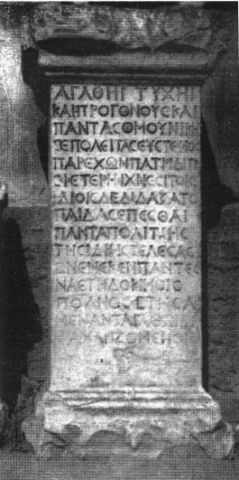
Inscription
ἀγαθῆι τύχηι. /
καὶ προγόνους καὶ / πάντας ὁμοῦ νίκη/σε πολείτας
Εὐστέφιος /(5) παρέχων πατρίδι τῇ / σφετέρῃ·
ἴχνεσι τοῖς / ἰδίοις δ’ἐδιδάξατο / παῖδας ἕπεσθαι /
πάντα πολιτίης /(10) τῆς ἰδίης τελέσας· /
ὧν ἕνεκεν πάντες / ναέτη Δοκίμοιο /(13) πόληος
στήσα/μεν ἀντ’ ἀγαθῶν μι/κρὰ χαριζόμενοι
Inscription translation
To Good Fortune. Eustephius defeated [our] ancestors as well as all contemporary citizens, when presenting himself to his fatherland. Fulfilling all his own civic duties, he taught children to follow his own footprints. Therefore we, all the inhabitants of the city of Docimium, set up a small thing for the good things [he did], rewarding [them].
Bibliography
- Merkelbach, R. and J. Stauber (eds.), Steinepigramme aus dem griechischen Osten. Bd. 3. Der "Ferne Osten" und das Landesinnere bis zum Tauros, Munich 2001, 383, no.16/53/2
Discussion
INSCRIPTION
Verse epigram of three distichs laid out over 14 lines, with an introductory formula, 15 lines in all:
ἀγαθῆι τύχηι. /
καὶ προγόνους καὶ / πάντας ὁμοῦ νίκη/σε πολείτας
Εὐστέφιος /(5) παρέχων πατρίδι τῇ / σφετέρῃ·
ἴχνεσι τοῖς / ἰδίοις δ’ἐδιδάξατο / παῖδας ἕπεσθαι /
πάντα πολιτίης /(10) τῆς ἰδίης τελέσας· /
ὧν ἕνεκεν πάντες / ναέτη Δοκίμοιο / πόληος
στήσα/μεν ἀντ’ ἀγαθῶν μι/κρὰ χαριζόμενοι
'To Good Fortune. Eustephius defeated [our] ancestors as well as all contemporary citizens, when presenting himself to his fatherland. Fulfilling all his own civic duties, he taught children to follow his own footprints. Therefore we, all the inhabitants of the city of Docimium, set up a small thing for the good things [he did], rewarding [them].'
Letter height 3.5 cm.
Whether the small thing set up (lines 13-14) refers to a statue is not explicit in the text. The verb στήσαμεν, however, normally refers to the erection of a statue; another constitutive feature of late antique statue base inscriptions is the downplay of the honour as but a small recompense for the good deeds of the honorand (lines 14-15). It is very likely that this is a statue base.
DESCRIPTION (from Peek 1931 and the published image)
Tall rectangular block of white marble, with badly chipped mouldings at top and bottom: H 117, W (at the mouldings) 56, D (at mouldings) 41.5 cm. Peek 1931 described the block as an altar; but there is no reason to suppose that is other than a statue base.
PROVENANCE AND CURRENT LOCATION
There is no published record of the findspot of the base; the inscription, however, tells us that it was set up in Docimium. It is today in the Izmir Archaeological Museum, inv. no. 17
HONORAND, AWARDER AND DATE
The honorand, Eustephius, was a local man, obviously from a family with a long tradition in Docimium (line 2). The inscription glorifies his dedication to his home city and the fulfillment of his civic duties, with no account of particular wisdom or erudition. It is therefore impossible that this is the same man as the sophist Eustephius from Aphrodisias (PLRE II, 436-7), as Merkelbach 2001 has suggested.
The awarder of the statue was the city of Docimium.
The verse form dates our inscription to the 4th–6th century (Robert 1948, 108 – 10 and passim); but it is unlikely to be much later than around 450.
FURTHER DISCUSSION
The praise of Eustephius' fulfillment of all his civic duties (πάντα πολιτίης τῆς ἰδίης τελέσας, lines 9-10), by which he gives an example to future generations, probably reflects the attempt of many members of the curial class in Late Antiquity to escape from the onerous duties of councillors (Jones 1964, 737-57; Demandt 1998, 408-12).
Discussion references
- Demandt, A., Geschichte der Spätantike, München 1998
- Jones, A. H. M., The Later Roman Empire, 2 vols., Oxford 1964
- Martindale, J. R., The Prosopography of the Later Roman Empire. Vol. II A.D. 395-527, Cambridge 1980
- Peek, W., Griechische Epigramme, Mitteilungen des Deutschen Archäologischen Instituts, Athenische Abteilung, 56, 1931, pp. 119-34, pp. 124-5 no. 20
- Robert, L., A Travers l'Asie Mineure. Poètes et Prosateurs, Monnaies Grecques, Voyageurs et Géographie, Paris 1980, p. 256 fig. 2
- Robert, L., Epigrammes du Bas-Empire (Hellenica IV), Paris 1948
Cite: Last Statues of Antiquity, LSA-671 (Ulrich Gehn).