
LSA-672
Base for statue of 'Marcianus', possibly the military commander Lucius Aurelius Marcianus. Cibyra (Caria). Possibly late third to early fourth century.
Record details
Photographs
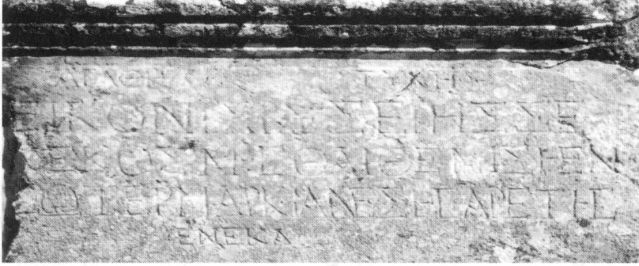
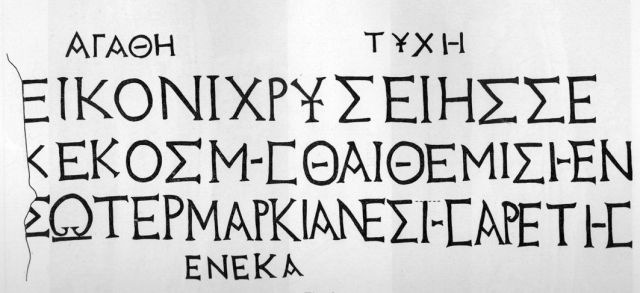
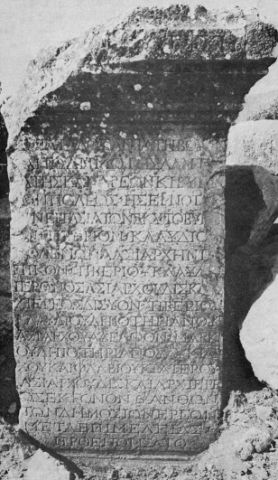
Inscription
Ἀγαθῇ τύχῃ·/
εἰκόνι χρυσείῃ σσε (sic) / κεκοσμῆσθαι θέμις ἦεν, /
σῶτερ Μαρκιανέ, σῆς ἀρετῆς / ἕνεκα
Inscription translation
To Good Fortune. To decorate you with a golden statue would have been just, saviour Marcian, because of your virtue.
Bibliography
- Corsten, T. (ed.), Die Inschriften von Kibyra. Inschriften griechischer Städte aus Kleinasien, Bd. 60, Bonn 2002, pp. 99-100 no. 65
- Merkelbach, R. and J. Stauber (eds.), Steinepigramme aus dem griechischen Osten. Bd. 4. Die Südküste Kleinasiens, Syrien und Palaestina, Munich 2002, 6, no.17/1/1
Discussion
INSCRIPTION
Verse inscription of one distich, with introductory formula, laid out in five lines:
Ἀγαθῇ τύχῃ·/
εἰκόνι χρυσείῃ σσε (sic) / κεκοσμῆσθαι θέμις ἦεν, /
σῶτερ Μαρκιανέ, σῆς ἀρετῆς / ἕνεκα
'To Good Fortune. To decorate you with a golden statue would have been just, saviour Marcianus, because of your virtue.'
Letter height 3 - 3.5 cm.
DESCRIPTION (from Corsten 2002 and the published image)
Rectangular white marble base with mouldings at top and bottom, part buried at bottom; H (visible) 142, W 81 (shaft: 66), D 82 (shaft: 67) cm. Our inscription is from a re-use of the base, on whose right side is a 2nd-centrury inscription to Tiberius Claudius Polemon (Corsten 2002, no. 63).
PROVENANCE AND CURRENT LOCATION
The inscription was first recorded in 1878 by Collignon in the ruins of Cibyra. It was recorded 'at the eastern corner of the way leading through 'H' on Bean’s map' by Corsten 2002 (Bean’s map is reproduced at the end of the volume).
HONORAND AND DATE
Corsten 2002 argued that our honorand, 'Marcianus', is to be identified with Lucius Aurelius Marcianus, who is honoured as a dux in Termessus (LSA-619), whose military command was associated by Christol 1978 with the Isaurian upheavals of the later 3rd and earlier 4th centuries, and whose nomen Aurelius indicates a date in the tetrarchic rather than in the Constantinian period. While this identification is entirely possible, and would suit the description of our Marcianus as a 'saviour, σῶτερ', we have too little information to know whether it is correct.
FURTHER DISCUSSION
The motif of the modesty of the honour awarded, in comparison to the benefactions received - here a golden statue would have been deserved - is common in honorifc inscriptions of Late Antiquity.
Discussion references
- Brandt, H., Probus, Pacator Pamphyliae et Isauriae?
, Bonamente, G. & N. Duval (eds.), Historiae Augustae Colloquium Parisinum (HistoriaeAugustae Colloquia nova series I) 83-92, Macerata 1991 - Christol, M. 'Un duc dans une inscription de Termessos (Pisidie). Un témoignage sur les troubles intérieurs en Asie Mineure romaine au temps de la crise de l’empire', Chiron. Mitteilungen der Kommission für Alte Geschichte und Epigraphik des Deutschen Archäologischen Instituts, 8., Munich 1978
- Collignon, M., Inscriptions de Cibyra
, Bulletin de Correspondance Hellénique 2, 1878, 593-614, pp. 593-5 no. 1 - Harper, R. P., Türk Tarih Kurumu Yayınları 9, 1979 (VIII. Türk Tarih Kongresi), 522-3 no. 8 B, pp. 522-3 no. 8 B
- Jones, A. H. M. et al., The Prosopography of the Later Roman Empire. Vol. I 260-395, Cambridge et al. 1971 (1975)
Cite: Last Statues of Antiquity, LSA-672 (Ulrich Gehn).