
LSA-676
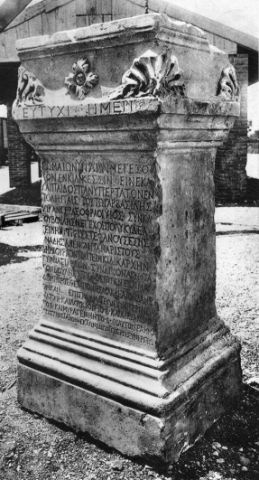
Base for statue of Papis signo Hemerius. Tarsus (Cilicia I). Third century, or possibly early fourth
Record details
Photographs
Inscription
Εὐτύχι Ἡμέρι.Ῥωμαίων ὕπατον, μεγ’ ἔξο/χον ἐν Κιλίκεσσιν
εἵνεκα / καὶ παιδὸς πανυπέρτατον ἐν / πολιήταις
- τούτῳ γὰρ βασιλῆς / δῶκαν γέρας, ὄφρα οἱ υἱός
συνκλή/του βουλῆς μετέχοι πολυκυδέα / τειμήν -
δημιουργὸν Πάπειν Κιλικάρχην / γυμνασίαρχον,
σύνδικον ἁγνότα/τον, βουλῆς στέφος, εὐγενὲς αἷμα /
Δημητρος θεράποντες ἀγακλέα τονδ’ ἀνέθηκαν.
ἐπὶ γραμματέων τῶν περὶ Νέω/να τὸ β’ καὶ Λούκιον τὸ β’ καὶ Ἀλέξανδρον / τὸ β’ καὶ Μυραγένην τὸ β’· οἱ αὐτοὶ γραμμα/τεῖς τὴν στατίωνα ἐκ τῶν ἰδίων τῷ ἰερῷ συνεργίῳ.
Inscription translation
To good fortune, Himerius. Him, the Roman consul, the most distinguished among the Cilicians, who also on behalf of his son is the highest among the citizens – for to him the emperors gave the award that the son should share the very splendid honour to be a member of the senatorial assembly – him, Papis, who consecutively placed three very noble wreaths upon his head, that of demiurgus, that of ciliciarchus, and that of gymnasiarchus, the entirely pure jury-man, the crown of the council, noble blood; the servants of Demeter set up this glorious man.
[Set up] when the men around Neon (for the second time) and Lucius (for the second time) and Alexander (for the second time) and Myragenes (for the second time) were clerks. The same clerks [provided] the meeting room from their own fortune for the sacred guild.
Bibliography
- Merkelbach, R. and J. Stauber (eds.), Steinepigramme aus dem griechischen Osten. Bd. 4. Die Südküste Kleinasiens, Syrien und Palaestina, Munich 2002, 209-11, no.19/13/01
Discussion
INSCRIPTION
In 17 lines. The inscription is made up of three parts. Line 1 gives the man's signum 'Himerius'; lines 2-13 are a verse inscripton of eight hexameters celebrating the honorand; lines 14-17 name the awarders, in prose:
Εὐτύχι Ἡμέρι.(ivy leaf)/
Ῥωμαίων ὕπατον, μεγ’ ἔξο/χον ἐν Κιλίκεσσιν
εἵνεκα / καὶ παιδὸς πανυπέρτατον ἐν / (5) πολιήταις
- τούτῳ γὰρ βασιλῆς / δῶκαν γέρας, ὄφρα οἱ υἱός
συνκλή/του βουλῆς μετέχοι πολυκυδέα / τειμήν –
τρεῖς στεφάνους ἑξης / ἀναδησάμενον παναρίστους /
(10) δημιουργὸν Πάπειν Κιλικάρχην / γυμνασίαρχον,
σύνδικον ἁγνότα/τον, βουλῆς στέφος, εὐγενὲς αἷμα /
Δημητρος θεράποντες ἀγακλέα τονδ’ ἀνέθηκαν. /
(14) ἐπὶ γραμματέων τῶν περὶ Νέω/να τὸ β’ καὶ Λούκιον τὸ β’ καὶ Ἀλέξανδρον / τὸ β’ καὶ Μυραγένην τὸ β’· οἱ αὐτοὶ γραμμα/τεῖς τὴν στατίωνα ἐκ τῶν ἰδίων τῷ ἰερῷ συνεργίῳ.
'To Good Fortune, Himerius.
Him, the Roman consul, the most distinguished among the Cilicians, who also on behalf of his son is the highest among the citizens – for to him the emperors gave the award that the son should share the very splendid honour to be a member of the senatorial assembly – him, Papin, who consecutively placed three very noble wreaths upon his head, that of demiurgus, that of ciliciarchus, and that of gymnasiarchus, the entirely pure jury-man, the crown of the council, noble blood; the servants of Demeter set up this glorious man.
[Set up] when the men around Neon (for the second time) and Lucius (for the second time) and Alexander (for the second time) and Myragenes (for the second time) were clerks. The same clerks [provided] the meeting room (stationa) from their own fortune for the sacred guild.'
Letter height not recorded.
The end of each hexameter is marked. There is a blank space between the end of the verse and the subsequent prose inscription. In line 2, ὕπατον is written on an erasure which originally read 'ἱππῆα, equestrian' (Ῥωμαίων ἱππῆα, μεγ’ ἔξοχον ἐν Κιλίκεσσιν etc.; Drew-Bear 1975, 302-3; see below, 'Honorand, Awarder, and Date'). This resolves the metrical flaw in the first hexameter, where the third metrical foot starts with a short instead of a long syllable (-πα- in ὕπατον).
DESCRIPTION (from Ramsay 1883, and the published image)
Tall marble base with mouldings at top and bottom. There are no published measurements. Above the upper moulding there is a plinth with mouldings at top, decorated with palmettes at all corners and a flower at the centre front, all in high relief. The first line of the inscription is carved on the uppermost fillet of the moulding above the epigraphc field; the epigraphic field is not framed. There are slight chips at the margins of the epigraphic field.
PROVENANCE AND CURRENT LOCATION
The base was excavated in the late 19th century in Tarsus (Ramsay 1883, 325: 'recently excavated’). The inscription tells us that it was set up in front of, or in, the meeting room (στατίων, Latin 'statio', line 17; Robert 1949, 202-4) of the guild of the corn traders of Tarsus (see below, 'Honorand, Awarder and Date’). There is no published record of its present location.
HONORAND, AWARDER AND DATE
The honorand, Papis (or Papeis, Papin) signo Hemerius (or Himerius) is otherwise unknown (Prosopographia Imperii Romani IV p. 69 no. 83 Hemerius). His family name Papis is given in line 10 in the accusative; this is an indigenous cognomen attested elsewhere in Cilicia and southern Asia Minor (Daux 1976, 250; Daux 1977, 62-8). He was a local man of Tarsus, since he held the office of demiurgus, by which the years were reckoned in Tarsus. Beyond this local office, he held the presidency of the assembly (koinon) of the province of Cilicia, and the supervision over the gymnasia (line 10). He was originally of equestrian rank, but was later in his life elevated to be consul (ὕπατον written over erased ἱππῆα in line 2, see above 'Inscription’).
The awarder of the statue was the guild of the corn traders of Tarsus, poetically referred to as 'the servants of Demeter, Δημητρος θεράποντες' (line 13) (Robert 1949, 201-2), whose officers are listed at the end of the inscription, where they also apparently refer to a benefaction of their own. They awarded the statue before Papis became consul, when they replaced his original rank attribute, thereby disturbing the metre of the verse inscription.
Ramsay 1883 dated the inscription to around 200, and Daux 1977, 69-70, on the basis of a careful analysis of the lettering, likewise dated it to around 200 ('vers la fin du IIe siècle de notre ère’, p. 69). However, a late antique date was recently proposed by Merkelbach 2002, who thought that Papis’ elevation to consul was in Constantinople soon after the city had become the new capital (see below, 'Further Discussion’). The decoration of the base itself suits a dating around 200, rather than one a century later; but it is always possible that it is a re-used piece.
FURTHER DISCUSSION
Papis is not recorded in the list of consuls; he therefore might have been a suffect consul (an office not known in Constantinople) or an honorary consul. If Merkelbach's proposal is accepted, that this is an inscription of the Constantinian period and that Papis was one of the many provincial notables adopted into the new senate of Constantinople, 'ὕπατον' in line 2 could stand for the more correct 'ὑπατικόν - consularis', mistakenly (or to flatter the honorand), referring to Papis being adopted by 'adlectio inter consulares'.
If the inscription is from around AD 200, then this is an early example of verse being used for an honorific inscription. On balance we are fairly confident that this monument is indeed early 3rd century, but have included it because there is an element of doubt, and because it is a good example of the use of verse by provincial notables, before the habit was taken up for imperial officials at the end of the century.
Discussion references
- Prosopographia imperii romani saec. I. II. III, Berlin & Leipzig 1933-, vol. IV p. 69 no. 83
- Daux, G., A propos d’une inscription honorifique de Tarse, Zeitschrift für Papyrologie und Epigraphik 20, 1976, 249-52
- Daux, G., Le Consul Papeis de Tarse, Epigraphica 39, 1977, 51-70
- Drew-Bear, T., Two Ghost-Words and a Consul: Inscriptions of Pergamum and Tarsus, Harvard Studies in Classical Philology 79, 1975, 301-3
- Ramsay, W. M., Unedited Inscriptions of Asia Minor, Bulletin de Correspondance Hellenique 7, 1883, 297- 328, pp. 325-7 no. 54
- Robert, L., Inscription de Tarse, Hellenica VII, 197-205, Paris 1949
Cite: Last Statues of Antiquity, LSA-676 (Ulrich Gehn).