
LSA-677
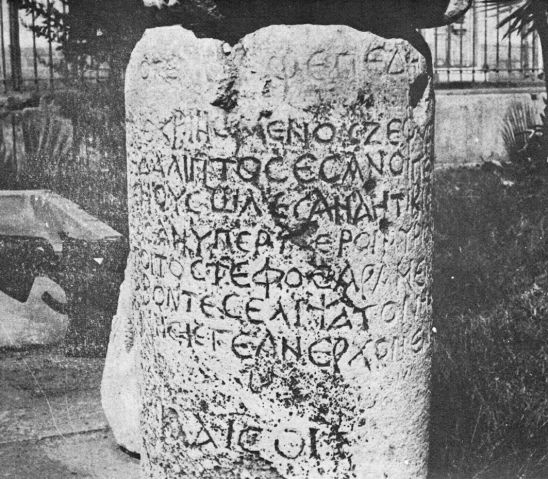
Columnar base, possibly for statue of chariot and horses. Adana (Cilicia I). Fifth century ?
Record details
Photographs
Inscription
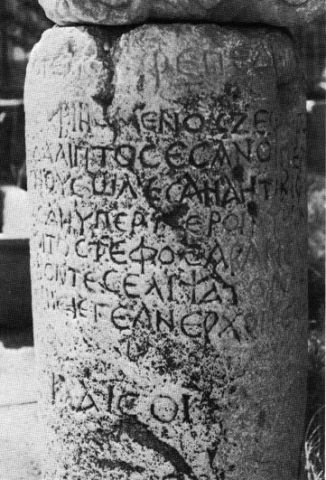
Ἅρμα τ[όδε πτηνὸν... οου] ποτέ. Τίς (σ)φ’ ἐπέδησεν
ἡνιόχων, ἵπποις κρινόμενο(ν) Ζεφύρῳ;
Ἀμφιθάλασσος ἤδ’ Ἄλιπτος ἔσαν οἱ περὶ νίκης
(4) δῆριν παρθεμένους ὤλεσαν ἀντιβίους·
καὶ ζῶντες μὲν ἔασαν ὑπέρτεροι μυρίον ἄλλων,
δημοχαρεῖς ἵπποι τὸ στέφος ἀράμενοι,
νίκην δ’ αὖτε λαβόντες ἐλίψατον ἡδ(έ)α πάτρῃ
(8) ἄμφω μνημοσύνη(ν) (ε)ἰς γαν ἐρχόμενου.
Καὶ σοί.
Inscription translation
This chariot was once the winged chariot of ..oos. Which charioteer then stopped it, that was challenging Zephyrus thanks to its horses? It was Amphithalassos and Aleiptos who destroyed those contenders who were rivals in the struggle for victory. Alive, they were a thousand times superior to all the others, the horses which won the crown to the joy of their party. After having achieved victory, they both left to their hometown the sweetness of memory when they went into the earth. - To you also.
Bibliography
- Merkelbach, R. and J. Stauber (eds.), Steinepigramme aus dem griechischen Osten. Bd. 4. Die Südküste Kleinasiens, Syrien und Palaestina, Munich 2002, 215-16, no.19/4/2
Discussion
INSCRIPTION
Epigram of four distichs laid out in eight lines, one verse per line. Below the epigram, a good wish in prose is added:
Ἅρμα τ[όδε πτηνὸν... οου] ποτέ. Τίς (σ)φ’ ἐπέδησεν
ἡνιόχων, ἵπποις κρινόμενος (sic) Ζεφύρῳ;
Ἀμφιθάλασσος ἤδ’ Ἄλιπτος ἔσαν οἱ περὶ νίκης
δῆριν παρθεμένους ὤλεσαν ἀντιβίους·
(5) καὶ ζῶντες μὲν ἔασαν ὑπέρτεροι μυρίον ἄλλων,
δημοχαρεῖς ἵπποι τὸ στέφος ἀράμενοι,
νίκην δ’ αὖτε λαβόντες ἐλίψατον ἡδ(έ)α πάτρῃ
ἄμφω μνημοσύνη(ν) (ε)ἰς γαν ἐρχόμενου.
Καὶ σοί.
'This chariot was once the winged chariot of ..oos. Which charioteer then stopped it, that was challenging Zephyrus thanks to its horses? It was Amphithalassos and Aleiptos who destroyed those contenders who were rivals in the struggle for victory. Alive, they were a thousand times superior to all the others, the horses which won the crown to the joy of their party. After having achieved victory, they both left to their hometown the sweetness of memory when they went into the earth. - To you also.'
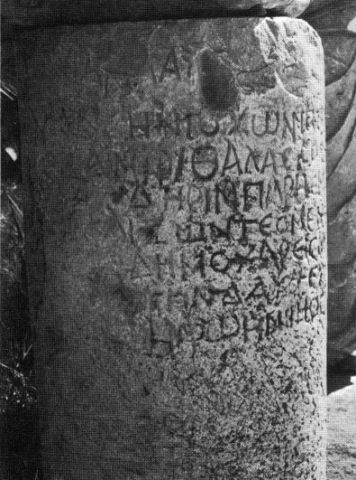
On the back of the column, the sculptor had begun to carve the same epigram, but obviously considered this first attempt flawed, and abandoned it: Ἅρμα τόδε πτηνὸν [...] / οου ποτέ, τίς (σ)φ’ (space) ἐπέδη/σεν (space) / ἡν (space)
This enables us to reconstruct most of the first verse of the epigram, which is very badly damaged on the front face.
Letter height 2 - 3.5 cm.
We reproduce the inscription here with the reading proposed by Dagron & Feissel 1987. This version is accepted by Merkelbach 2002 except for their interpretation of κρινόμενος in line 2 as an error for κρινόμενον; we agree, however, with Dagron & Feissel that the overall sense speaks strongly in favour of an error by the sculptor.
DESCRIPTION (from Dagron & Feissel 1987, and the published images)
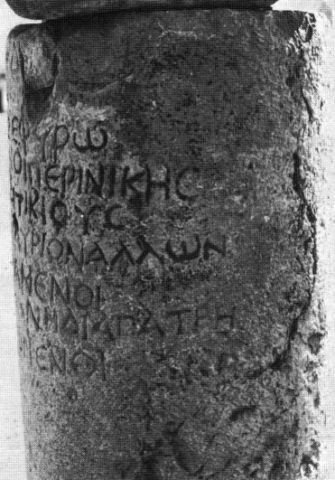
Columnar limestone base, H 95, diameter 46 cm. The upper rim is chipped, rendering the first line of the inscription partly illegible (see above, 'Inscription’). As Dagron & Feissel 1987, 92 point out, there is no hole for a fixing on the top face.
PROVENANCE AND CURRENT LOCATION
There is no published record of the provenance of the inscription; it was probably once set up on the spina of a hippodrome in one of the Cilician cities, probably (but not necessarily) Adana (Dagron & Feissel 1987, 95; Dagron & Marcillet-Jaubert 1978, 396). It is today in the courtyard of the Adana Museum, to the right of the main entrance (without published inv. no.).
HONORAND, AWARDER AND DATE
This is an epitaph for two race horses, Amphithalassos ('the one surrounded by the sea’ – perhaps an allusion to breeding on an island) and Aleiptos ('the invincible) (Dagron & Feissel 1987, 94; Dagron & Marcillet-Jaubert 1978, 397). It is extraordinary that horses, instead of a charioteer, are given the principal praise for victory - horses are named on charioteer bases in Constantinople (e.g. LSA-349), but only in a subsidiary role. Also here the circus factions do not feature, unlike the honorific epigrams to charioteers in Constantinople where they play a prominent role (LSA-349, LSA-361, LSA-489, LSA-490, LSA-491, LSA-499, LSA-500, LSA-501, LSA-502, LSA-503, LSA-504, LSA-505, LSA-506, LSA-507, LSA-508, LSA-509, LSA-510, LSA-511).
The inscription was dated to the 5th century by Dagron & Marcillet-Jaubert 1978, 396 'because of its carving, the nature of the text, and the underlying world of the demes’ ('la gravure, la nature du texte, et le monde sus-jacent des dèmes nous feraient pencher pour le Ve s.’). We agree that it is late antique in date.
FURTHER DISCUSSION
Dagron & Marcillet-Jaubert 1978, 396 proposed that on this base was set, either the very chariot alluded to in the epigram, or a sculptural representation of it; Dagron & Feissel 1987, 95 preferred to see a statue representing the named pair of horses; while Merkelbach 2002, 215 assumed that a representation of both chariot and horses was set up on top of the column. Dagron & Feissel 1987, 93, however, justly remark that the absence of a fixing hole on the top face of the column arouses some doubt about such assumptions. Certainly the modest dimensions of the column do not allow for a large scale statue of a biga or of two horses.
Discussion references
- Dagron, G. & D. Feissel, Inscriptions de Cilicie (Travaux et Mémoires du Centre de Recherche d'Histoire et Civilisation de Byzance, 4), Paris 1987, pp. 92-5 no. 49 pl. 23
- Dagron, G. & J. Marcillet-Jaubert, Inscriptions de Cilicie et d'Isaurie, Belleten (Türk Tarih Kurumu) 42, 373-420, 1978, pp. 395-7 no. 29 pl. 4
Cite: Last Statues of Antiquity, LSA-677 (Ulrich Gehn).