
LSA-678
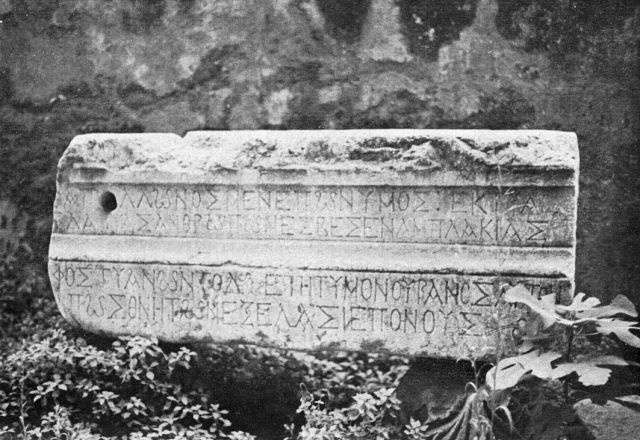
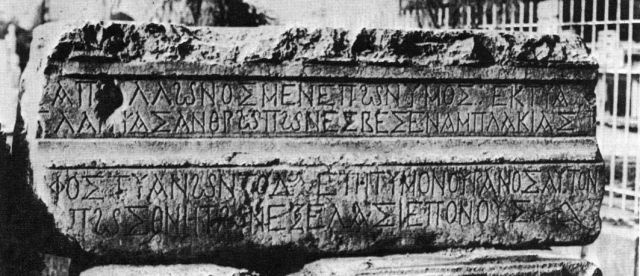
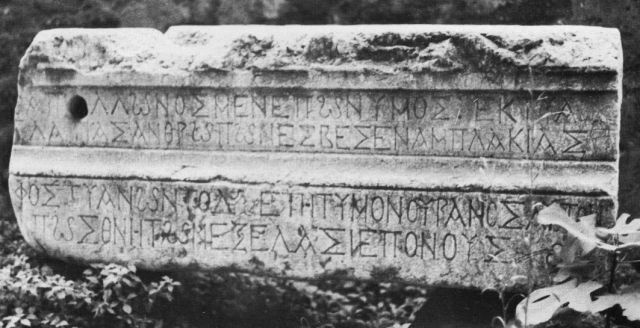
Architrave block carrying statue of Apollonius of Tyana, first-century thaumaturge. Mopsuhestia (Cilicia II). Third to fourth century
Record details
Photographs
Inscription
[Οὗτο]ς ̣ Ἀπ[ό]λλωνος μὲν ἐπώνυμος: ἐκ Τυά/[νων δ]ὲ ̣
λάμψας ἀνθρώπων ἔσβεσεν ἀμπλακίας. /
[---]φος Τυάνων τό δ’ ἐτήτυμον, Οὐρανὸς αὐτὸν /
[πέμψεν ὅ]πως θνητῶν ἐξελάσιε πόνους. (ivy leaf)
Inscription translation
This man is named after Apollo, from Tyana he is shining forth, and extinguishes the faults of men.
This true man ... of Tyana, the sky sent him so that he might drive out the sufferings of mortals.
Bibliography
- Dagron, G. & D. Feissel, Inscriptions de Cilicie (Travaux et Mémoires du Centre de Recherche d'Histoire et Civilisation de Byzance, 4), Paris 1987, pp. 137-41 and 163-4 (addenda) no. 88 pl. 36
- Merkelbach, R. and J. Stauber (eds.), Steinepigramme aus dem griechischen Osten. Bd. 4. Die Südküste Kleinasiens, Syrien und Palaestina, Munich 2002, 218, no.19/15/2
Discussion
INSCRIPTION
Epigram in two distichs, laid out over four lines. Each verse occupies one line, exept for the first hexameter whose last two syllables overflow onto line 2.
[Οὗτο]ς ̣ Ἀπ[ό]λλωνος μὲν ἐπώνυμος: ἐκ Τυά/[νων δ]ὲ ̣
λάμ ̣̣̣ψας ἀνθρώπων ἔσβεσεν ἀμπλακίας. /
[---]φος Τυάνων τό δ’ ἐτήτυμον, Οὐρανὸς αὐτὸν /
[πέμψεν ὅ]πως θνητῶν ἐξελάσιε πόνους. (ivy leaf)
'This man is named after Apollo, from Tyana he is shining forth, and extinguishes the faults of men.
This true man ... of Tyana, the sky sent him so that he might drive out the sufferings of mortals.'
Letter height 5 cm.
We reproduce the inscription with the completions proposed by Dagron & Feissel 1987. There is disagreement among scholars regarding the second distich, where Dagron & Feissel reconstruct the text to yield an opposition between the terrestrial birth of Apollonius and his celestial parentage. Another group of scholars completes the text here so as to produce an opposition between his earthly burial and his elevation to heaven, from whence he pours out his benefactions to mortals (Dagron & Feissel 1987, 138; Nollé & Berges 2000, 421); but, as Dagron & Feissel 1987, 140 point out, no grave or even cenotaph of Apollonius was known, and no posthumous miracles are reported.
DESCRIPTION (from Dagron & Feissel 1987, Nollé & Berges 2000, and the published images)
Architectural block, probably an architrave, with a moulding at top: H 53, W 139, D (at top) 35, (at bottom) 30 cm. The moulding and the right edge are chipped; the left end is broken and lost, losing part of the inscription. The block is divided into two bands by a horizontal fillet. In line 1 of the inscription, a round hole has destroyed the third letter of the honorand’s name.
PROVENANCE AND CURRENT LOCATION
The inscripton was found in Misis (today Yakapınar), a village on the left side of the river Pyramus, opposite the ancient city of Mopsuhestia (http://www.trismegistos.org/place/12908). Today it is in the garden of the New Museum in Adana, inv. no. 1515
Dagron & Marcillet-Jaubert 1978, and independently Bowie 1978, both proposed that the inscription was originally set up in the nearby Cilician city of Aegeae, where Apollonius was active for a long time (Dagron & Feissel 1987, 140).
HONORAND, AWARDER AND DATE
Apollonius of Tyana, the honorand, was a thaumaturge (miracle worker) active in the 1st century AD, whose thought and example remained influential after his death. In the earlier 3rd century, the Athenian sophist Philostratus dedicated a detailed biography to him, possibly influenced or even commissioned by the empress Julia Domna (Jones 2005, 4, 17). He was still popular in the fourth century (Jones 1980, 193-4; Dagron & Feissel 1987, 139 with n. 34; Alföldi & Alföldi 1990; Jones 2005, 18).
Dagron & Marcillet-Jaubert 1978, 405, proposed a date later than 217, but before the christianization of the empire, for our inscription. Dagron & Feissel 1987, 141 did not exclude the later 4th century ('le IVe s. est à fait possible’). Jones 1980, 190-1, argued that the lettering of the inscription was of the 3rd/ 4th century, but made a case for a date in the late 4th century. Nollé & Berges 2000, 422 date it to the late 3rd/ 4th century on the basis of the lettering, while Merkelbach 2002 suggests a broad dating of 220/350 ('zwischen 220 und 350 n. Chr.'). We are uncertain where in the 3rd and 4th century this interesting monument should be placed.
FURTHER DISCUSSION
A late antique medallion portrait of Apollonius is known from Aphrodisias (LSA-211).
Discussion references
- Alföldi, A. & E. Alföldi, Die Kontorniat-Medaillons, Berlin 1990, pp. 102-3 cat. no. 110, 111 pl. 38,1-4; 215, 1-2
- Bowie, E. L., Apollonius of Tyana: Tradition and Reality, Aufstieg und Niedergang der römischen Welt. 2. Principat. Band 16, Teilband 2, (ed. by W. Haase) pp. 1652-1699, Berlin 1978, pp. 1687-8
- Dagron, G. & J. Marcillet-Jaubert, Inscriptions de Cilicie et d'Isaurie, Belleten (Türk Tarih Kurumu) 42, 373-420, 1978, pp. 402-5 no. 33 pl. VI
- Jones, C. P., Philostratus, The Life of Apollonius of Tyana. Books I-IV. Edited and translated by Christopher P. Jones, Cambridge (Mass.) 2005
- Jones, C. P., An Epigram on Apollonius of Tyana, Journal of Hellenic Studies 100, 1980, pp. 190-4
- Nollé, J. & D. Berges, Tyana. Archäologisch-historische Untersuchungenzum südwestlichen Kappadokien. Teil II (Inschriften griechischer Städte aus Kleinasien Band 55,2), Bonn 2000, pp. 420-2 no. 112
Cite: Last Statues of Antiquity, LSA-678 (Ulrich Gehn).