
LSA-679
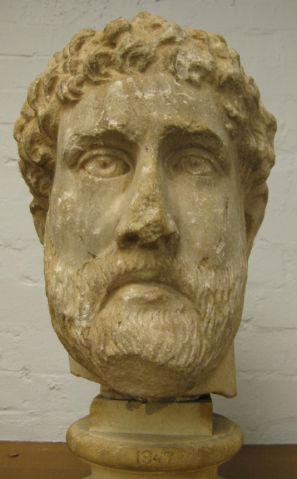
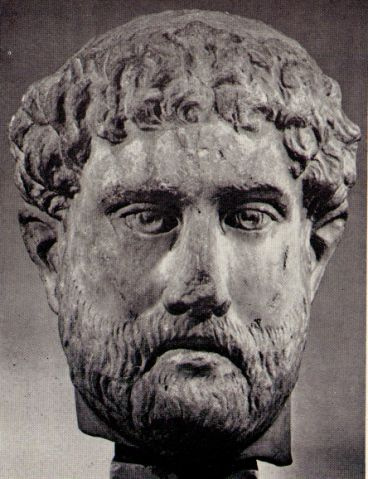
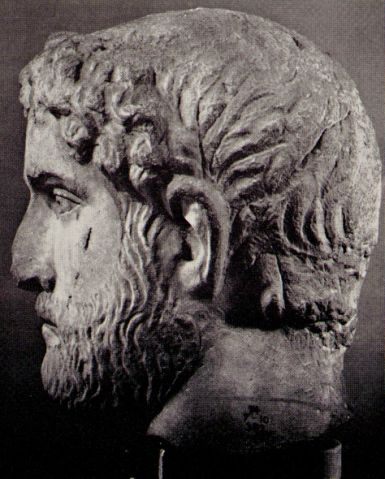
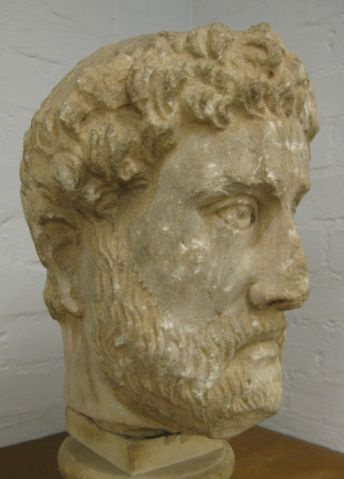
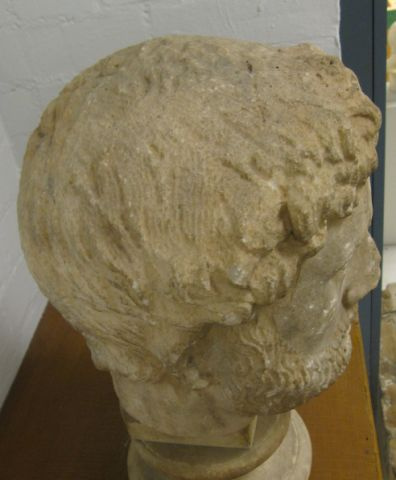
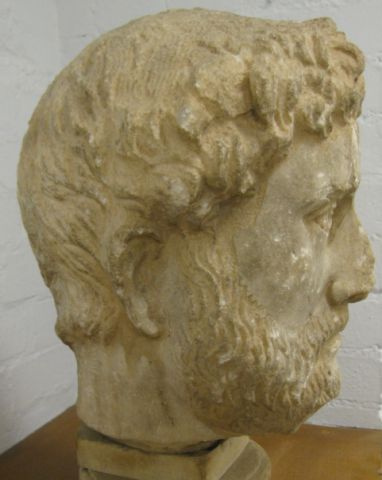
Re-cut portrait head of bearded man. From Ephesus. Late fourth to early fifth century.
Record details
Photographs
Bibliography
- Inan, J. and E. Rosenbaum, Roman and Early Byzantine Portrait Sculpture in Asia Minor, Oxford 1966, 142-3, no. 179, pl. 103.3-4
- Smith, A. H., A Catalogue of Sculpture in the Department of Greek and Roman Antiquities, British museum III. , London 1904, 176, no. 1947, pl. 19
Discussion
DESCRIPTION (Object)
Over life-size head. H: 29.5, W: 22.5 cm. Medium-grained white marble.
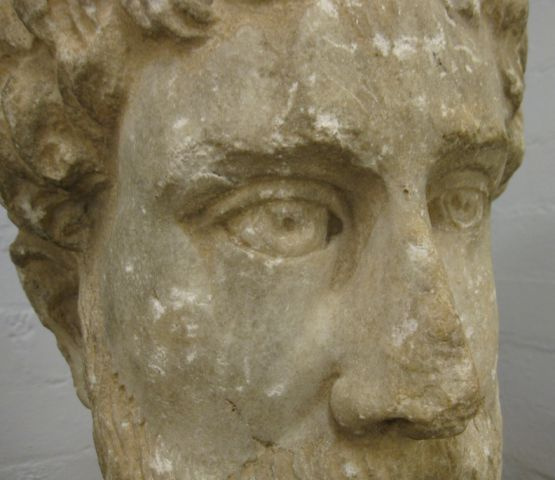
The head has broken diagonally through the neck; more of the left side of the neck is preserved. The tip of the nose is missing, and there is a chip in the chin and various smaller chips.
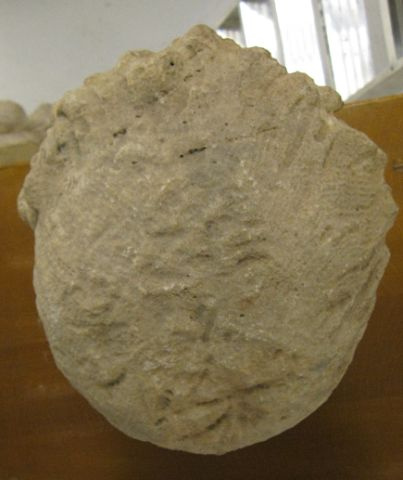
The head has been re-cut from an earlier portrait. The original hair was fuller and was taken down with a claw chisel, traces of which are visible on the sides and top of the head. The beard has also been worked over and cut into the flesh of the face, seemingly to make it more regular and uniform. The mouth has also been re-drilled. The pupil of the left eye is made of two separate drill points; another drill hole defines the inner canthus. Around the drill points of the pupil in the left eye are two engraved line. The pupil of the right eye has one large drill hole within a hollow surface and encircled by an engraved line, the iris. The right ear lobe has been awkwardly curtailed.
PROVENANCE
John Turtle Wood excavated at Ephesus for the British Museum between 1863 -1874. He was interested in finding the Artemision and concentrated his excavation efforts on it. There is however no precise find location given for this head.
DESCRIPTION (Subject)
The head shows a mature man of indeterminate age with a full but trimmed beard. His hair is combed forward and has more volume and curl around the face. He has irregularly and emphatically marked eyes.
DATE
The head has clearly been re-worked. Inan and Rosenbaum and Smith place the re-working in the period of Gallienus. This is not impossible but seems unlikely to this author.
The final product seeks to reproduce a hairstyle of the later fourth and earlier fifth century; the hair is brushed forward to the brow; it indents at the base of the neck; it gains curl and volume between the ears. This style is visible on the Obelisk of Theodosius in Istanbul, on the statue of Oecumenius, LSA-150, probably of the later fourth century at Aphrodisias, and in numerous other examples (see LSA-161, LSA-178, LSA-704). The use of the claw-chisel to create linear strands is a typical technical detail of such heads (see LSA-200 and LSA-460).
Cite: Last Statues of Antiquity, LSA-679 (J. Lenaghan).