
LSA-684
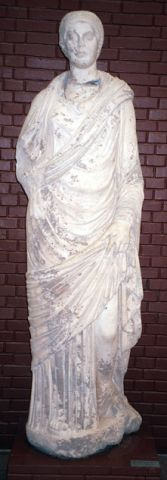
Portrait statue of draped woman with separately worked, re-cut head. From Ephesus. Fourth century?
Record details
Photographs
Bibliography
- Bammer, A., R. Fleischer, and D. Knibbe , Führer durch das Archäologische Museum in Selçuk-Ephesos, Vienna 1974, 27-9
- Quatember, U., Das Nymphaeum Traiani in Ephesos. Forschungen in Ephesos, XI,2, Vienna 2011, 67-8, no. 2, pl. 118.1-2
Discussion
DESCRIPTION (Object)
Over life-size statue. H: 2.04, W (of plinth): 60, D (of plinth): 47 cm. Medium-grained white marble.
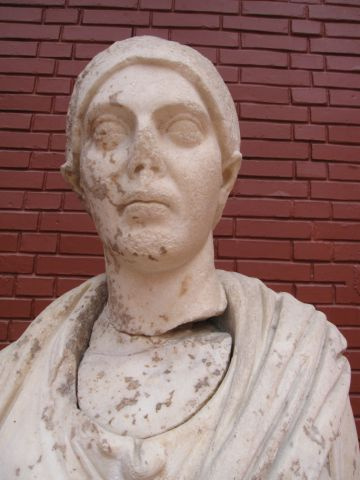
The head and neck have been worked separately from the body and inserted. The neck has broken at the base. The right forearm is missing.
Both head and body show signs of re-working. The eyes are, however, unmarked.
Body: (1) The plinth has been trimmed back around the left foot. (2) The right arm has been modified. The right forearm had to either be raised and holding an attribute of Ceres (for example, LSA-409) or folded across the chest (for example, LSA-1596 ) . The extant drapery, however, shows that it was mainly covered and held near the side. This seems to be a secondary solution for a broken raised arm. (3) The neckline has also been worked over. It is far too low and has been given an unusual sagging fold.
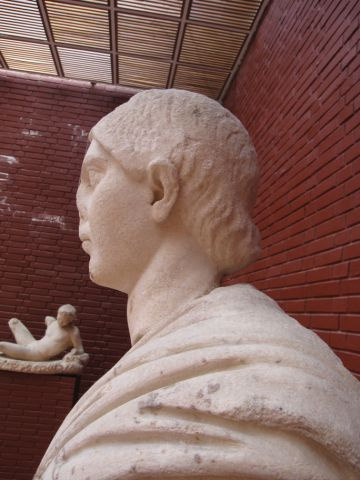
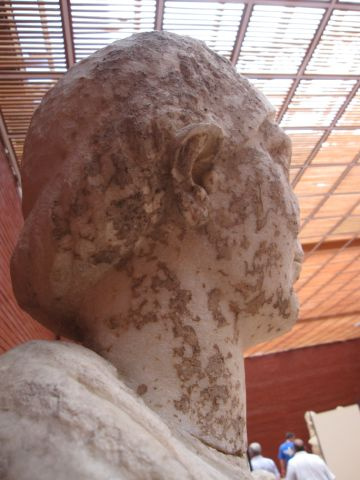
Head: (1) A ponytail at the back has been cut off so as to fit the head within the fold of the mantle. (2) At the front of the head, from ear to ear, behind the fringe, there is has a roughly worked surface. Previous scholars have assumed that this was for the attachment of stucco hair piece. On a separately worked head, this is unlikely to have been part of the original design. It is more likely to have been either a deliberate secondary removal of hair or a secondary preparation for a crown. (3) The fringe of the hair has been evenly cut back to form a smooth, almost 90 degree angle or shelf.
PROVENANCE
Found in the Nymphaeum Traiani, in front of the north niche of the east wall. Fleisher identifies the statue as Iulia Lydia Laterane because of the dedicatory inscription. The inscription (OJH 1959 p.329), dedicates the building to Artemis of Ephesus,Trajan and Ephesus before AD 114. Claudius Ariston, a three-time asiarch and neokoros with Julia Lydia Laterane, daughter Asia, archipriestess and prytaneis, erected the building. The sculpture found at the Nymphaeum, however, is disparate, and there is evidence for late-antique interventions in the structure and decoration; see Quatember, chapter 9. Significantly, the middle niche of the second storey carries an inscription for a late-antique governor.
DESCRIPTION (Subject)
The composite statue shows a woman in one of the three-most popular body types for portrait statues of Roman women, the ‘Ceres’ type (see, for example, LSA-409and LSA-2592). This statue however holds no attributes and has been considerably reshaped (see above, Discussion Object).
The head was made with large area of bare chest at the base of the neck. A socket has been cut through the drapery to fit this head. The head faces stiffly forward.
It shows a woman with regular features and no indication of age. The hair has been cut back to form a roll or wreath of long wavy locks around the back of the head. Around the front the hair lies flat and may have held a crown.
DATE
The head with unmarked eyes was made originally to represent a woman of the first century AD or even a goddess. It was never intended to be inserted into a Ceres statue type which generally has a high neckline that leaves little flesh at the base of the neck visible.
The statue with its thick rounded plinth might date to either the first or the second century AD. It however has been adjusted and put together at a later date.
The context suggests a refurbishment of the facade in the fourth or fifth century, and this statue should belong to that refurbishment.
Discussion references
- Atalay, E., Weibliche Gewandstatuen des 2. Jahrhunderts n. Chr. aus ephesischen Werkstätten, Vienna 1989, 97-8, no. 36, fig. 75
Cite: Last Statues of Antiquity, LSA-684 (J. Lenaghan).