
LSA-685
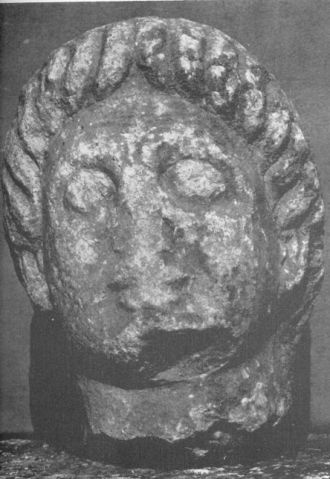
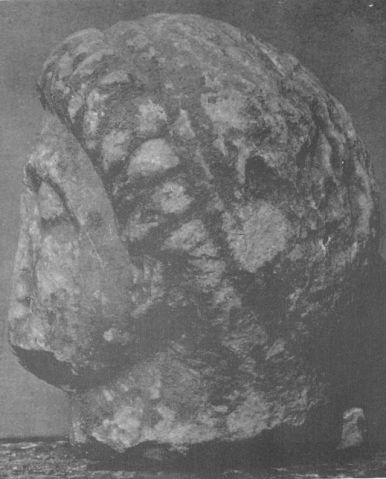
Portrait head of clean-shaven man (emperor?), wearing flat fillet (diadem?). From south of Ephesus. Fourth century.
Record details
Photographs
Bibliography
- Inan, J. and E. Rosenbaum, Roman and Early Byzantine Portrait Sculpture in Asia Minor, Oxford 1966, 148, no. 189, pl. 111.1-2
Discussion
DESCRIPTION (Object)
Life-size head. H: 31, W: 23,5, H (chin to crown): 24. Coarse-grained bluish-white marble. Broken through neck. Nose broken off. Much of chin missing. Mouth and area of eyes mostly destroid. Whole surface rough and encrusted. Back and top of head only summarily carved.
PROVENANCE
Found at Kirazlı, about 30 km south of Selçuk and 10 km east of Kuşadası, in a modern wall.
DESCRIPTION (Subject)
The subject wears a flat headband, and has clean-shaven cheeks that are smooth and without physiognomical modelling. Above the headband the hair is unworked. At the front, below the diadem, the hair falls forward onto the brow in an arched fringe of thick, centre-parted finger-like or banana-like locks. At the sides the hair seems to cover the tops of the rudimentary ears.
DATE
Inan and Rosenbaum compared the hairstyle and the total lack of modelling in the face with portraits from the second half of the fourth century. For them, the head is a very provincial work and therefore difficult to date closely.
The centre-parted hairstyle and plain youthful shaven features are most like those of Constantine, and the flat headband may well have been intended as an imperial diadem. The head is then probably best taken as a rough local reception of Constantine's diademed portrait image (the diadem was adopted as a new imperial insignia in 324).
Cite: Last Statues of Antiquity, LSA-685 (J. Auinger).