
LSA-687
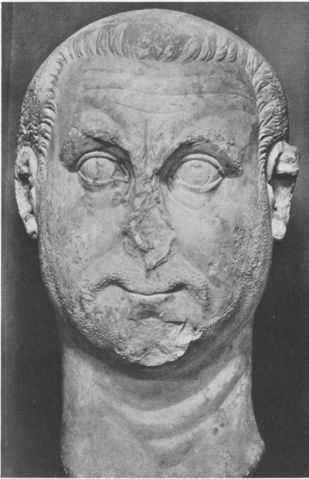
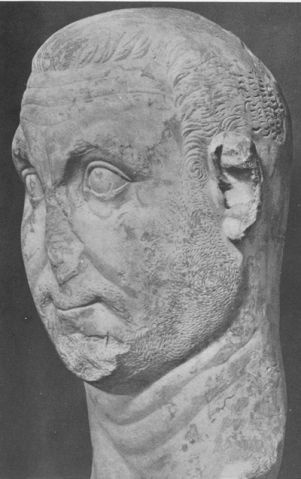
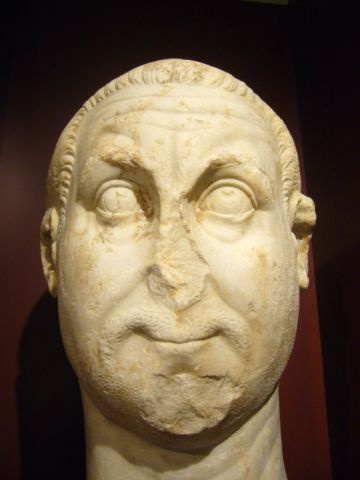
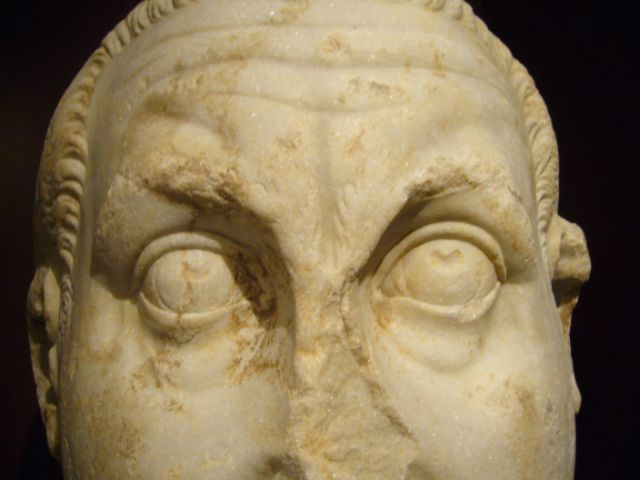
Colossal portrait head of Licinius (Vienna-Izmir type). From Ephesus. Early fourth century.
Record details
Photographs
Bibliography
- Inan, J. and E. Rosenbaum, Roman and Early Byzantine Portrait Sculpture in Asia Minor, Oxford 1966, 149-150, no. 191, pl. 175.1-2
- L'Orange, H. P., Studien zur Geschichte des spätantiken Porträts, Oslo 1933, 76-7, 144, no. 105, figs. 199-200
Discussion
DESCRIPTION (Object)
Colossal male head. H: 86, H (chin to crown): 58, W: 45,5, D: 46 cm. Coarse-grained, white marble with greyish veins.
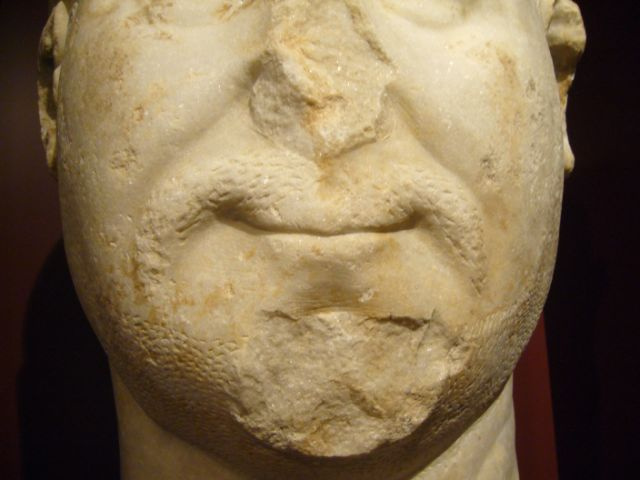
Missing chin, nose and outer helices of ears. Chips in various places.
Moustache and beard are rendered by minute chisel-strokes. Pupils are halfmoon-shaped, the irises are incised as very large three-quarter circles cutting into the curves of the lower lids. Lower neck is finished as a tenon for insertion in a statue. Rectangular dowel hole in the nape to fasten the head with the statue. Modern metal dowel above the nape in the hair. Crown of head was originally added separately as a shallow disk of marble.
PROVENANCE
Theatre of Ephesus, found in the central passage beneath the stage building, in 1897. The head once belonged to a statue of the central niches of the scaena.
DESCRIPTION (Subject)
Head of a man with a full, round and elder face on a long thick neck. Head is turned towards his right side.
The large round staring eyes are wide open and set close together. Rising arched eyebrows. High forehead is marked by three horizontal lines and deep vertical groove above the nose. His mouth is small, thin-lipped and the lips are pressed together. The corners of the mouth are turned up, seems to be smile. Two short grooves lead down from the corners of the mouth. Shallow grooves lead from the nostrils towards the corners of the mouth. He is wearing a light stubbled moustache and beard. The beard begins in front of the ears, which at the sides form rather ornate patterns.
Hair sits flatly on the head, short individual locks are brushed forward. Sharp angles over the temples. Over the forehead the fringe of short locks is arranged to turn in on both sides towards the centre inan axial-symmetrical arrangement.
Very tight, even contour around the neck where it joined the body indicates the head belonged most likely to a cuirassed figure.
DATE
At first L'Orange published the head, because of stylistical reasons he dated him at the end of his Theodosiasn-Honorian group, early fifth century. Kollwitz dated the head in the mid of the fifth century, comparsion to one head in the Louvre (LSA-591). In 1950 a second head of the same person was found at the agora of Izmir (325">LSA-325), they are replicas. Inan and Rosenbaum prefered the date of L'Orange for both heads at the beginning of the fifth century. For Oberleitner the head must be imperial because of his scale, it should represent emperor Marcian. Meischner was thinking about a date before the reign of Theodosius.
The most recent treatment (Smith, JRS 1998) has convincingly argued for an early fourth century date, and identification with Licinius I. (for the Identification and date see LSA-325).
Discussion references
- Kollwitz, J., Oströmische Plastik der theodosianischen Zeit, Berlin 1941, 130-1, pl. 44
- Meischner, J., 'Das Porträt der valentianischen Epoche,', Jahrbuch des Deutschen Archäologischen Instituts, 107 (1992), 217-34, pl. 87-91, 217-21, pl. 87
- Oberleitner, W. 'Fragment eines spätantiken Porträtkopfes aus Ephesos', Jahreshefte des Österreichischen Archäologischen Instituts in Wien 44, Vienna 1959, Oberleitner: 153-65, figs. 141-5.
- Smith, R.R.R.,'The public image of Licinius I: Portrait sculpture and imperial ideology in the early fourth century', JRS 87, 1997, 171-9, pls. 1. 2,1-3
Cite: Last Statues of Antiquity, LSA-687 (J. Auinger).