
LSA-688
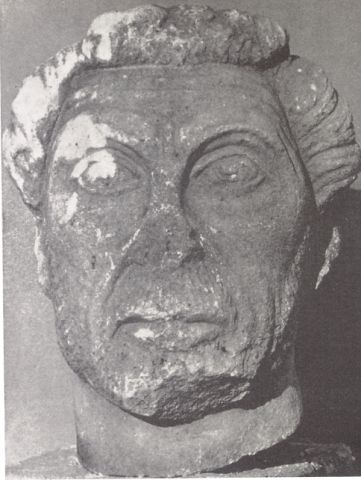
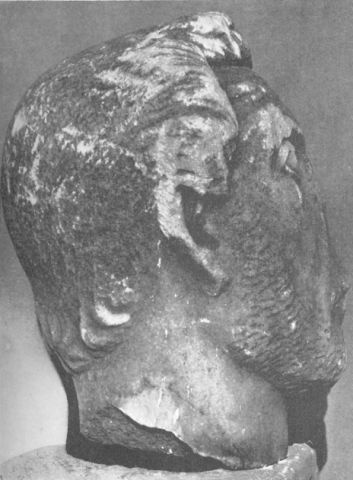
Portrait head of a man with stubble-beard. From Ephesus. Fifth century.
Record details
Photographs
Bibliography
- Alzinger, W. 'Zwei spätantike Porträtköpfe aus Ephesos', Jahreshefte des Österreichischen Archäologischen Instituts in Wien 42, Vienna 1955, 27, 36-42, fig. 22-23
- Inan, J. and E. Rosenbaum, Roman and Early Byzantine Portrait Sculpture in Asia Minor, Oxford 1966, 150-51, no. 192, pl. 179.1-2
Discussion
DESCRIPTION (Object)
Life-size head. H: 26,5, W: 20,5 cm. H (chin to crown): 22,5 cm. Coarse-grained white marble.
Head broken at neck. Left part of chin, nose, large chip from the right eyebrow and rims of ears are broken off. Here and there minor chips on hair and on various parts of face chipped off.
Top and back of the head treated with tooth-chisel. Roll above the forehead and alongside the temples have been carved in details, individual locks being indicated by long strokes of the chisel. Moustache and beard with short strokes of the chisel on a raised surface. The pupils are not drilled in but outlined by an incised line forming a circle. Irisis are incised in the shape of three-quarters of a circle.
PROVENANCE
The head was found in a field outside the Magnesian Gate and was brought by farmers in 1954.
DESCRIPTION (Subject)
Head of a man with a full growth of hair, brushed forward and forming a thick roll above the forehead and alongside the temples, and a flatter roll at the back. He has a stubbled short beard and moustache. Forehead with horizontal grooves, and between the eyebrows vertical grooves. Also deep naso-labial folds leading from the nostrils towards the corners of the mouth with thin lips. Eyes almond-shaped, eyebrows form highly arched ridges.
DATE
This portrait head forms together because of stylistic and technical reasons with other heads from Ephesos a portrait group (LSA-688, LSA-689). All of them with a very expressive expression.
Inan and Rosenbaum saw stylistic affinities with the Aphrodisias ‘magistrates’ (LSA-169 and LSA-170), especially the older one. But the workmanship of the Ephesus head is much cruder than that of the Aphrodisias magistrate. The head should be contemporary with the Aphrodisias portrait, so the second quarter of the fifth century. All other dates of scholars like Oberleitner (mid of the fifth century), Alzinger (425-450) and Sande (sixth century) are of stylistic reasons too.
Discussion references
- Oberleitner, W. 'Beiträge zur Geschichte der spätantiken Porträtplastik aus Ephesos', Jahreshefte des Österreichischen archäologischen Instituts in Wien 47, Vienna (1964-65), 16, 28-9, 34, no. 6, fig. 18
- Sande, S., 'Zur Porträtplastik des 6. Jhds n. Chr.,' , Acta ad archaeologiam et artium historiam pertinentia, 6 (1975), 65-166., 102-3, fig. 61
Cite: Last Statues of Antiquity, LSA-688 (J. Auinger).