
LSA-691
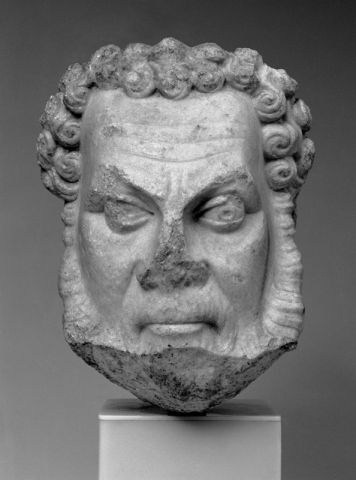
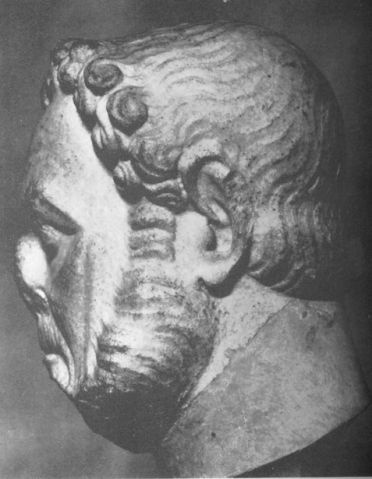
Portrait head of curly-haired man with full beard. From Ephesus. Fifth century.
Record details
Photographs
Bibliography
- Inan, J. and E. Rosenbaum, Roman and Early Byzantine Portrait Sculpture in Asia Minor, Oxford 1966, 153, no. 195, pl. 182,1-2
- Rodenwaldt, G., Griechische Porträts aus dem Ausgang der Antike, 76. Programm zum Winckelmannsfeste der Archaeologischen Gesellschaft zu Berlin, Berlin 1919, 21, 26-7, no. 14, fig. 10-11
Discussion
DESCRIPTION (Object)
Life-size head. H: 22,8, W: 13 cm. Medium-coarse-grained white marble with blue veins.
Broken off below mouth in irregular line and the right side of back of skull. The break including right ear. Greater part of nose and minor chips of eyebrows chipped off. Right eye destroyed.
Hair and beard chisel-work. The individual locks being rendered by long, shallow chisel-strokes.
Skin rasp-work. Pupils are drilled in the shape of a circle slightly flattened at the top, the iris are incised as three-quarters of a circle. Small drill-holes in the inner corners of the eyes.
PROVENANCE
From Ephesus.
DESCRIPTION (Subject)
Head of an elderly man. Hair consists of flat, wavy locks brushed forward and down towards the nape of the neck from one point at the back of the skull. Above the forehead and alongside the temples the hair forms two tiers of tight curls and in the nape of neck a flat roll.
High forehead with horizontal grooves and two vertical between the eyes. High arched eyebrows. Beard sticks out and begins at the level of the eyes.
Narrow eyes with heavy lids.
DATE
The head is part of the portrait-group around the head of Eutropius from Ephesus, in Vienna LSA-690. The heads from the group are linked together because of stylistic, formal and technical reasons. The centre of the production could be Ephesus (nearly every head was found there, except a bust near Izmir LSA-1084 and one head from the Agora in Izmir LSA-320).
There are only stylistical grounds in comparision with other heads (e.g. the head of the emperor from Barletta LSA-441) and some diptycha (for the curls above the forehead e.g. the diptychon of Boethius) to date all the heads from the group in the fifth century. The most scholars date the group in the mid or in the second half of the fifth century. Only Heintze dates the group earlier in the first half of the fifth century.
Because of the presence of the toga at the Balcova-bust maybe the date of the group could be earlier at the end of the fourth century (LSA-1084) .
Discussion references
- Auinger, J. 'Eine spätantike Togabüste aus Balçova', Jahreshefte des Österreichischen Archäologischen Instituts in Wien 72, Vienna 2003, 20-23
- L'Orange, H. P., Studien zur Geschichte des spätantiken Porträts, Oslo 1933, 86, 147, no. 116, figs. 219-20
- Meischner, J., 'Das Porträt der theodosianischen Epoche II (400 bis 460 n. Chr.),' , Jahrbuch des Deutschen Archäologischen Instituts, 106 (1991), 385-407, 386
- Oberleitner, W. 'Beiträge zur Geschichte der spätantiken Porträtplastik aus Ephesos', Jahreshefte des Österreichischen archäologischen Instituts in Wien 47, Vienna (1964-65), 16, 21-4, no. 3, figs. 11-12
Cite: Last Statues of Antiquity, LSA-691 (J. Auinger).