
LSA-696
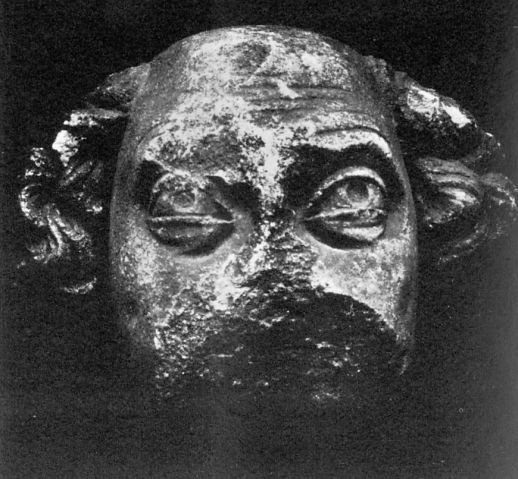
Upper part of portrait head of man with balding pate, wreath hairstyle, and inset pupils. From Ephesus. Fifth century
Record details
Photographs
Bibliography
- Inan, J. and E. Rosenbaum, Roman and Early Byzantine Portrait Sculpture in Asia Minor, Oxford 1966, 155-6, no. 200, pl. 186,3
- Oberleitner, W. 'Fragment eines spätantiken Porträtkopfes aus Ephesos', Jahreshefte des Österreichischen Archäologischen Instituts in Wien 44, Vienna 1959, 90. 92-93, fig. 65
Discussion
DESCRIPTION (Object)
Fragment of a portrait head.
Upper part of a head, broken off below the nose in an irregular line through the cheeks. Lower part of nose broken off. Right eyebrow chipped off, minor chips in various places.
Iris are incised as three quarters of a circle, large circular pupils.
PROVENANCE
Theatre.
DESCRIPTION ( Subject)
Upper part of a male portrait head of an elderly man. Bald at top, but curly locks at both sides of the face. High forehaed with horizontal grooves. Eyes almond shaped, lower lids descend to big tear sacs.
DATE
Stylistically Oberleitner compared the head with an head from Ephesus in Vienna LSA-694 and with the head of Stephanos LSA-698, chronological in iustinianic time. Inan and Rosenbaum followed Oberleitner, Sande dated him because of stylistical reasons at the beginning of the sixth century.
Discussion references
- Sande, S., 'Zur Porträtplastik des 6. Jhds n. Chr.,' , Acta ad archaeologiam et artium historiam pertinentia, 6 (1975), 65-166., 87ff.#, fig. 31
Cite: Last Statues of Antiquity, LSA-696 (J. Auinger).