
LSA-697
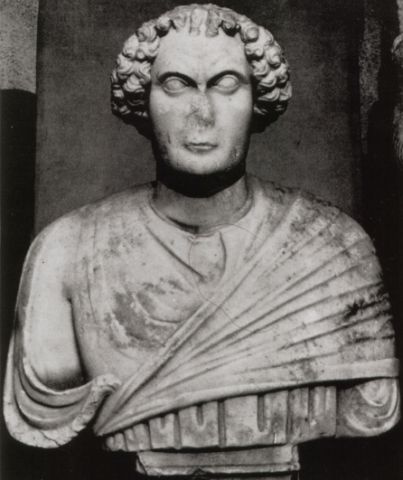
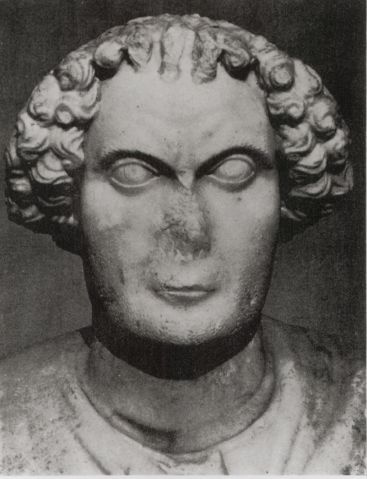
Togate bust of man with curly hair. From Ephesus. Fifth century
Record details
Photographs
Bibliography
- Inan, J. and E. Rosenbaum, Roman and Early Byzantine Portrait Sculpture in Asia Minor, Oxford 1966, 156-157, no. 201, pl. 184.2, 185.3-4
- Oberleitner, W. 'Fragment eines spätantiken Porträtkopfes aus Ephesos', Jahreshefte des Österreichischen Archäologischen Instituts in Wien 44, Vienna 1959, 87-88, 93-94, 97, fig. 63-64
Discussion
DESCRIPTION (Object)
Life-size bust. H: 68,5, H (chin to crown): 21, H (foot): 13, W: 50,5 cm. Fine to medium-grained white marble.
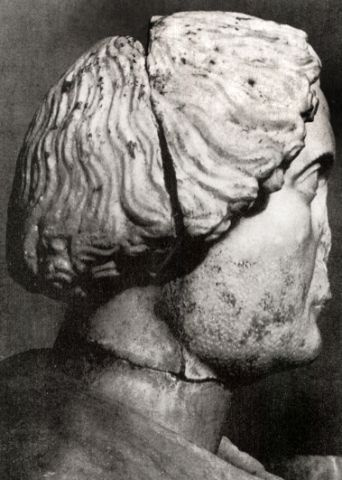
The bust is preserved in 3 parts, the front and back of the head, and the bust itself. The nose and the ends of the locks in the middle of the forehead are chipped of. The major part of the foot of the bust on the right side is broken off, supplemented in concrete.
The hair is deeply drilled around the face. Iris are renderednas circular disks, pupils not indicated. Drill-holes in the inner corners of the eyes. Beard and moustache pecked.
The bust was made in one piece from the head to the foot of the bust. The front of the bust is highly polished. The back of the bust is hollowed with spin in the middle - tooth chisel.
PROVENANCE
Found in 1956 and 1958, in the stairway leading to the Baths of Scholasticia from Kuretes-Street.
DESCRIPTION (Subject)
Man of mature year, wearing the late antique toga. Long waved locks are brushed forward and down towards from the middle of the top. On both sides of the face the locks form tight curls puffed out at the sides in two rows and stretched into corkscrews above the forehead. Eyes almond shaped. Mouth with thin lips.
Lower edge of the bust below the chest. He wears a late antique toga over the colobium . Toga draped in the typically late fashion with the contabulatio spread out over the left shoulder, narrow folds. Vertical folds below are very stiff and schematised.
DATE
Stylistic reasons lead Oberleitner to a iunstinianic date, he compared the hairstyle and the pecked beard with the high officials on the mosaics in Ravenna. For Inan and Rosenbaum there seems to be a kind of classicistic trend in Justinianic art, like the Barberini Diptych. So the bust seems to be one of the masterpieces of Justinianic art. Özgan and Stutzinger dated the bust at the end of the fifth century.
Compare with another bust from Ephesus LSA-707.
Discussion references
- Özgan, R. and D. Stutzinger. 'Untersuchungen zur Porträtplastik des 5. Jhs.n.Chr. anhand zweier neugefundener Porträts aus Stratonikeia. ', Istanbuler Mitteilungen 35, Istanbul 1985, 253-4, 271ff.#, pl. 53.4
Cite: Last Statues of Antiquity, LSA-697 (J. Auinger).