
LSA-698
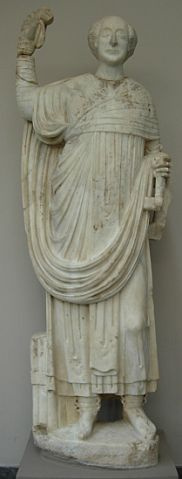
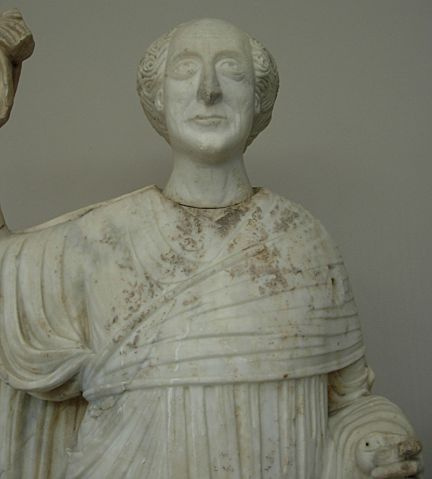
Togate statue with separately worked head, perhaps of Stephanus, proconsul of Asia. From Ephesus. Fourth to sixth century.
Record details
Photographs
Bibliography
- Inan, J. and E. Rosenbaum, Roman and Early Byzantine Portrait Sculpture in Asia Minor, Oxford 1966, 157-8, no. 202, pl. 178,4. 186,4
- Oberleitner, W. 'Fragment eines spätantiken Porträtkopfes aus Ephesos', Jahreshefte des Österreichischen Archäologischen Instituts in Wien 44, Vienna 1959, 86, 90, 92-93, 97, 99-100 figs. 60--62
Discussion
DESCRIPTION (Object)
Overlife-size togate statue. H: 202 cm. Medium-grained white marble with greyish blue veins.
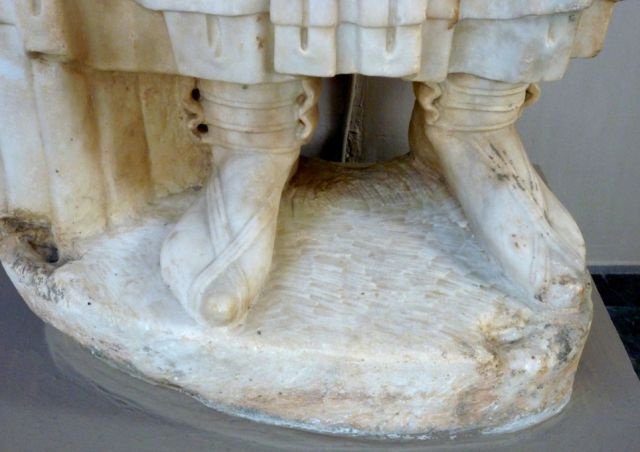
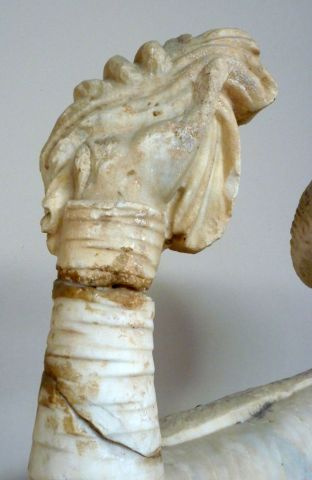
Head separately worked and insert. Preserved in a good condition, only parts of the plinth with the left heel, the upper part of the sceptre and three fingers of the left hand are broken off. Break trough the right ankle of the hand. Tip of the nose is chipped off.
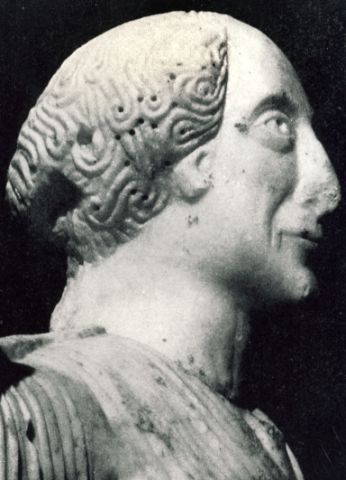
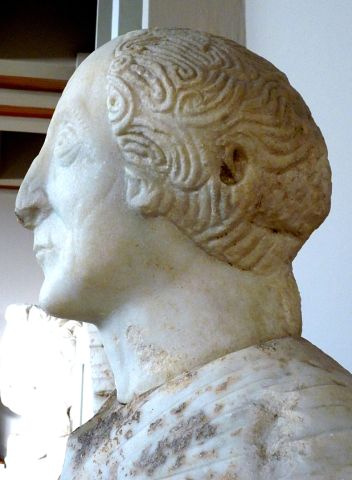
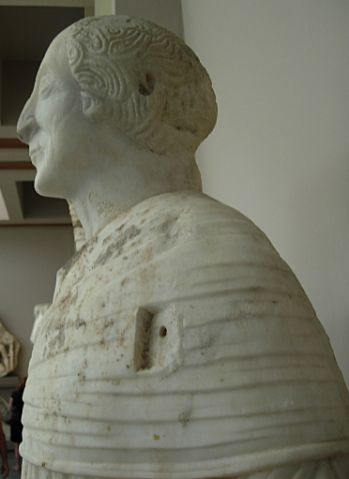
Drill holes in the hair. Pupil in the shape of a circle drilled. Hair of eyebrows chiseled. Clamb-holes on the top of the plinth, to fix with the base. For the upper part of the sceptre small square cutting with a fixing-hole in the middle in the mid of the upper arm. Two fingers of the left hand have fixing-holes too. Back of the statue rough smoothed.
PROVENANCE
Embolos, east end on the north side, in front of the stoa, found in 1957.
Found in front of a base with an inscription for Stephanus LSA-732.
DESCRIPTION (Subject)
Statue of a standing man in mature age. Figure stands with weight over the right leg. The right arm is raised holding the <mappa>. The left forearm is projecting, holding a sceptre. A bundle uppright scrolls supports the statue of the right leg. He wears the senatorial calcei with the crossed straps directly over the foot and their ends falling near the ankles.
The statue wears a late antique toga over two tunics: a long-sleeved (the tunica manicata ), and, over it a slightly shorter colobium . The toga's lower edge, the sinus, hangs along the right side of the body until the knee and is then draped over the left arm. The long-sleeved under-tunic is visible on the right arm and at the shins. The colobium appears at the right chest and below the lower curve ot the sinus.
Separately worked head. Neck in shape of a truncated cone. Man with bold plate, beside the temples and at the back of the head the hair puffs up in long curly locks, in the shape of snails. Head is re-cut from a much more bigger head, on both sides auricles are visible.
Whole head has graphic elements. High forehead with some shallow horizontal grooves. High arched eyebrows in the shape of nearly a half-circle with regular vertical single hairs. Almond-shaped eyes are small but with big round pupils. Heavy #Tränensäcke#. Long thin nose. Mouth with thin lips, with a slight smiling. #Spitz zulaufendes# chin with a small vertical fold in the mid.
DATE
The Stephanos is the only example from Ephesos, where a late antique statue was found together with the base (LSA-732). The dating of the single parts of the monument is very controversial.
Miltner who found the ensemble, dated the inscription in the fourth century and so the torso with the head too. Since Oberleitner's stylistical research we know that the head is later, at the beginning of the sixth century (also Sande). But he put the torso in the sixth century too. Foss acclaims Oberleitners dating of the statue and saw the inscription in the sixth century.
But since Feissel's study of the Stephanos inscriptions of Ephesos we know, that the inscription must date around 410.
So the inscription of the base is around 410, the torso from the stylistic point of view later than the inscription and the reworked head at the beginning of the sixth century.
Discussion references
- Auinger, J. 'Zum Umgang mit Statuen hoher Würdenträger in spätantiker und nachantiker Zeit entlang der Kurenstrasse in Ephesos', Vienna 2009, 33-5, fig. 8-9
- Bammer, A., R. Fleischer, and D. Knibbe , Führer durch das Archäologische Museum in Selçuk-Ephesos, Vienna 1974, 85-6
- Foss, C., Stephanus, Proconsul of Asia and Related Statues, History and Archaeology of Byzantine Asia Minor
, (Reprint ed. p. III) Aldershot 1990, pp. 196-219, 196-218 - Goette, H.R., Studien zu römischen Togadarstellungen, Mainz 1990, 63. 147, no. E13, pl. 45,6
- Sande, S., Zur Porträtplastik des sechsten nachchristlichen Jahrhunderts, Institutum Romanum Norvegiae, Acta ad archeologiam et artium historiam pertinentia 6, Roma 1975, 65-106, 85-7, fig. 26. 27
Cite: Last Statues of Antiquity, LSA-698 (J. Auinger).