
LSA-701
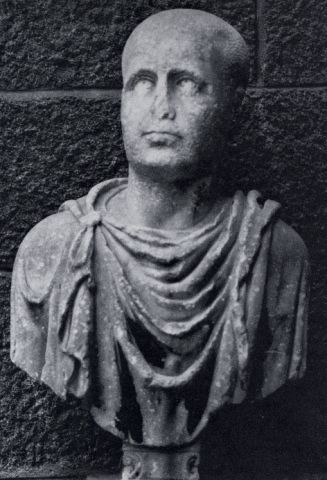
Portrait bust of man with short cropped hair and stubble beard in cloak. Ancyra (Galatia). Later third century.
Record details
Photographs
Bibliography
- Inan, J. & E. Alföldi-Rosenbaum, Römische und frühbyzantinische Porträ̈tplastik aus der Türkei : neue Funde, Mainz 1979, pl. 189
- Inan, J. and E. Rosenbaum, Roman and Early Byzantine Portrait Sculpture in Asia Minor, Oxford 1966, 210-211, no. 292 (mid-third century)
Discussion
DESCRIPTION (Object)
Over life-size bust. H: 86, W: 46.5 cm. H (head and neck): 32.5, H (head to crown): 25 cm. Fine-grained white marble.
The head, bust, and cylindrical bust support were worked in one piece of marble. The back of the bust is hollowed out and has a spine. The tip of the nose, the ear lobes, and some crests of folds are chipped.
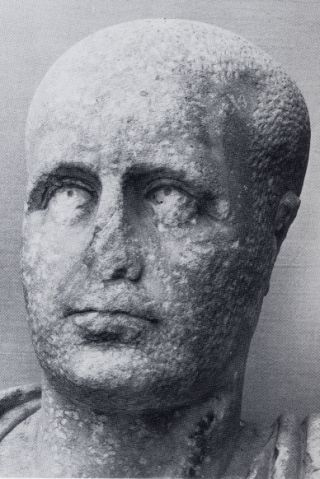
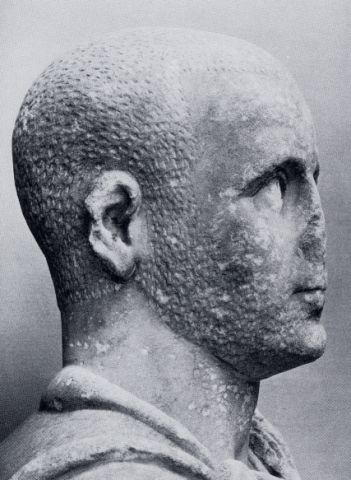
The head has been re-cut from an earlier portrait. The hair and beard have been taken down to a lightly raised surface on which repetitive chisel strokes indicate hair. The ear lobes were probably reduced in the cutting and in any case now sit too close to the head. The upper lip is flat and poorly defined, once having been covered with a full moustache. The eyes have been given single drill holes to indicate the pupils. Possibly the folds immediately below the neck line were also worked over.
PROVENANCE
Found in Ankara
DESCRIPTION (Subject)
The portrait bust shows a man who looks up and to his right. He wears a cloak fastened by a round fibula on the right shoulder and an inner garment below.
The man wears a close-cropped hairstyle and a stubble beard. His mature age is signalled mainly by the bags beneath the eyes which have been carefully modelled. In contrast, the naso-labial folds are not deep, and there are no prominent creases across the brow. The re-cutting and the lack of distinction between the tall brow and the short hair behind it give the impression of large swelling skull. This is accentuated by the drooping eyebrows set over narrowly-spaced eyes.
DATE
The beard and hairstyle of this head place it securely in the second half of the third century. Inan and Rosenbaum place it around the middle of the century on the basis of comparisons to portraits of Trajan Decius (AD 249-251) and Trebonius Gallus (AD 251-53). The portrait traditionally believed to represent Decius (now in the Capitoline) is far more expressive and has a different beard style.
The coin portraits of Trebonius Gallus and his immediate successor Aemilianus (AD 253) do bear some similarities. The portraits of the Tetrarchs (284-324), however, wear this same short beard and hairstyle and had a greater longevity. The frozen, inorganic, and block-like aspect of this head is a stylistic quality most often associated with the portraits of the Tetrarchs.
This is portrait is emblematic of the difficulties in dating portraits which wear this military style and which have been re-cut.
Cite: Last Statues of Antiquity, LSA-701 (J. Lenaghan).