
LSA-704
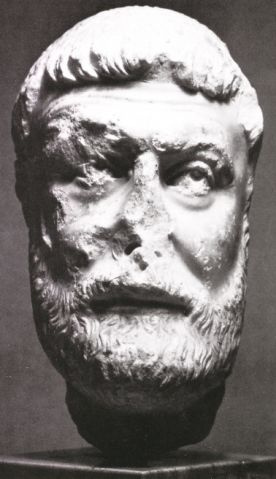
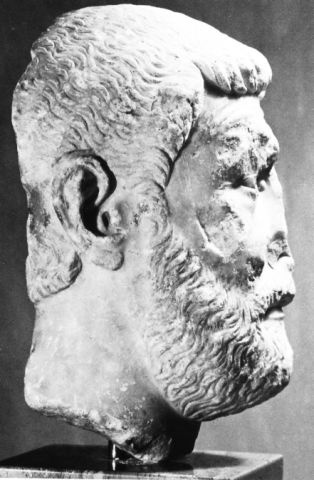
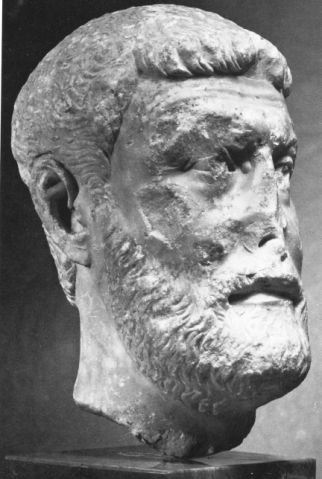
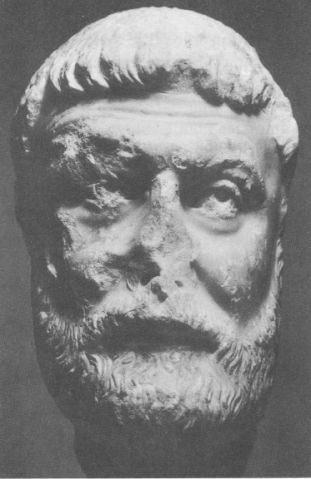
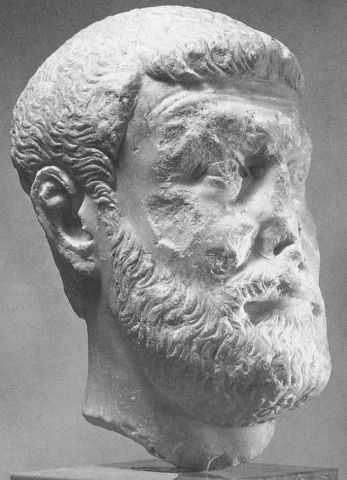
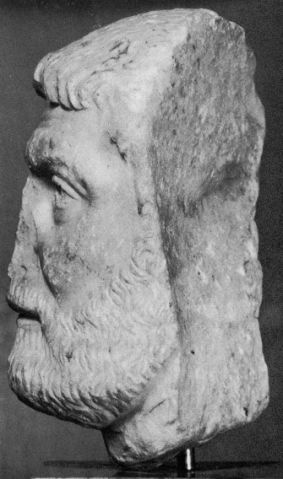
Portrait head of full-bearded man. From Ephesus. Later fourth century.
Record details
Photographs
Bibliography
- Metzler, D. 'Ein Meisterwerk spätantiker Porträtkunst', Archäologischer Anzeiger , Berlin 1969, 195-203, figs. 1-4
Discussion
DESCRIPTION (Object)
Over life-size head. H: 29, H (chin to crown): 24 cm. Grey white, fine-grained marble.
The front of the head is preserved from the middle of the neck to the top of the head. The back has broken off from in front of the left ear to c. 5 cm behind the right ear. The preserved bottom edge of the neck seems very regular and has either been smoothed down to make a better sale or was possibly worked in antiquity to be dowelled into a statue. The nose is broken, and the right eyebrow is badly battered. There is a chip in the right cheek.
The hair of the head, eyebrows, beard, and moustache have been rendered primarily with a chisel. The irises are marked by semi-circular lines of a flat chisel, and the pupils are deeply drilled large holes in a ‘pelta’ shape that touch the upper lids.
PROVENANCE
Purchased near Ephesus.
DESCRIPTION (Subject)
The head turns to its left. It depicts mature man with hair combed forward and a full but tidy beard and moustache.
The hair is combed forward onto the brow in short curving locks. It maintains a uniform volume over the entire head. Across the brow the hair bends to the left, and at the right temple there is a small part. The beard is composed of regular curving strands which match those of the head hair. The beard and the moustache cover the cheeks and upper lip fully.
The face has a rectangular shape with a broad U-shaped chin. The brow is low and features two creases. Both eyebrows flare over the outer eye. The eyes are emphatically marked and look to the left. There are fine lines at the outer corners.The flesh below the eyes is modelled, and the naso-labial folds are pronounced.
IDENTIFICATION AND DATE
The head depicts a private individual. It wears a fashion style that was popular in the second half of the fourth century (Obelisk of Theodosius). Several other male portraits show mature men with the same basic fashion style and are carved in a similar ‘late’ manner. These include LSA-150, LSA-178, LSA-380, LSA-960, LSA-961, and LSA-1721. Of these examples, only LSA-150, the Oecumenius of Aphrodisias, has a date based on external evidence. The inscription of his base seems to belong in the later fourth century.
Discussion references
- Inan, J. & E. Alföldi-Rosenbaum, Römische und frühbyzantinische Porträ̈tplastik aus der Türkei : neue Funde, Mainz 1979, no. 153
Cite: Last Statues of Antiquity, LSA-704 (J. Lenaghan).