
LSA-705
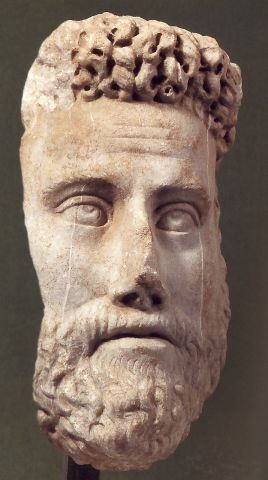
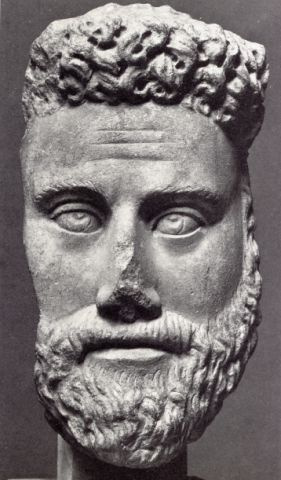
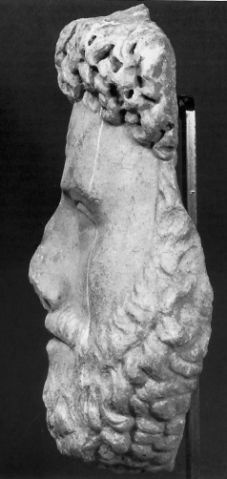
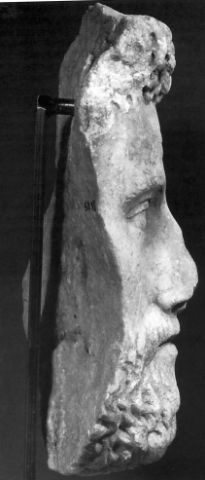
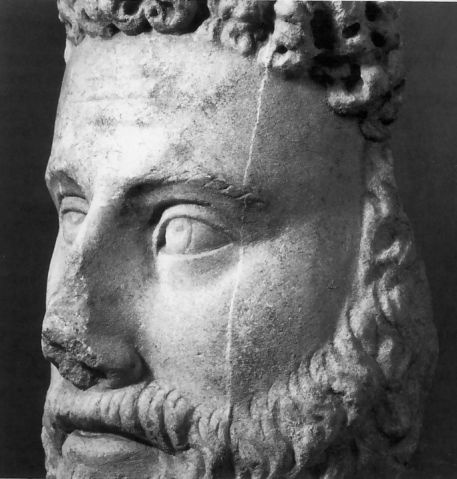
Portrait head of bearded man and wreath hairstyle. From Asia Minor. Late fourth to early fifth century.
Record details
Photographs
Bibliography
- Inan, J. & E. Alföldi-Rosenbaum, Römische und frühbyzantinische Porträ̈tplastik aus der Türkei : neue Funde, Mainz 1979, 188-9, no. 154, pl. 254.3-4 (W. Oberleitner: mid 5th c.)
- Strocka, V. (ed.), Römische Bildnisse : Porträts der Berliner Antikensammlung in Freiburg , Munich 2000, 203-214, no. 18 (C. Schmidlin: re-working of later 5th c.)
Discussion
DESCRIPTION (Object)
Over size head. H: 34, W: 18 cm. Large-grained grey marble (from Belevi, characterized by vertical veins: Oberleitner in Inan and Rosenbaum)
.
The head is broken vertically from behind the brow hair down to the back of the mandible. The nose is chipped.
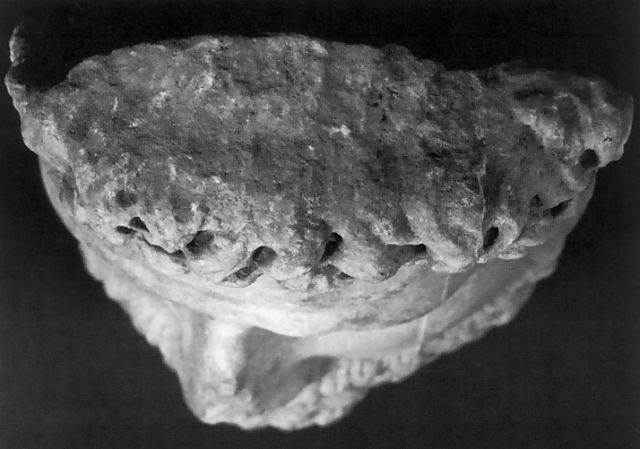
The pupils of the eyes are marked by U-shaped drill channels. The irises are engraved and oval in form with the long side on the vertical axis. There is ample drill work in the hair over the brow.
The head has probably been re-cut from an earlier portrait; see C. Schmidlin.
PROVENANCE
In 1880s purchased in Asia Minor (near Ephesus) by a collector in Heidelberg. Sold to Berlin Museum in the 1930s.
DESCRIPTION (Subject)
The portrait bust shows a man with a full beard, a full moustache, and full hair. The hair is brushed forward and forms a stack of two to three tiers of curls over the brow. The face is full; the eyes are relatively small but with large markings; and the brow is marked by three engraved lines which are stiff and short.
DATE
The fashion style of beard and hair, the drilling of the brow hair, and the rendering of the eyes are similar to those of the portrait of Oecumenius LSA-150 from Aphrodisias and LSA-869 from Cyprus. Oecumenius, identified by his base at Aphrodisias, should be dated to the late fourth or early fifth century. Such a date seems well-confirmed by the Obelisk of Theodosius in Istanbul on which this fashion style is attested.
Examples of similarly styled portraits are LSA-445, LSA-450, and LSA-2282, all from Asia Minor.
Cite: Last Statues of Antiquity, LSA-705 (J. Lenaghan).