
LSA-708
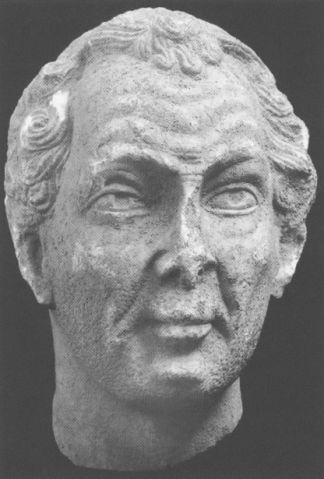
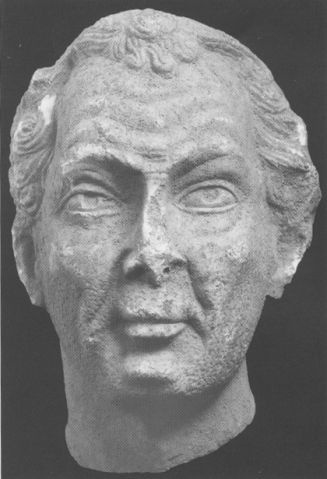
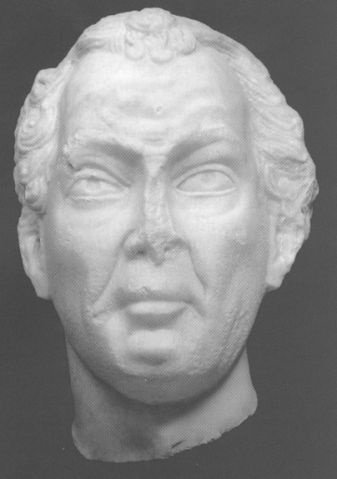
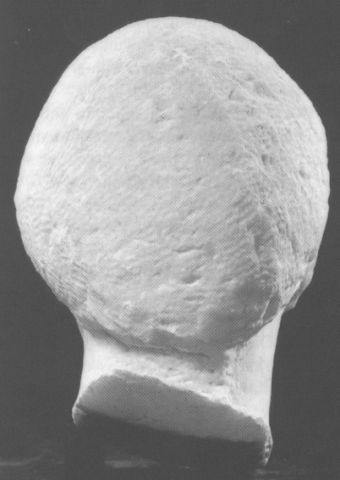
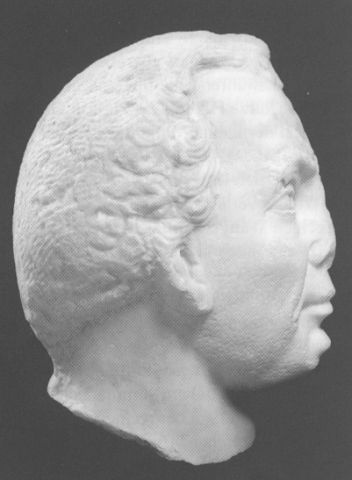
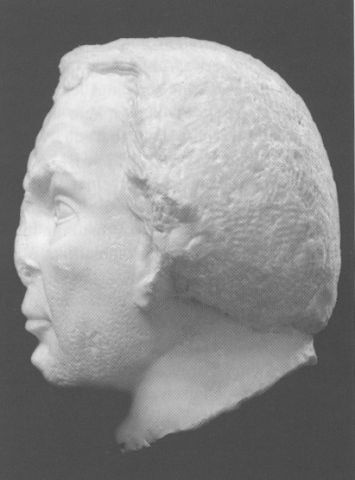
Re-cut (?) portrait head of man with wrinkled brow, small chin, and unworked back. From Ephesus. First half of fifth century.
Record details
Photographs
Bibliography
- Aurenhammer, M. 'Drei neue römische Porträtköpfe von der Tetragonos Agora in Ephesos.', Jahreshefte des Österreichischen Archäologischen Institutes in Wien 69 , Vienna 2000, 25-33, fig. 13-18
Discussion
DESCRIPTION (Object)
Overlife-size male portrait head. H: 34,5, H (chin to crown): 30, W: 23,6, D: 27,2 cm. Greyish-blue, coarse-grained marble.
Head broken at the lower edge of neck. Nose, some minor chips from the hair and rims of the ears broken off. Smaler damages on the upper lip, forehead, cheeks and the right eyebrow with orbital and upper lid.
Neck at the front and on both sides, face and the hair around it are totally finished with polished surface. Back and top of the head have been rounded and smoothed wit chisel and tooth-chisel. Vertical strip at the back-side of the neck rough chiselled. Pupils are drilled in the shape of a circle slightly flattened at the top. The beard and moustache are pecked.
PROVENANCE
Tetragonos Agora, in a drain, found in 1998. Found in the last layer at the top of the drain. After the drain was abonded, the haed was deposited there.
DESCRIPTION (Subject)
The head was turned to his left side. The long face attracts attention because of a lot of asymmetric details. High forehead with three dominant horizontal wrinkles, following the shape of the eyebrows. Small horizontal wrinkles between the eyebrows. Eyes are narrow and almond-shaped, the left eye is wider open. Above the upper-lids heavy orbitals.
Nose narrow and short, mouth small. High filtrum between nose and mouth. Deep naso-labial folds, flesh of cheeks retained there. Prominent cheekbones. Chin small and #spitz hervorspringend#. He wears a moustache and a beard.
Hair only direcetly around the the face worked out. Three curls falling in the middle of the forehead, on top of the three curls a bigger one. On both sides big, brushed back curls frame the face.
DATE
Aurenhammer links the head because of some stylistic details with other ephesian portrait heads, summarised in the "Exressive Gruppe" (LSA-688, LSA-689, LSA-702). Maybe a link between the workshops exist.
But the head is much more naturalistic and has a totally unknown coiffeur for late antique portraits in Ephesus. Because of the naturalistic style Aurenhammer compares the head with a male bust from Statonikeia LSA-447. Aurenhammer dates the head from the Agora near the two "magistrates" from Aphrodisias (LSA-169, LSA-170), in the first half of the 5th century.
Cite: Last Statues of Antiquity, LSA-708 (J. Auinger).