
LSA-710
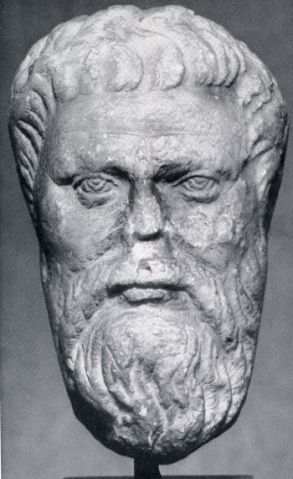
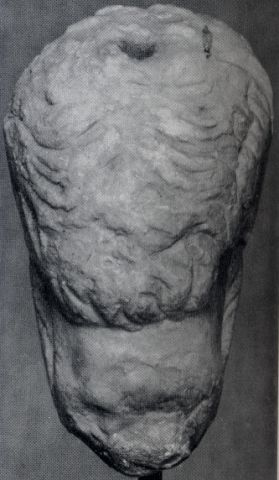
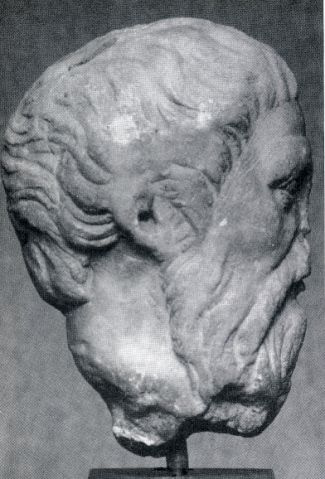
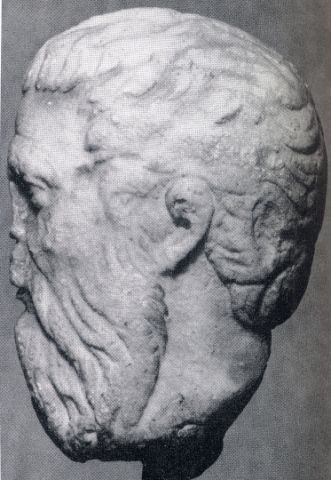
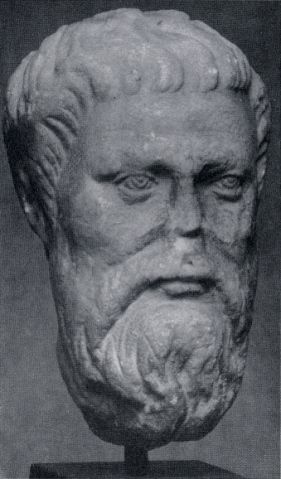
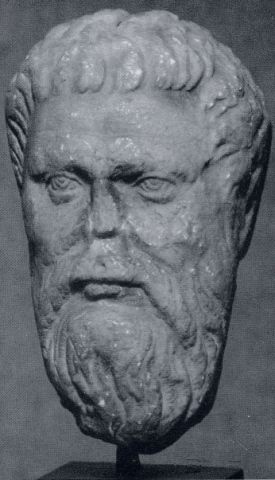
Under life-size portrait head of Plato. Unknown Provenance, possibly Asia Minor. Fourth or fifth century.
Record details
Photographs
Bibliography
- Heintze, H. von 'Studien zur Griechischen Portätkunst', Mitteilungen des Deutschen Archäologischen Instituts, Römische Abteilung 71, Heidelberg 1964, 81-103, pls. 19-21
- Richter, G.M.A., The Portraits of the Greeks, London 1965, 167, no. 23
Discussion
DESCRIPTION (Object)
Under life-size head. H: 18.5, W: 11 cm. White-grey alabaster (von Heintze: from Cappadocia).
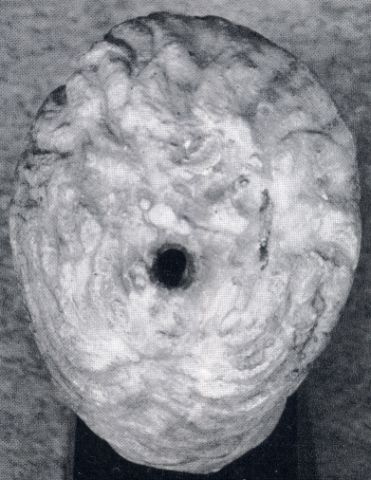
The head has broken off near the base of the neck. Size and a hint of a spine (?) suggest that this was once a bust. The nose is mainly missing, and there is a hole in the top of the head which may be modern.
The eyes have been marked by concentric engraved semi-circles.
PROVENANCE
According to von Heintze it is from Asia Minor. This seems mainly based on her assessment of the marble.
DESCRIPTION (Subject)
The head is a recognizable version of the portrait type of Plato (compare, especially LSA-712, as well as LSA-908and LSA-2537). He wears a long beard, long moustache, and short hair. The details of the hair, however, adhere only loosely to those of the original model. The hair is combed forward from the back to the front, and the fringe crosses the brow in an even line with the locks ever so gently curving to the right. The brow is broad, and the cheekbones wide-set.
DATE AND HONORAND
The eye-markings and loose replication of the original model suggest a date in the fourth or fifth century for this version of Plato. Von Heintze places it in the first quarter of the fourth century.
Portraits of famous past intellectuals were popular in late antiquity; see, for example, the series of tondi portraits from a late house in Aphrodisias (LSA-206 , LSA-207, LSA-208, LSA-209, LSA-210, LSA-211, LSA-212, LSA-213, and LSA-214).
The head seemingly bears technical similarities (in the rendering of the eyes and cheekbones) to LSA-64.
Discussion references
- Danguillier, C., Typologische Untersuchungen zur Dichter- und Denkerikonographie in römischen Darstellungen von der mittleren Kaiserzeit bis in die Spätantike, Oxford 2001, 256, no. 34 (early fourth c.)
Cite: Last Statues of Antiquity, LSA-710 (J. Lenaghan).