
LSA-711
Lost fragment of base for statue of Honorius, emperor. Ephesus (Asia). 393-423
Record details
Photographs
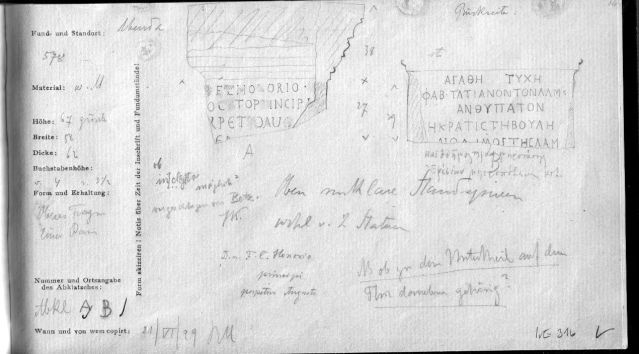
Inscription
[D(omino)] n(ostro) Fl(avio) Honorio, / [d]octo principi, / [pe]rpetuo Aug[usto], / [semp]er [triumphatori]
Inscription translation
To our lord Flavius Honorius, learned ruler, perpetual Augustus, forever triumphant.
Bibliography
- Wankel, H. et al., Die Inschriften von Ephesos II. Inschriften griechischer Städte aus Kleinasien vol. 12, Bonn 1979, 116, no. 316
Discussion
INSCRIPTION
In four lines:
[D(omino)] n(ostro) Fl(avio) Honorio, / [d]octo principi, / [pe]rpetuo Aug[usto], / [semp]er [triumphatori].
'To our lord Flavius Honorius, learned ruler, perpetual Augustus, forever triumphant.'
Letter height 3.5 - 4 cm.
DESCRIPTION (from Inschriften von Ephesos)
Fragment of reused base: H 67, W 58, D 62 cm. White marble.
Upper part of a monolithic rectangular base, broken and lost below line 4. Crown moulding with fine and multiple profiles. Front side broken, profile on right side largely preserved. Our inscription to Honorius is carved on what was originally the back of the base; on the original front is an inscription to the proconsul Fabius Tatianus, 100-130 A.D. (Inschriften von Ephesos, no. 666C). On the top face there are various cuttings, among them the settings for the feet for two bronze statues; no doubt the earlier for Tatianus and the later for Honorius.
PROVENANCE AND CURRENT LOCATION
The inscription was first recorded in 1899 by R. Heberdey on the Arcadiane, west of the East gate. Its present location is unknown.
HONORAND AND DATE
Flavius Honorius (384-423), younger son of Theodosius I, was Augustus 393-423. After his father's death in 395, he became ruler of the western part of the Roman Empire. The dating of our dedication cannot be narrowed further than his emperorship, the circumstances of the honour being unknown.
Discussion references
- Roueché, C. 'The Kuretenstrasse: the Imperial Presence in Late Antiquity', Neue Forschungen zur Kuretenstrasse von Ephesos : Akten des Symposiums für Hilke Thür vom 13. Dezember 2006 an der Österreichischen Akademie der Wissenschaften, Vienna 2009, 161-2
- Sironen, E. , 'Life and administration of late Roman Attica in the light of public inscriptions'
P. Castrén, Post-Herulian Athens : aspects of life and culture in Athens, A.D. 267-529 , Helsiniki 1994, 15-62
Cite: Last Statues of Antiquity, LSA-711 (A. Sokolicek).