
LSA-712
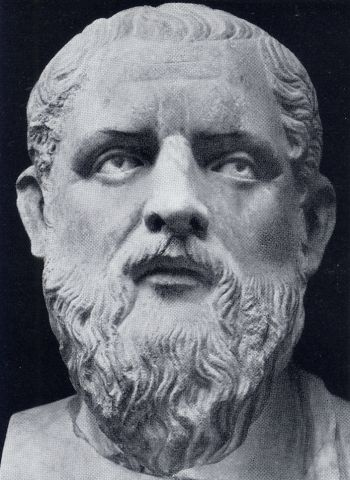
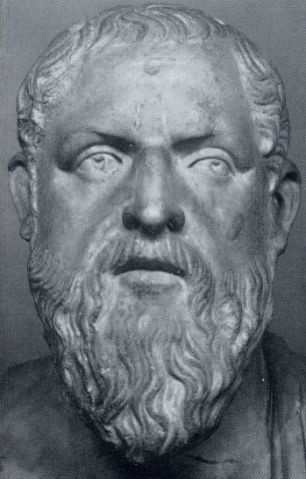
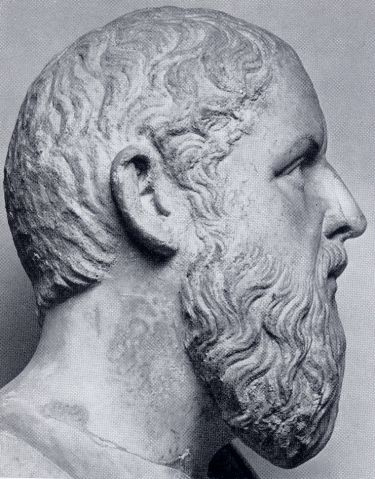
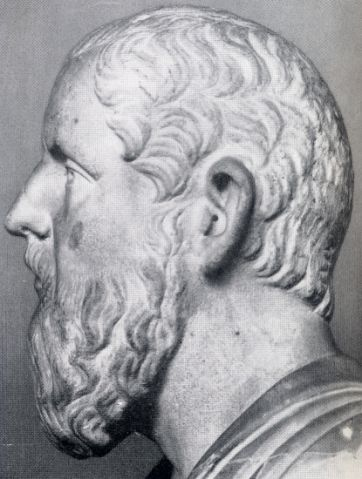
Portrait head of Plato set on herm. Italy. Fourth century.
Record details
Photographs
Bibliography
- Lippold. G., Die Sculpturen des Vaticanischen Museums. Band III, Berlin 1956, Part 2, 462-3, no. 22 pl. 199
- Richter, G.M.A., The Portraits of the Greeks, London 1965, 168, no. 6*, fig. 962-3 (doubts identification)
Discussion
DESCRIPTION (Object)
Over life-size head. H: 56, H (from crown to end of beard): 33 cm. Greyish Italian? marble (Lippold).
The head has broken through the base of the neck. It has been re-set on a herm. The nose is restoration
The hair is rendered with a flat chisel. The hair at the back of the head is only schematically worked. The pupils are deep, drilled, and crescent-shaped.
PROVENANCE
Not specified in the Vatican catalogue but presumably from Rome or the area around it.
DESCRIPTION (Subject)
The head, which turns to its left, is a recognizable version of the portrait of Plato (see also LSA-710 ,LSA-908,LSA-2537). He wears a long beard, long moustache, and short hair, the fringe of which curves to his right. In comparison to other portraits of Plato, the hair behind the ears and the hair over the brow fall in short locks. There are two lines across the brow and two vertical creases rise over the nose. The eyes are heavily marked; the cheeks hang loosely; the mouth is short from side to side. The lines of the cheeks and around the mouth are asymmetrical and animate the face in an unexpected manner.
The herm wears a himation over the left shoulder.
DATE
The carving of the pupils indicates a date no earlier than the late third century and in fact find best comparisons in fourth century (see LSA-596 of the early fourth century and LSA-163 of the late fourth century). Von Heintze dated it to the Constantinian period and Danguillier placed it at the end of the third century.
Facial movement in a portrait of Plato is atypical for high imperial versions of the portrait. For this reason, Richter considered the identification doubtful. Yet loose adherence to the models is typical in the late period. For example, LSA-2512 a portrait of Socrates, and LSA-2106, a portrait of Menander, share the same rendering of the eyes and movement of the lower face.
Discussion references
- Danguillier, C., Typologische Untersuchungen zur Dichter- und Denkerikonographie in römischen Darstellungen von der mittleren Kaiserzeit bis in die Spätantike, Oxford 2001, 256, no. 38 (later 3rd c.)
- Heintze, H. von 'Studien zur Griechischen Portätkunst', Mitteilungen des Deutschen Archäologischen Instituts, Römische Abteilung 71, Heidelberg 1964, 85-9, 96-7, pl. 22.3-4 (Constantinian)
Cite: Last Statues of Antiquity, LSA-712 (J. Lenaghan).