
LSA-714
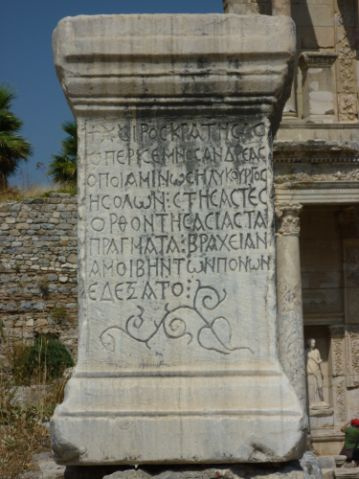
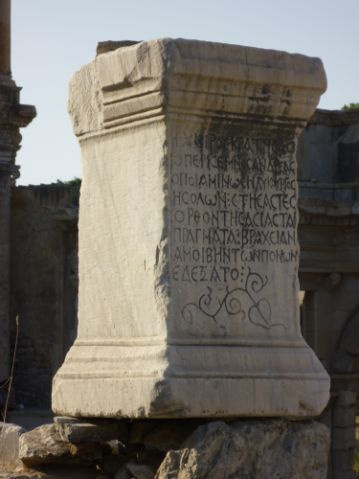
Base for statue of Andreas, probably governor of Asia. Ephesus (Asia). Late fourth to fifth century.
Record details
Photographs
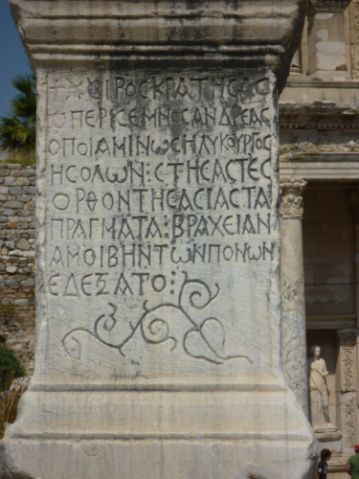
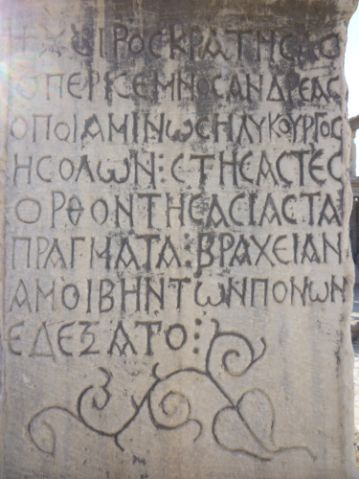
Inscription
☩ χειρὸς κρατήσας / ὁ περίσεμνος Ἀνδρέας / ὁποῖα Μίνως ἢ Λυκοῦργος / ἢ Σόλων στήσας τ’ ἐς / ὀρθὸν τῆς Ἀσίας τὰ / πράγματα βραχείαν / ἀμοιβὴν τῶν πόνων / ἐδέξατο.
Inscription translation
(cross) Having been strong of hand, most august Andreas, just as a Minos or Lycurgus or Solon, having set right the doings of Asia, he has received [this] small recompense for his labours.
Bibliography
- Bauer, F. A., Stadt, Platz und Denkmal in der Spätantike, Mainz 1996, 282
- Engelmann, H. Knibbe, D. & R. Merkelbach, Die Inschriften von Ephesos Teil IV. Inschriften griechischer Städte aus Kleinasien, vol. 14, Bonn 1980, 162-3, no. 1301
Discussion
INSCRIPTION
Verse inscription laid out in eight lines:
☩ χειρὸς κρατήσας / ὁ περίσεμνος Ἀνδρέας / ὁποῖα Μίνως ἢ Λυκοῦργος / ἢ Σόλων στήσας τ’ ἐς /(5) ὀρθὸν τῆς Ἀσίας τὰ / πράγματα βραχείαν / ἀμοιβὴν τῶν πόνων / ἐδέξατο.
'(cross) Having been strong of hand, most august Andreas, just as a Minos or Lycurgus or Solon, having set right the doings of Asia, he has received [this] small recompense for his labours.'
(Translation J. Lenaghan)
Letter height 3 cm.
Three superimposed dots separate the words in lines 4 and 6, and appear at the end of the final line. In line 4 there is an apostrophe: τ’ ἐς. Below the inscription is a large ivy leaf and tendril.
DESCRIPTION
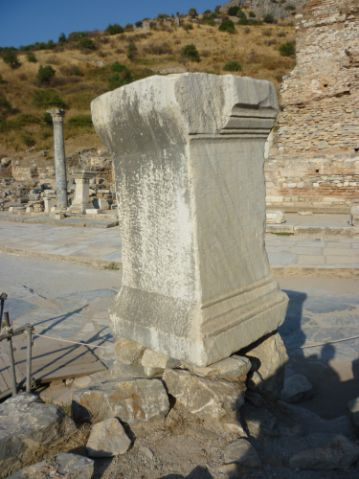
Base of coarse white marble: H 110, W 62.5, D 62 cm.
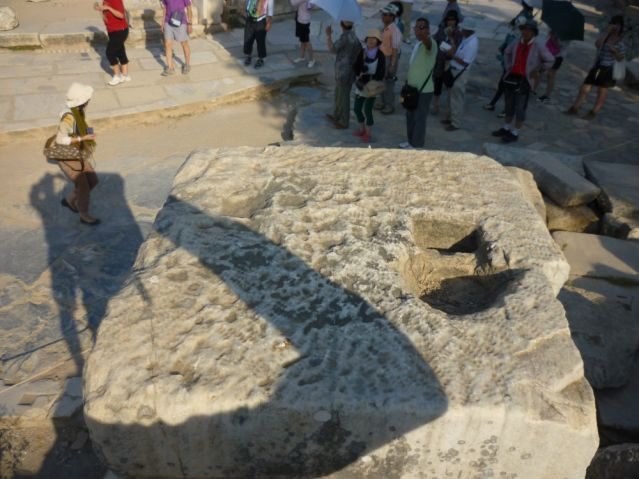
Well preserved monolithic base, with upper and lower mouldings on all sides (but only roughly finished at the back). The inscription is set in a shallow countersunk field whose surface bears vertical chisel marks, possibly signs of re-use. On the top face, cuttings for the support of a bronze statue.
PROVENANCE AND CURRENT LOCATION
Found in 1905, built into a late wall, during excavations at the eastern end of the Marble Street (in 1906 a number of statues were uncovered, also built into this wall). Today set up on the Marble Street, close to its findspot.
HONORAND, AWARDER AND DATE
Andreas, the honorand (PLRE II, 87 Andreas 6), is compared to the mythical and quasi-mythical judges Minos, Lycurgus and Solon, and is praised for his support of the province of Asia (στήσας τ’ ἐς ὀρθὸν τῆς Ἀσίας τὰ πράγματα, lines 4-5). These core motifs in the praise of high ranking state officials of the 4th and 5th centuries (Robert 1948), and the specific reference to Asia, strongly suggest that Andreas was a governor (proconsul) of the province, though this is not explict and he is not known from other sources.
The awarder of the inscription is not stated. The reference (in line 5) to the benefits Andreas had brought to the province of Asia suggest that it might have been the provincials or the provincial assembly.
Verse inscriptions of this type were in use through the 4th and 5th centuries. The cross at the beginning of our inscription points to a date not earlier than the later 4th century.
Discussion references
- Auinger, J. 'Zum Umgang mit Statuen hoher Würdenträger in spätantiker und nachantiker Zeit entlang der Kurenstrasse in Ephesos', Vienna 2009, 37 (for the findspot)
- Robert, L., Epigrammes du Bas-Empire (Hellenica IV), Paris 1948
- Robert, L., Epigrammes du Bas-Empire (Hellenica IV), Paris 1948, 21
Cite: Last Statues of Antiquity, LSA-714 (A. Sokolicek).