
LSA-715
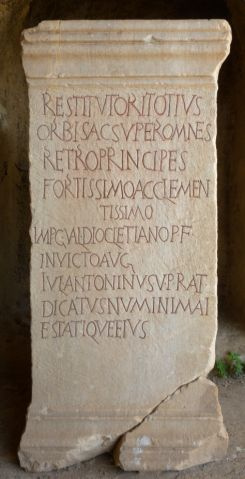
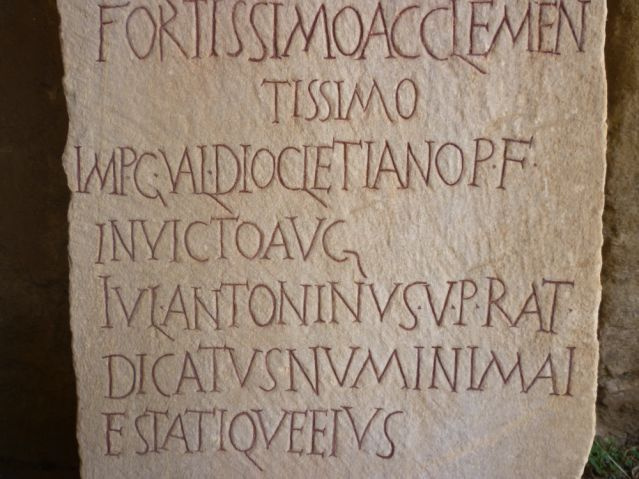
Base for statue of Diocletian, emperor. Ephesus (Asia). 284-305
Record details
Photographs
Inscription
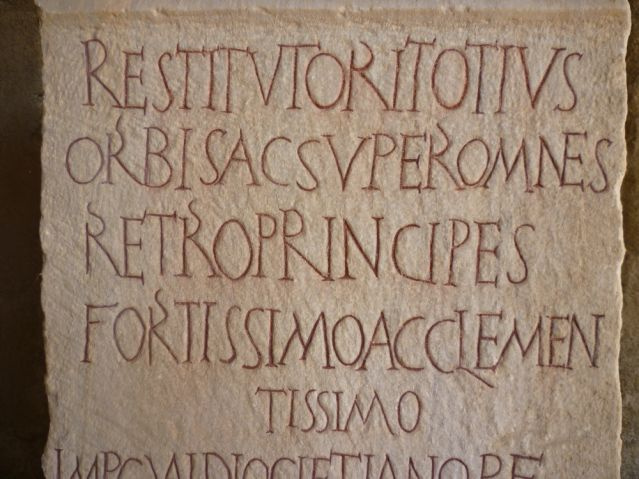
Restitutori totius / orbis, ac super omnes / retro principes /(4) fortissimo ac clemen/tissimo, / imp(eratori) G(aio) Val(erio) Diocletiano, p(io), f(elici), / invicto Aug(usto), / Iul(ius) Antonius, v(ir) p(erfectissimus), rat(ionalis), /(9) dicatus numini mai/estatique eius.
Inscription translation
To the restorer of the entire world, and the strongest and most clement, above all previous rulers, G(aius) Val(erius) Diocletianus, pious, fortunate, unconquered Augustus. Iulius Antoninus, of perfectissimus rank, rationalis, dedicated to his divine spirit and majesty [set this up].
Bibliography
- Wankel, H. et al., Die Inschriften von Ephesos II. Inschriften griechischer Städte aus Kleinasien vol. 12, Bonn 1979, 109, no. 308
Discussion
INSCRIPTION
In ten lines:
Restitutori totius / orbis, ac super omnes / retro principes /(4) fortissimo ac clemen/tissimo, / imp(eratori) G(aio) Val(erio) Diocletiano, p(io), f(elici), / invicto Aug(usto), / Iul(ius) Antonius, v(ir) p(erfectissimus), rat(ionalis), /(9) dicatus numini mai/estatique eius.
'To the restorer of the entire world, and the strongest and most clement, above all previous rulers, G(aius) Val(erius) Diocletianus, pious, fortunate, unconquered Augustus. Iulius Antoninus, of perfectissimus rank, rationalis, dedicated to his divine spirit and majesty [set this up].'
(Translation J. Lenaghan)
Letter height 4 - 5 cm.
DESCRIPTION
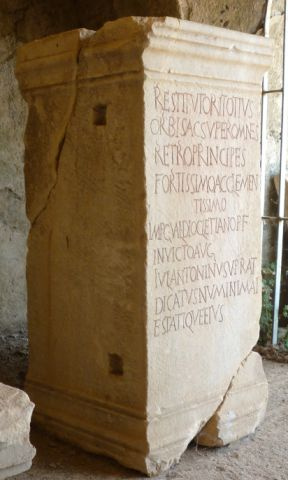
White marble base: H 120, W 50.5, D 52 cm.
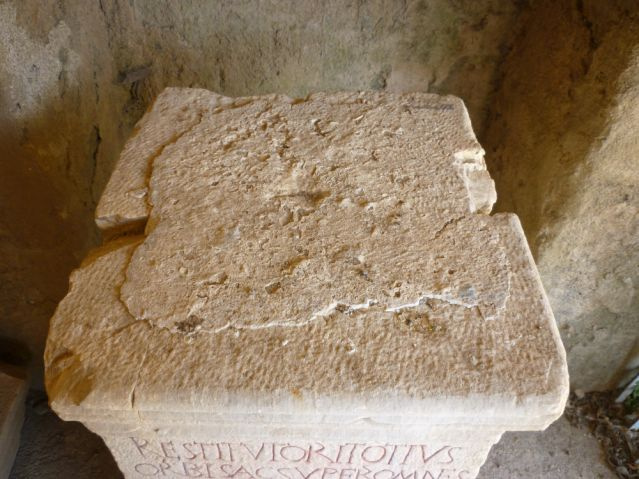
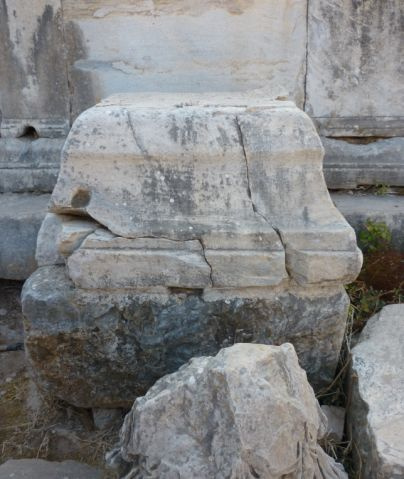
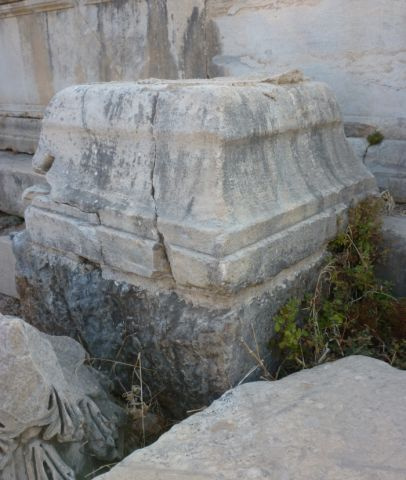
Fully preserved rectangular base, right lower corner damaged. Crown and base mouldings worked in one piece, with double profiles, nearly identical on each moulding. Back side rough, no profiles. Top face with breaks, partly covered by mortar (antique?), possibly for securing the statue (if so this will have been marble, not bronze). No cuttings visible.
PROVENANCE AND CURRENT LOCATION
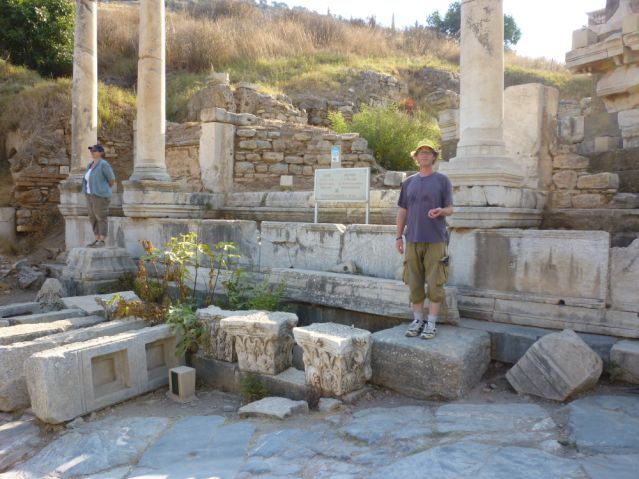
Found at or in front of the Hydreion on the Curetes street (Kuretenstrasse). The lower socle is still in situ on the left side of the Hydreion; the rest of the base is kept in the storeroom in the substructures of Domitian's temple.
HONORAND, AWARDER AND DATE
Diocletian, the honorand, was Augustus 284-305.
Julius Antoninus (PLRE I, 76, Iulius Antoninus 10), the awarder, was a rationalis (line 4); this brief title had come into use in the course of the 3rd century to denote the highest ranking official (procurator a rationibus) of the imperial treasury, the fiscus (Hirschfeld 1905, 34-38, Delmaire 1989, 25). In the tetrarchic period it was also used to refer to the head of the central treasury and to the heads of the diocesan treasuries (Delmaire 1989, 25). Julius Antoninus also set up two dedications to Diocletian in Nicomedia (LSA-628, LSA-630).
Discussion references
- Delmaire, R., Largesses sacrées et 'res privata'. L'aerarium impérial et son administration du IVe au VIe siècle, Rome 1989
- Hirschfeld, O., Die kaiserlichen Verwaltungsbeamten bis auf Diokletian, 2nd edition, Berlin 1905
- Jones, A. H. M., The Later Roman Empire, 2 vols., Oxford 1964
- Jones, A. H. M. et al., The Prosopography of the Later Roman Empire. Vol. I 260-395, Cambridge et al. 1971 (1975)
Cite: Last Statues of Antiquity, LSA-715 (A. Sokolicek).