
LSA-718
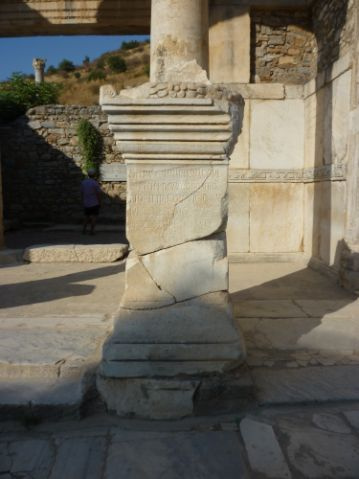
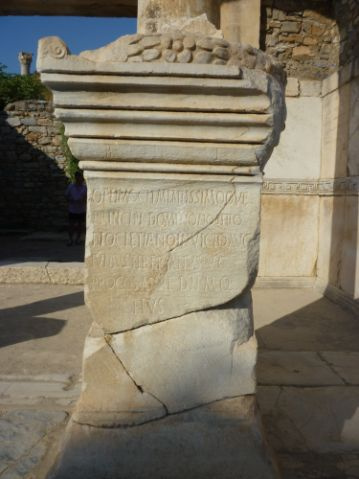
Base for statue of Diocletian, emperor. Ephesus (Asia). 293-303
Record details
Photographs
Inscription
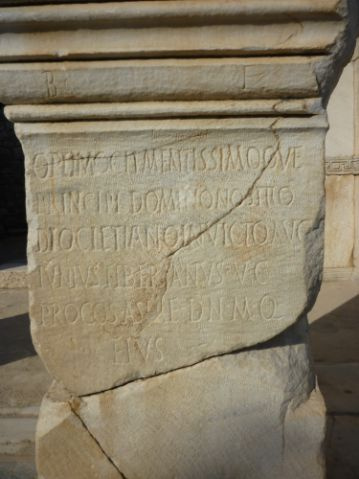
B(onae) F(ortunae). / Optimo clementissimoque / principi, domino nostro / Diocletiano, invicto Aug(usto), /(5) Iunius Tiberianus, v(ir) c(larissimus), / proco(n)s(ul) Asiae, d(evotus) n(umini) m(aiestati)q(ue) / eius.
Inscription translation
To Good Fortune. To the best and most clement ruler, our lord Diocletianus, unconquered Augustus. Iunius Tiberianus, of clarissimus rank, proconsul of Asia, devoted to his divine spirit and majesty, [set this up].
Bibliography
- Bauer, F. A., Stadt, Platz und Denkmal in der Spätantike, Mainz 1996, 424
- Wankel, H. et al., Die Inschriften von Ephesos II. Inschriften griechischer Städte aus Kleinasien vol. 12, Bonn 1979, 106, no. 305,1
Discussion
INSCRIPTION
In seven lines:
B(onae) F(ortunae). / Optimo clementissimoque / principi, domino nostro / Diocletiano, invicto Aug(usto), /(5) Iunius Tiberianus, v(ir) c(larissimus), / proco(n)s(ul) Asiae, d(evotus) n(umini) m(aiestati)q(ue) / eius.
'To Good Fortune. To the best and most clement ruler, our lord Diocletianus, unconquered Augustus. Iunius Tiberianus, of clarissimus rank, proconsul of Asia, devoted to his divine spirit and majesty, [set this up].'
Letter height 4 - 6 cm. The opening invocation 'B(onae) F(ortunae)' is carved on the lowest torus of the upper moulding.
DESCRIPTION
Monolithic white marble base, with wreath on top of upper moulding and clear signs of re-use: H 115, W 90 (original), D 85 cm (preserved).
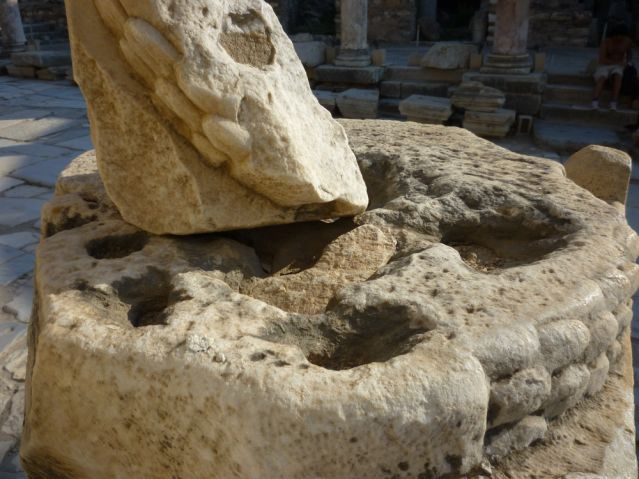
Rectangular base, broken into numerous pieces, now restored. Crown and base mouldings worked in one piece with the shaft. Right side of crown moulding damaged, with parts missing. Base moulding with simple high profile. Crown moulding accentuated on corners with decorated small 'corner architraves' (palmettes). Above the moulding is a laurel wreath with central frontal flower, worked in one piece with the base, diameter 90 cm. The back side of the wreath is rough.
On the top face are various cuttings, among them cuttings for the feet of a bronze statue, apparently over life-size. Some of the cuttings were dowel holes made for inserting metal pins, now modified by the robbing out of the metal. The relative chronology of the various holes, evidently from more than one period, is unclear.
PROVENANCE AND CURRENT LOCATION
Found in front of the temple of Hadrian, probably in front of the column to the left of the entrance (second base from east); The precise context and circumstances of its discovery are unknown. Today set up near its findspot, in front of the temple of Hadrian.
HONORAND, AWARDER AND DATE
Diocletian, the honorand, was Augustus 284-305.
Iunius Tiberianus, the awarder, was governor (proconsul) of Asia (PLRE I, 912 Iunius Tiberianus 7); he set up dedications to Diocletian's co-emperors, Constantius Caesar (Constantius I, LSA-719) and Galerius Caesar (LSA-720), likewise in front of the temple of Hadrian and with similar inscriptions. Tiberianus held the higher office of prefect of the city of Rome in 303. The terminus post quem for our inscription is therefore 293 (the appointment of the Caesars of the tetrarchy), the terminus ante quem 303.
FURTHER DISCUSSION
Our inscription must have formed part of a dedication to all four tetrarchs, of which that to Diocletian's fellow Augustus, Maximian, is today missing, perhaps removed as a result of damnatio memoriae.
Discussion references
- Malcus, B. 'Die Prokonsuln von Asien von Diokletian bis Theodosius II', Opuscula Atheniensa, 7 (1967) 91-154, 94
- Roueché, C. 'The Kuretenstrasse: the Imperial Presence in Late Antiquity', Neue Forschungen zur Kuretenstrasse von Ephesos : Akten des Symposiums für Hilke Thür vom 13. Dezember 2006 an der Österreichischen Akademie der Wissenschaften, Vienna 2009, 155-169, at 159
- Roueché, C. 'The Kuretenstrasse: the Imperial Presence in Late Antiquity', Neue Forschungen zur Kuretenstrasse von Ephesos : Akten des Symposiums für Hilke Thür vom 13. Dezember 2006 an der Österreichischen Akademie der Wissenschaften, Vienna 2009, 155-169, at 159
- Roueché, C. 'The Kuretenstrasse: the Imperial Presence in Late Antiquity', Neue Forschungen zur Kuretenstrasse von Ephesos : Akten des Symposiums für Hilke Thür vom 13. Dezember 2006 an der Österreichischen Akademie der Wissenschaften, Vienna 2009, 155-169, at 159
Cite: Last Statues of Antiquity, LSA-718 (A. Sokolicek).