
LSA-720
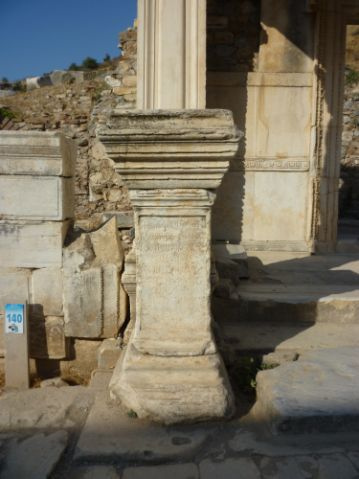
Base for statue of Galerius, emperor. Ephesus (Asia). 293-303
Record details
Photographs
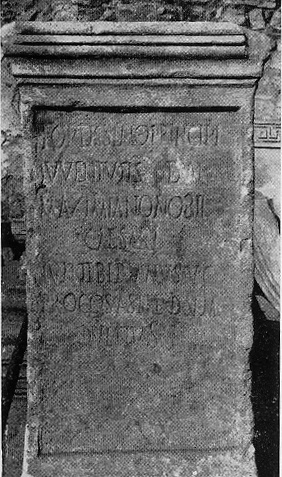
Inscription
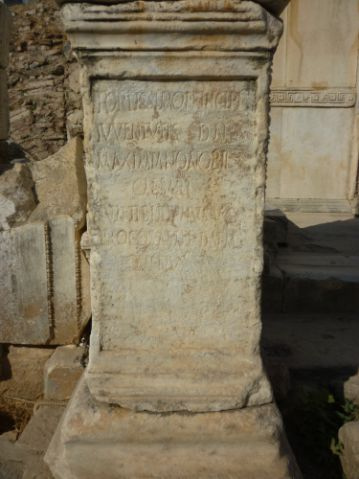
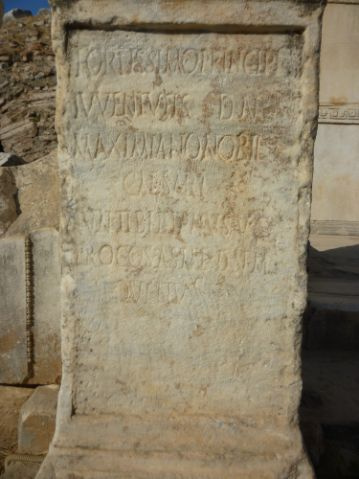
B(onae) F(ortunae). / Fortissimo principi / iuventutis d(omino) n(ostro) / Maximiano nobil(issimo) /(5) Caesari, / Iun(ius) Tiberianus, v(ir) c(larissimus), / proco(n)s(ul) Asiae d(evotus) n(umini) m(aiestati)/que eius.
Inscription translation
To Good Fortune. To the strongest prince of the youth (princeps iuventutis), our lord the most noble Maximian Caesar. Iunius Tiberianus, of clarissimus rank, governor (proconsul) of Asia, devoted to his divine spirit and majesty (set this up).
Bibliography
- Bauer, F. A., Stadt, Platz und Denkmal in der Spätantike, Mainz 1996, 424
- Wankel, H. et al., Die Inschriften von Ephesos II. Inschriften griechischer Städte aus Kleinasien vol. 12, Bonn 1979, 107, no. 305,3
Discussion
INSCRIPTION
In eight lines:
B(onae) F(ortunae). / Fortissimo principi / iuventutis d(omino) n(ostro) / Maximiano nobil(issimo) /(5) Caesari, / Iun(ius) Tiberianus, v(ir) c(larissimus), / proco(n)s(ul) Asiae d(evotus) n(umini) m(aiestati)/que eius.
'To Good Fortune. To the most powerful prince of youth (princeps iuventutis), our lord Maximianus, most noble Caesar. Iunius Tiberianus, of clarissimus rank, governor (proconsul) of Asia, devoted to his divine spirit and majesty, [set this up].'
Letter height 4.5 - 5 cm. The opening invocation, 'B(onae) F(ortunae)', is carved on the lower torus of the upper moulding.
DESCRIPTION
Composite white marble base: H 105, W 49, D 49cm.
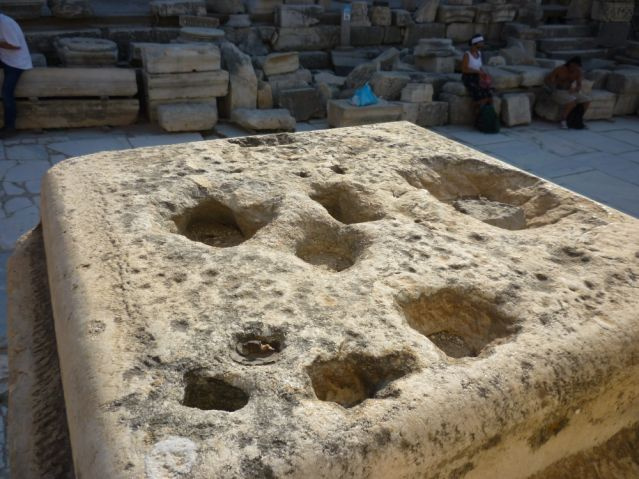
Composite base consisiting of shaft and two separate mouldings, made up of reused pieces. Base moulding with simple middle-high profile, damaged on left side and in front. Shaft with simple torus at bottom; at top, profile at corners turned upwards. Slightly damaged on all sides. The inscription set within a frame. Vertical cutting on right side, corresponding to a cutting on the same side of the crown moulding, presumably for a metal cramp. Shaft probably reused, but without traces of an older inscription. Tall crown moulding with various tori and trochili, accentuated at the top with beak-like corner acroteria (mostly broken); exterior parts with palmettes in relief. Top face has various cuttings, among them settings for a bronze statue, but no footprints. Substantial remains of a lead attachment used for fixing the (missing) statue. In frontal area of the top face, four small cuttings apparently to support a rectangular device, with remains of iron fixings in the holes. At right back side, three small cuttings facing each other, with remains of lead and iron (perhaps for a tripod?). On left side, vertical cutting corresponding to cutting of shaft.
PROVENANCE AND CURRENT LOCATION
Found in front of the temple of Hadrian, probably in front of the second right (west) column; the precise context and circumstances of its discovery are unknown. Today probably where it was found.
HONORAND AND DATE
Galerius, the honorand, was Caesar 293-305.
Iunius Tiberianus, the awarder, was governor (proconsul) of Asia (PLRE I, 912 Iunius Tiberianus 7); he set up statues to Constantius' co-emperors, the Augustus Diocletian (LSA-718) and Caesar Constantius I (LSA-719), likewise in front of the temple of Hadrian and with similar inscriptions. Tiberianus held the higher office of prefect of the city of Rome in 303. The terminus post quem for our inscription is therefore 293 (the appointment of the Caesars of the tetrarchy), the terminus ante quem 303.
FURTHER DISCUSSION
Our inscription must have formed part of a dedication to all four tetrarchs, of which that to Diocletian's fellow Augustus, Maximian, is today lost, perhaps removed as a result of damnatio memoriae.
Discussion references
- Malcus, B. 'Die Prokonsuln von Asien von Diokletian bis Theodosius II', Opuscula Atheniensa, 7 (1967) 91-154, 94
- Roueché, C. 'The Kuretenstrasse: the Imperial Presence in Late Antiquity', Neue Forschungen zur Kuretenstrasse von Ephesos : Akten des Symposiums für Hilke Thür vom 13. Dezember 2006 an der Österreichischen Akademie der Wissenschaften, Vienna 2009, 155-69, at 159
Cite: Last Statues of Antiquity, LSA-720 (A. Sokolicek).