
LSA-721
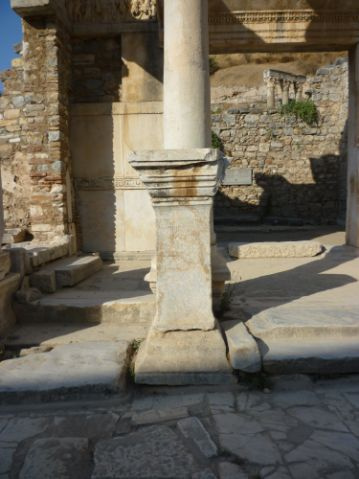
Base for statue of Theodosius, father of emperor Theodosius I. Ephesus (Asia). 379-387.
Record details
Photographs
Inscription
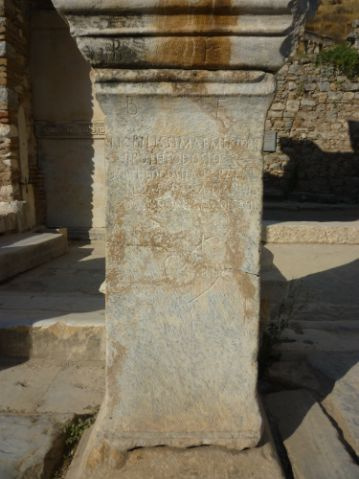
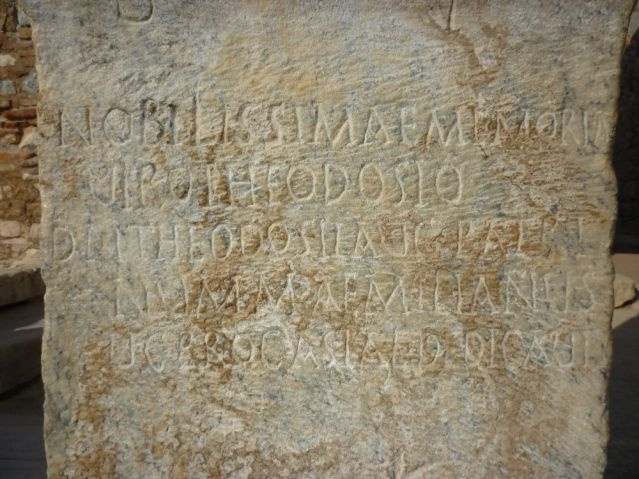
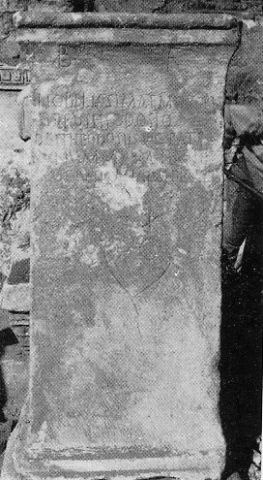
B(onae) F(ortunae). / Nobilissimae memoriae viro, / Theodosio, /(5) d(omini) n(ostri) Theodosii Aug(usti) patri, Numm(ius) / Aemilianus, / v(ir) c(larissimus), proc(onsul) Asiae, dedicavit.
Inscription translation
To Good Fortune. To the man of most noble memory, Theodosius, father of our lord Theodosius Augustus. Nummius Aemilianus, of clarissimus rank, proconsul of Asia, dedicated [this].
Bibliography
- Bauer, F. A., Stadt, Platz und Denkmal in der Spätantike, Mainz 1996, 424
- Wankel, H. et al., Die Inschriften von Ephesos II. Inschriften griechischer Städte aus Kleinasien vol. 12, Bonn 1979, 107-108, no. 306
Discussion
INSCRIPTION
In six lines:
B(onae) F(ortunae). / Nobilissimae memoriae viro, / Theodosio, /(5) d(omini) n(ostri) Theodosii Aug(usti) patri, Numm(ius) / Aemilianus, / v(ir) c(larissimus), proc(onsul) Asiae, dedicavit.
'To Good Fortune. To the man of most noble memory, Theodosius, father of our lord Theodosius Augustus. Nummius Aemilianus, of clarissimus rank, proconsul of Asia, dedicated [this].'
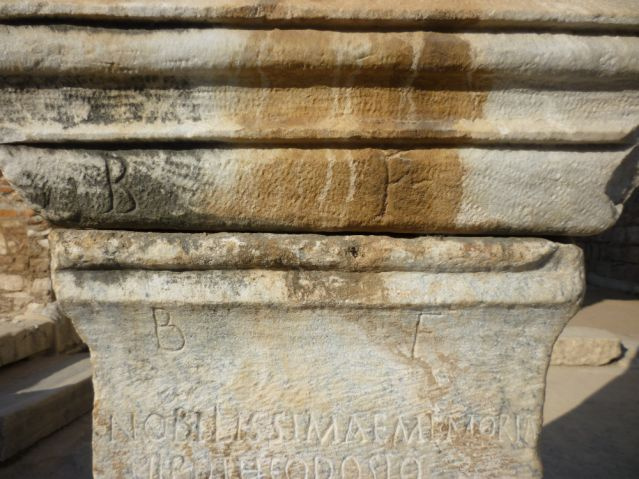
The opening invocation to Good Fortune does not belong with the rest of the inscription (see below, 'Description').
Letter height 3 - 3.5 cm.
DESCRIPTION
Composite base of white marble: H 116, W 54, D 51 cm.
Composite base consisiting of shaft and two separate mouldings, made up of reused pieces. The crown moulding, inscribed 'B(onae) F(ortunae)', has been set on on this shaft in error, since it clearly belongs with the inscribed shaft LSA-719.
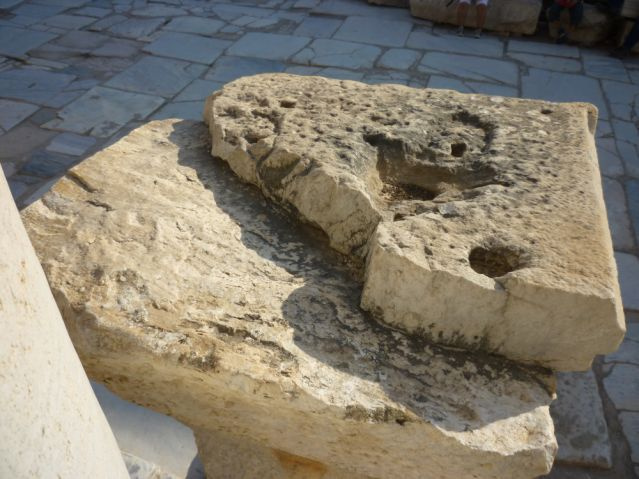
Base moulding with simple high profile, undamaged. Shaft with simple torus at bottom (in large part broken) and top, and no frame, probably reused, but without traces of an older inscription. Crown moulding (which should be set on LSA-719) tall with sequence of 3 tori and trochili. On the top a flat plain plinth-like covering. No accentuation whatsoever, but broken diagonally (and lost) from rear left to front right. Traces of lead for fixing the statue's right foot (Miltner 1959, 281 erroneously says left). Top face has some cuttings, among them for the setting of a bronze statue, one footprint fully preserved and one in part. Surface roughly chiseled with pointed tool.
PROVENANCE AND CURRENT LOCATION
Found in front of the temple of Hadrian, probably in front of second right (west) column; the precise context and circumstances of its discovery are unknown. Set up today, presumably where found.
HONORAND, AWARDER AND DATE
The honorand, Theodosius, was father of the emperor Theodosius I (PLRE I, 902-4 Flavius Theodosius 3). He was executed by Valentinian I, probably in 375. Our dedication, along with many others across the empire, was set up posthumously during the reign of his son (379-95).
Nummius Aemilianus, the awarder (full name Nummius Aemilianus Dexter, PLRE I, 251 Nummius Aemilianus Dexter 3; Malcus 1967, 119-20), was governor (proconsul) of Asia within the period 379-87. He was a native of Barcino (modern Barcelona), and was granted a statue in his hometown by the provincials of Asia after his time in office (LSA-1989).
FURTHER DISCUSSION
This base was set up amongst a group of tetrarchic bases in front of the temple of Hadrian (LSA-718, LSA-719, LSA-720), all erected between 293 and 303. It apparently replaced a dedication to Maximian, removed after he suffered damnatio memoriae (Roueche 2009, 160).
Discussion references
- Malcus, B. 'Die Prokonsuln von Asien von Diokletian bis Theodosius II', Opuscula Atheniensa, 7 (1967) 91-154, 119
- Miltner, F. '22. Vorläufiger Bericht über die Ausgrabungen in Ephesos', Jahreshefte des Österreichischen Archäologischen Institutes in Wien 44, Vienna 1959, 243-314
- Roueché, C. 'The Kuretenstrasse: the Imperial Presence in Late Antiquity', Neue Forschungen zur Kuretenstrasse von Ephesos : Akten des Symposiums für Hilke Thür vom 13. Dezember 2006 an der Österreichischen Akademie der Wissenschaften, Vienna 2009, 155-69, at 160
Cite: Last Statues of Antiquity, LSA-721 (A. Sokolicek).