
LSA-722
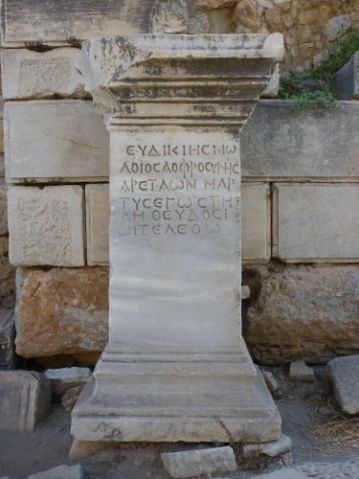
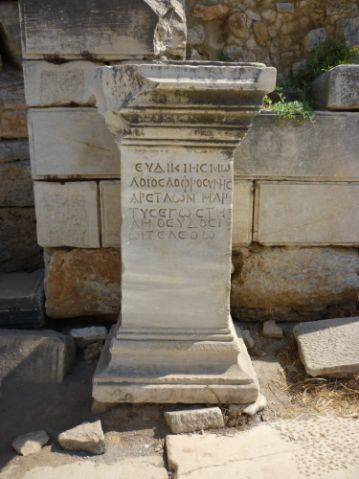
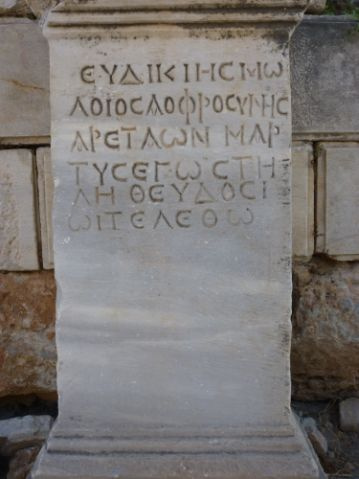
Base for statue of Theodosius, probably governor of Asia. Ephesus (Asia). Fourth to fifth century
Record details
Photographs
Inscription
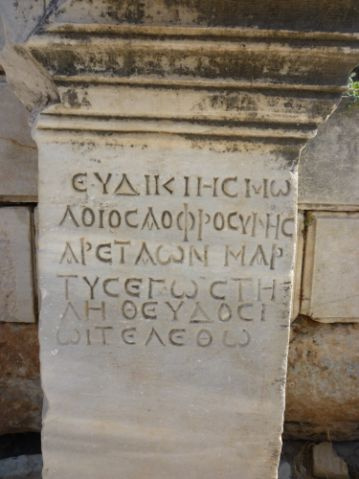
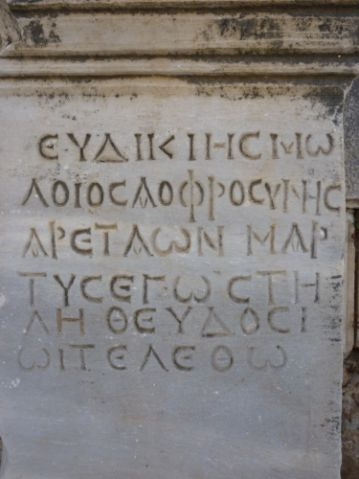
εὐδικίης, μώ/λοιο, σαοφροσύνης, / ἀρετάων μάρ/τυς ἐγὼ στή/λη Θεοδοσί/ωι τελέθω.
Inscription translation
Of justice, of toil, of moderation, of the virtues, I, the statue (stele) to Theodosius, bear witness.
Bibliography
- Bauer, F. A., Stadt, Platz und Denkmal in der Spätantike, Mainz 1996, 424
- Engelmann, H. Knibbe, D. & R. Merkelbach, Die Inschriften von Ephesos Teil IV. Inschriften griechischer Städte aus Kleinasien, vol. 14, Bonn 1980, 168, no. 1311
Discussion
INSCRIPTION
Verse inscription of one elegiac distich laid out in six lines:
εὐδικίης, μώ/λοιο, σαοφροσύνης, / ἀρετάων μάρ/τυς ἐγὼ στή/λη Θεοδοσί/ωι τελέθω.
'Of justice, of toil, of moderation, of the virtues, I, the statue (stele) to Theodosius, bear witness.'
Letter height 4.5 cm. The letters are unusually deeply cut.
DESCRIPTION
White marble base: H 165, W 87, D 72 cm.
Monolithic base with integral crown and base mouldings. There are no clear signs of re-use; it is possible, however, since the inscription is cut on an unframed flat surface.
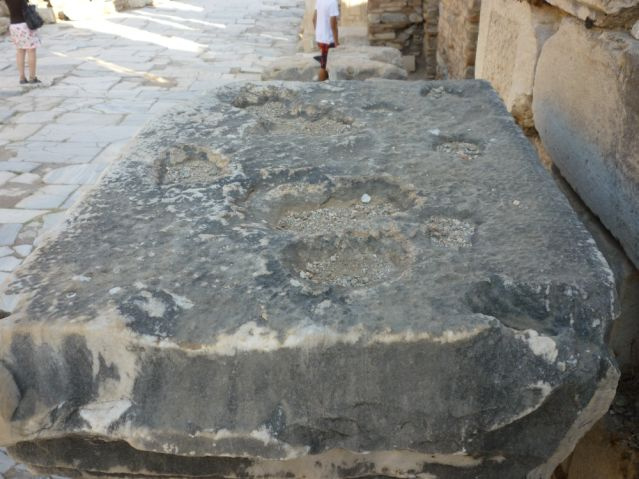
Base moulding with small oblique band and larger trochilus, slightly damaged. Shaft with small simple torus at bottom and top, and no frame for the inscription. Crown moulding of middling height, damaged on the left, with one torus and widening trochilus, uppermost band with beak-like acroteria in relief. Top face with cuttings, among them for bronze statue.
PROVENANCE AND CURRENT LOCATION
Found in front of the baths of Scholasticia (Miltner, 1956), in the debris in front of the apse-facade. Today set up close to its findspot in front of the east corner of the baths.
HONORAND AND DATE
Theodosius, the honorand, is praised in verse for his justice, toil, moderation and other virtues, core motifs for the praise of governors in Late Antiquity. Although his office is not explicitly stated, Theodosius was probably a governor (proconsul) of Asia.
The dedication was attributed to the emperor Theodosius I by Wankel et al. 1980. However, this seems highly unlikely to us. Emperors excel in all virtues through their very office. In inscriptions of the 4th/5th century, it is the eternal and ubiquitous victoriousness of the emperor which is praised, whereas justice and moderation are attributed to imperial magistrates, toiling to spread these virtues - in origin imperial - throughout the empire. Moreover, the verse form would be highly unusual for an emperor in the 4th century, whereas it is constantly used for high imperial officials.
Of the men of this name known so far, our honorand is most likely to be identified with the proconsul of Asia who received a statue at Smyrna (LSA-486) (PLRE II, 1102 Theodosius 16; Malcus 1967, 133-4). There is no way of dating his tenure of office more tightly than within the 4th/5th century.
Stichel 1982 thought that the honorand was Theodosius the Elder, the father of the emperor Theodosius I. However, the inscription gives no support to this assumption.
Discussion references
- Stichel, R. H. W., Die römische Kaiserstatue am Ende der Antike, Roma 1982, 92 no. 79
- Wankel, H. et al. (eds.), Die Inschriften von Ephesos III. Inschriften griechischer Städte aus Kleinasien, vol. 13, Bonn 1980, Nr. 1311
Cite: Last Statues of Antiquity, LSA-722 (A. Sokolicek and Ulrich Gehn).