
LSA-723
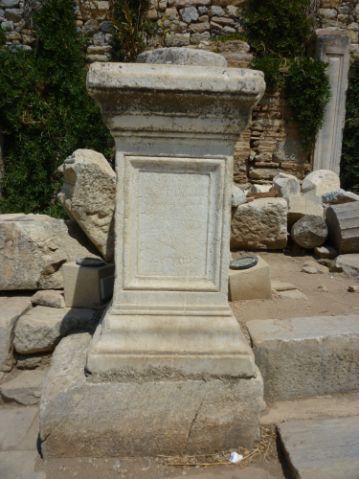
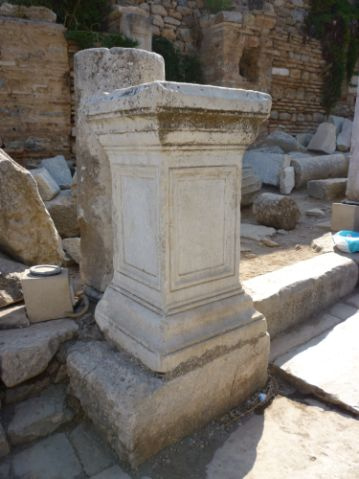
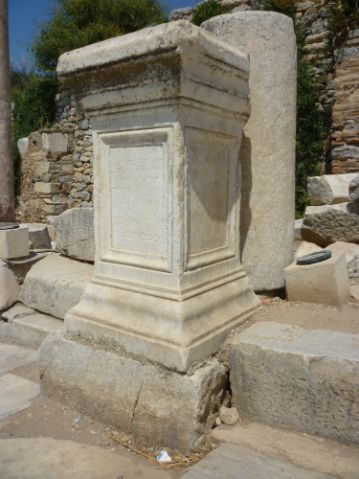
Base for statue of empress Aelia Flacilla, wife of Theodosius I. Ephesus (Asia). 379-386
Record details
Photographs
Inscription
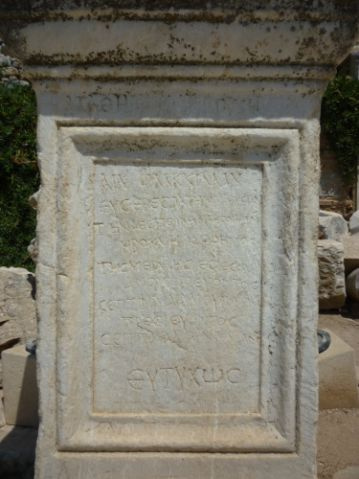
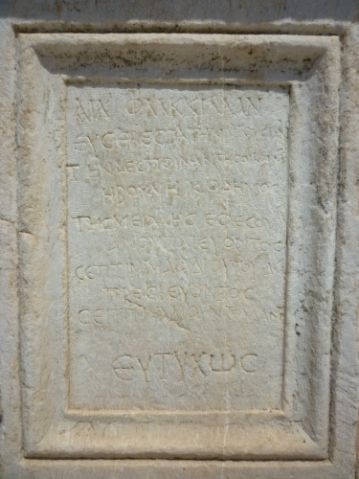
ἀγαθῇ τύχῃ· / Αἰλ(ίαν) Φλάκκιλλαν / εὐσεβεστάτην Αὐγοῦσταν, / τὴν δέσποιναν τῆς οἰκουμέ(νης), /(5) ἡ βουλὴ κ(αὶ) ὁ δῆμος / τῆς μεγάλης Ἐφέσου, / ἀνθυπατεύοντος / Σεπτιμ(ίου) Μαιαδίου τοῦ λαμ(προτάτου), / πρεσβεύοντος /(10) Σεπτ(ιμίου) Μαιαδίου νε(ωτέρου) τοῦ λαμ(προτάτου)· / εὐτυχῶς.
Inscription translation
To Good Fortune. Ael(ia) Flacilla, most pious Augusta, mistress of the civilized world; the council and people (boule kai demos) of great Ephesus [honour her], in the proconsulship of Septimius Maeadius, of clarissimus rank, with Septimius Maeadius the younger, of clarissimus rank, as [his] legate. With good fortune.
Bibliography
- Roueché, C. 'The image of Victory: new evidence from Ephesus', Mélanges Gibert Dagron, Travaux et Mémoires 14, Paris 2002, 527-46.
- Wankel, H. et al., Die Inschriften von Ephesos II. Inschriften griechischer Städte aus Kleinasien vol. 12, Bonn 1979, 114-115, no. 314
Discussion
INSCRIPTION
In eleven lines:
ἀγαθῇ τύχῃ· / Αἰλ(ίαν) Φλάκκιλλαν / εὐσεβεστάτην Αὐγοῦσταν, / τὴν δέσποιναν τῆς οἰκουμέ(νης), /(5) ἡ βουλὴ κ(αὶ) ὁ δῆμος / τῆς μεγάλης Ἐφέσου, / ἀνθυπατεύοντος / Σεπτιμ(ίου) Μαιαδίου τοῦ λαμ(προτάτου), / πρεσβεύοντος /(10) Σεπτ(ιμίου) Μαιαδίου νε(ωτέρου) τοῦ λαμ(προτάτου)· / εὐτυχῶς.
'To Good Fortune. Ael(ia) Flacilla, most pious Augusta, mistress of the civilized world; the council and people (boule kai demos) of great Ephesus [honour her], in the proconsulship of Septimius Maeadius, of clarissimus rank, with Septimius Maeadius the younger, of clarissimus rank, as [his] legate. With good fortune.'
Letter height 2 - 3.5 cm.
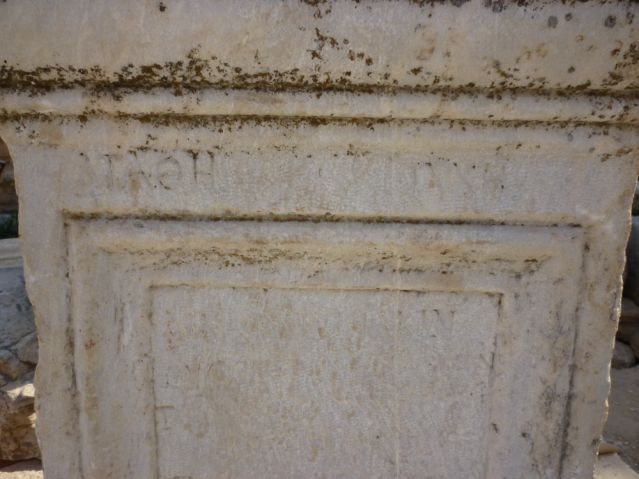
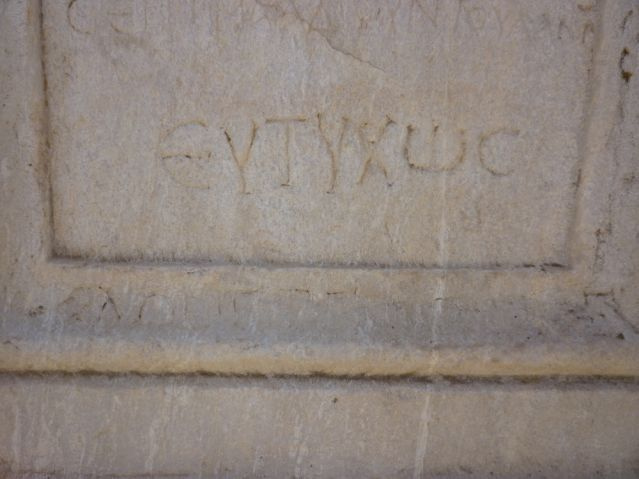
The invocation to Good Fortune is carved on the moulded frame above the main inscription. On the lower moulding of the same frame is carved λογιστεύοντος, 'examining' (interpreted by C. Roueché as part of an older inscription; but see below, 'Description').
DESCRIPTION
White marble base: H 120, W 66, D 66 cm.
Monolithic base with integral crown and base mouldings. If the final word of the inscription, 'λογιστεύοντος', was the remains of an earlier inscription, then our base is a reused peice (Roueché 2002, 531). It is possible, however, that the word is a later addition.
Base moulding with high simple profile. Shaft with small simple torus at bottom and top. Moulded panels on three sides. Upper moulding about same size as bottom moulding. Top face with cuttings, among them probably ones for a bronze statue, but no footprints. Cuttings round, but with an unusual addition in the form of a concentric larger segment of a circle. Remains of lead in one rectangular hole.
PROVENANCE AND CURRENT LOCATION
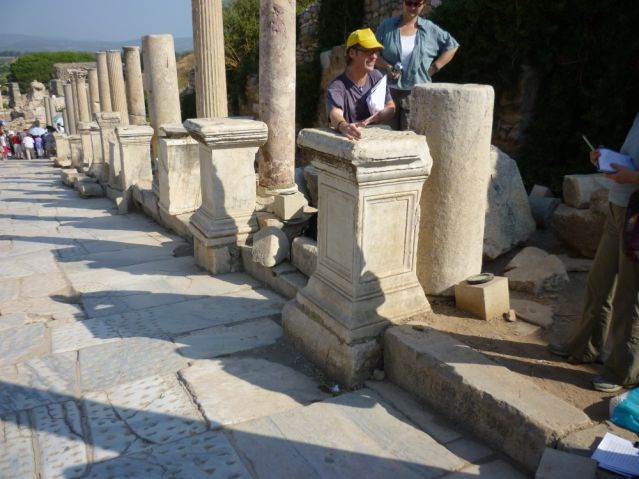
Found on the east side of the east part of the 'Curetes Street (Kuretenstrasse)', set in the centre of a series of bases (fourth base from the east). Today standing where it was found.
HONORAND, AWARDER AND DATE
Aelia Flacilla, the honorand, was the wife of Theodosius I and Augusta from 379 until her death in 386 (PLRE I, 341-2 Aelia Flavia Flacilla).
The inscription was set up by the council (boule) and the people (demos) of Ephesus (lines 5-6), possibly on the initiative of the proconsul Septimius Maeadius and his son, both recorded in lines 8-10. Both men are only known from this inscription and therefore cannot contribute to a dating more precise than the reign of Flacilla (PLRE I, 530 Septimius Maeadius 1 and 531, Sep. Maeadius Iunior).
FURTHER DISCUSSION
Flacilla's base stands in the middle of a series of eight bases which bore statues of Nike (Victory), with one additional base at the very east end, honouring the doctor Alexandros (LSA-735 ). The Nike bases are high-imperial in date, but were assembled and set up here in Late Antiquity, presumably at the time that Flacilla's statue was erected (Roueché 2002).
The same council and people of Ephesus honoured Flacilla with a second statue, in the Theatre Street (LSA-745); she was also honoured in Aphrodisias (LSA-185).
Discussion references
- Malcus, B. 'Die Prokonsuln von Asien von Diokletian bis Theodosius II', Opuscula Atheniensa, 7 (1967) 91-154, 116-117, no. 11
- Roueché, C. 'The image of Victory: new evidence from Ephesus', Mélanges Gibert Dagron, Travaux et Mémoires 14, Paris 2002
Cite: Last Statues of Antiquity, LSA-723 (A. Sokolicek).