
LSA-724
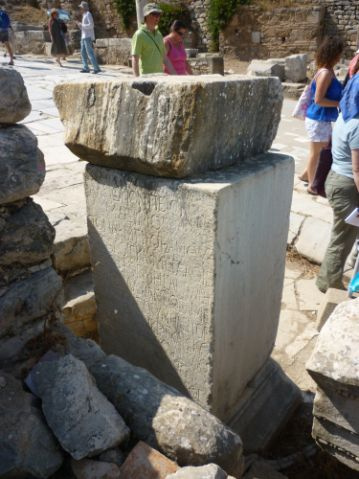
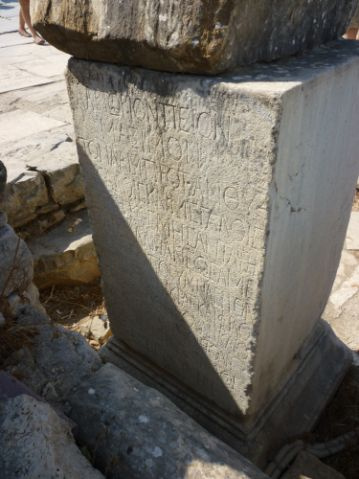
Base for statue of Lucius Artorius Pius Maximus, governor of Asia. Ephesus (Asia). 286-298
Record details
Photographs
Inscription
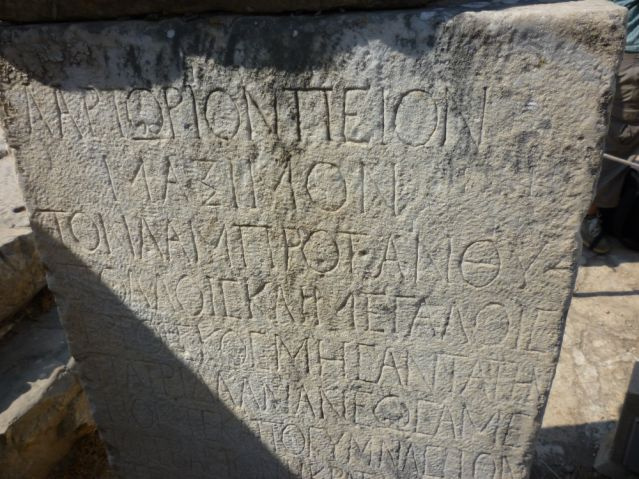
Μάξιμον, / τὸν λαμπρότ(ατον) ἀνθύπ(ατον), / πολλοῖς καὶ μεγάλοις / ἔργοις κοσμήσαντα τὴν /(5) πατρίδα, ἀνανεωσάμε/νόν τε καὶ τὸ γυμνάσιον / τὸ Σεβαστὸν, ἡ κρατ(ίστη) καὶ φιλο/σέββ(αστος) (sic) Ἐφεσίων βουλὴ καὶ ὁ /(9) λαμπρότ(ατος) δῆμος, τὸν ἑ/αυτῶν καὶ τῆς / πατρίδος / εὐεργέτην.
Inscription translation
Maximus, governor (proconsul) of clarissimus rank, decorating the fatherland with many and great works as well as refurbishing the imperial gymnasium; the most powerful and emperor-loving council (boule) of the Ephesians, and the most splendid people (demos) [honour] their own and the fatherland's benefactor.
Bibliography
- Bauer, F. A., Stadt, Platz und Denkmal in der Spätantike, Mainz 1996, 424
- Wankel, H. et al. (eds.), Die Inschriften von Ephesos III. Inschriften griechischer Städte aus Kleinasien, vol. 13, Bonn 1980, 19, no. 621
Discussion
INSCRIPTION
In twelve lines:
Μάξιμον / τὸν λαμπρότ(ατον) ἀνθύπ(ατον) / πολλοῖς καὶ μεγάλοις / ἔργοις κοσμήσαντα τὴν /(5) πατρίδα ἀνανεωσάμε/νόν τε καὶ τὸ γυμνάσιον / τὸ Σεβαστὸν ἡ κρατ(ίστη) καὶ φιλο/σέββ(αστος) Ἐφεσίων βουλὴ καὶ ὁ /(9) λαμπρότ(ατος) δῆμος τὸν ἑ/αυτῶν καὶ τῆς / πατρίδος / εὐεργέτην.
'Maximus, governor (proconsul) of clarissimus rank, decorating the fatherland with many and great works as well as refurbishing the imperial gymnasium; the most powerful and emperor-loving council (boule) of the Ephesians, and the most splendid people (demos) [honour] their own and the fatherland's benefactor.'
The double beta in 'φιλοσέββ(αστος) (emperor-loving)' shows that there were two emperors reigning at the time of the inscription.
Letter height 5 - 7 cm. Long, accurately carved letters; text centred, with very little space between lines.
DESCRIPTION
Composite base of white marble: H 97, W 60, D 60 cm.
Composite base, with attached crown and base mouldings. Shaft without any decoration. Its exact square measurements suggest it is very likely original and not reworked. The crown moulding was added later for the statue of Damocharis (inscription on opposite face of base, LSA-727). Whether the lower moulding is original is unclear. For a description of the mouldings, see LSA-727.
PROVENANCE AND CURRENT LOCATION
The inscription was found east of the Nymphaeum Traiani (##sketchbook Nr. 2904, F. Miltner in 1957##). Context not known. it is today set up close to its findspot, with our inscription to Artorius Pius Maximus facing away from the street.
HONORAND, AWARDER AND DATE
Lucius Artorius Pius Maximus, the honorand, was governor (proconsul) of Asia (τὸν λαμπρότατον ἀνθύπατον, line 2). He is known to have been prefect of the city of Rome in 298 (PLRE I, 589 L. Artorius Pius Maximus 43; Malcus 1967, 93-4), which provides the terminus ante quem for our inscription. A terminus post quem for his governorship of Asia is 286, the year in which he is recorded holding the (lower-ranking) governorship of Syria Phoenice (Chastagnol 1962, 30). A date after 286 (the year when Maximian was co-opted to the throne) is supported by the inscription's reference to two Augusti (φιλοσέββ(αστος), in lines 7-8, with a doubled beta). This reference to two Augusti may also indicate a date before 293, when two Caesars joined the Augusti as co-emperors (Chastagnol 1962, 31).
Miltner 1959, 349 believed that Maximus could have been governor of Asia after his prefecture of Rome; this is, however, profoundly unlikely. The prefecture of the City was the highest senatorial rank of the period, and the holding of a provincial governorship after this office would be unparalleled (Chastagnol 1960, 391-5; Chastagnol 1982, 169, 171-2).
Maximus, who is also known from a statue that he set up to Diocletian in Ephesus (LSA-743), may have been a native of the city (Chastagnol 1962, 31, reading κοσμήσαντα τὴν πατρίδα, in lines 4-5, as 'decorating his fatherland'; he is followed in this by PLRE). The 'imperial gymnasium' that he refurbished is the building now known as the 'Harbour baths-gymnasium'.
The inscription was set up by the council and the people of Ephesus.
FURTHER DISCUSSION
The reference to repair of the imperial gymnasium (lines 8-9), which is to be identified with the Harbour Gymnasium, has to be seen in the context of refurbishing the city after the serious earthquakes of Gallienus' reign (sole ruler 260-8). It is one of the earliest textual references in Ephesus to the late antique repair of damaged imperial buildings.
Discussion references
- Chastagnol, A., La préfecture urbaine a Rome sous le Bas-Empire, Paris 1960
- Chastagnol, A., Les fastes de la Préfecture de Rome au Bas-Empire, Paris 1962
- Chastagnol, A., La carrière sénatoriale du Bas-Empire depuis Diocletien, Epigrafia e ordine senatorio, 1. Atti del Colloquio intenazionale AIEGL, Roma 14 - 20 maggio 1981, pp. 167-92, Roma 1982
- Malcus, B. 'Die Prokonsuln von Asien von Diokletian bis Theodosius II', Opuscula Atheniensa, 7 (1967) 91-154, pp. 93-4
- Miltner, F. '22. Vorläufiger Bericht über die Ausgrabungen in Ephesos', Jahreshefte des Österreichischen Archäologischen Institutes in Wien 44, Vienna 1959
Cite: Last Statues of Antiquity, LSA-724 (A. Sokolicek - Ulrich Gehn).