
LSA-726
Base for statue of Theodorus, possibly governor of Asia. Ephesus (Asia). Possibly mid-sixth century.
Record details
Photographs
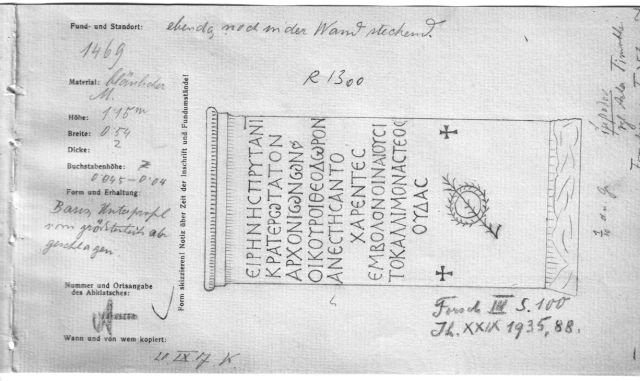
Inscription
εἰρήνης πρύτανι(ν), / κρατερώτατον / ἀρχὸν Ἰώνων, /
οἱ κοῦροι Θεόδωρον /(5) ἀνεστήσαντο / χαρέντες /
Ἔμβολον οἳ ναίουσι / τὸ κάλλιμον ἄστεος / οὖδας.
Inscription translation
To the chief of peace, most powerful ruler of the Ionians. The young men set up [this likeness of] Theodorus, the lovers of the embolos, who inhabit the city's beautiful ground.
Bibliography
- Engelmann, H. Knibbe, D. & R. Merkelbach, Die Inschriften von Ephesos Teil IV. Inschriften griechischer Städte aus Kleinasien, vol. 14, Bonn 1980, 162, no. 1300
Discussion
INSCRIPTION
Verse inscription of three hexameters laid out in nine lines:
εἰρήνης πρύτανι(ν), / κρατερώτατον / ἀρχὸν Ἰώνων, /
οἱ κοῦροι Θεόδωρον /(5) ἀνεστήσαντο / χαρέντες /
Ἔμβολον οἳ ναίουσι / τὸ κάλλιμον ἄστεος / οὖδας.
'To the chief of peace, most powerful ruler of the Ionians. The young men set up [this likeness of] Theodorus, the lovers of the Embolos, who inhabit the city's beautiful ground.'
Letter height 4 - 4.5 cm. The inscription is centred, with careful script. Line 1 is abbreviated at the end. Below the inscription, in the centre, is a wreath and branch; to its left and right a cross.
DESCRIPTION
Base of bluish marble: H 115, W 54 cm.
Simple base, fully preserved. No mouldings; top with torus, bottom torus chipped off.
PROVENANCE AND CURRENT LOCATION
The inscription was found in the Curetes Street (Kuretenstrasse), built into a wall east of the hall of the Curetes-columns. It is today set up close to its findspot.
HONORAND, AWARDER AND DATE
Theodorus, the honorand, is styled 'chief of peace' (εἰρήνης πρύτανιν, line 1) and 'most powerful ruler of the Ionians' (κρατερώτατον ἀρχὸν Ἰώνων, lines 2-3), clear references to some office held. He may have been a governor (proconsul) of Asia, though governors are normally praised for their justice; alternatively he could have been some other high-ranking imperial official, such as a vicar or praetorian prefect.
Who exactly the awarders, the 'lovers of the Embolos' (one of Ephesus' principal streets), were, and why they set up a statue to Theodorus, is unknown.
Verse inscriptions to high-ranking imperial office holders were set up in the Greek East throughout the 4th and 5th centuries. The presence of two crosses on our inscription strongly suggests that it was set up no earlier than the later 4th century.
A Theodorus, magister officiorum and twice proconsul (at least once probably of Asia, from the location where it was set up), was depicted in a painting in Ephesus, of the mid-6th century, recorded in an epigram by Agathias (Anthologia Graeca I 36; Mango 2004,118; PLRE III, 54 and 56); the date is determined by the known dates of Agathias, whose poetry collection was published in around 566/7. It is possible that he is our man, and that our base is therefore very late in date. However, the name Theodorus was common in the 5th- and 6th-century East (there are 208 Theodori listed in PLRE III), so the association is not certain. Furthermore, the description of the 6th-century painting tells us that it included an Archangel delivering Theodorus' insignia of office. This might indicate that, when it was painted, two-dimensional imagery, with complex Christian iconography, had replaced the traditional statuary and epigraphy of Antiquity (as on our base) as the way of honouring officials. However, it is also possible that different forms of imagery co-existed.
Our base is certainly no earlier than the late 4th century; it could be as late as c.560.
Discussion references
- Mango, C., The Art of the Byzantine Empire 312-1453, (5)2004, 118
- Merkelbach, R. and J. Stauber (eds.), Steinepigramme aus dem griechischen Osten. Bd. 1. Die Westküste Kleinasiens von Knidos bis Ilion , Stuttgart 1998, 311
Cite: Last Statues of Antiquity, LSA-726 (A. Sokolicek and Ulrich Gehn).