
LSA-727
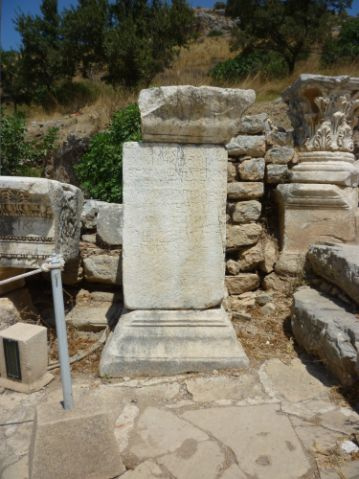
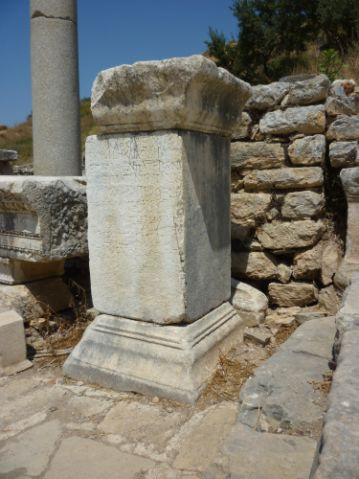
Base for statue of Damocharis, governor of Asia. Ephesus (Asia). Fourth to fifth century, or just possibly sixth
Record details
Photographs
Inscription
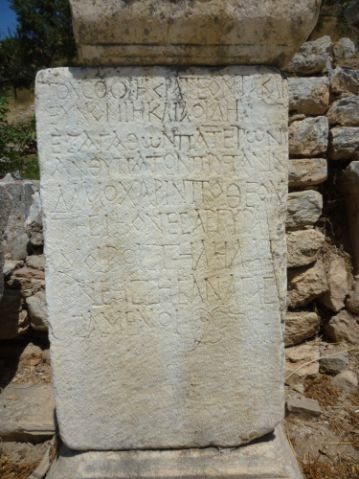
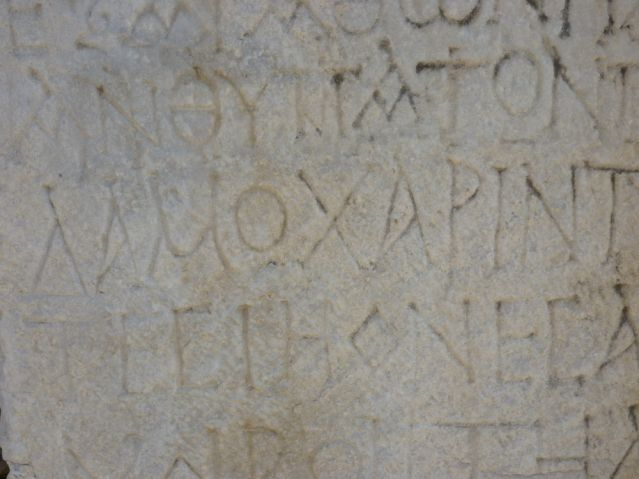
τὸν σοφίῃ κρατέοντα καὶ / εὐνομίῃ καὶ ἀοιδῇ / ἐξ ἀγαθῶν πατέρων / ἀνθύπατον πρύτανιν /(5) Δαμόχαριν ποθέον/τες Ἰήονες ἀργυρα/μοιβοὶ στήλῃ λα/ϊνέῃ στῆσαν ἀγασ/σάμενοι.
Inscription translation
Mighty in wisdom and justice and song, our prince, proconsul of good fathers, Damocharis; the admiring Ionian money-changers, rejoicingly set him up in a stone statue (stele). (leaf)
Bibliography
- Bauer, F. A., Stadt, Platz und Denkmal in der Spätantike, Mainz 1996, 424
- Engelmann, H. Knibbe, D. & R. Merkelbach, Die Inschriften von Ephesos Teil IV. Inschriften griechischer Städte aus Kleinasien, vol. 14, Bonn 1980, 163, no. 1302
- Miltner, F. '22. Vorläufiger Bericht über die Ausgrabungen in Ephesos', Jahreshefte des Österreichischen Archäologischen Institutes in Wien 44, 243-314, Vienna 1959, 348
Discussion
INSCRIPTION
Verse inscription of two elegiac distichs laid out in nine lines:
τὸν σοφίῃ κρατέοντα καὶ / εὐνομίῃ καὶ ἀοιδῇ /
ἐξ ἀγαθῶν πατέρων / ἀνθύπατον πρύτανιν /
(5) Δαμόχαριν ποθέον/τες Ἰήονες ἀργυρα/μοιβοὶ
στήλῃ λα/ϊνέῃ στῆσαν ἀγασ/σάμενοι. (leaf)
'Mighty in wisdom and justice and song, our prince, proconsul of good fathers, Damocharis; the admiring Ionian money-changers, rejoicingly set him up in a stone statue (stele). (leaf)'
(Trans J. Lenaghan)
Letter height 4 - 4.5 cm.
The text is aligned to the left and set out with little space between the lines.
DESCRIPTION
Composite base with separate crown and base mouldings. Dimensions of the whole monument: H 163.5, W 86.5, D c. 84 cm. Shaft of bluish marble without decoration, reused, with an inscription on the opposite side honouring Artorius Pius Maximus from the late 3rd century (LSA-724).
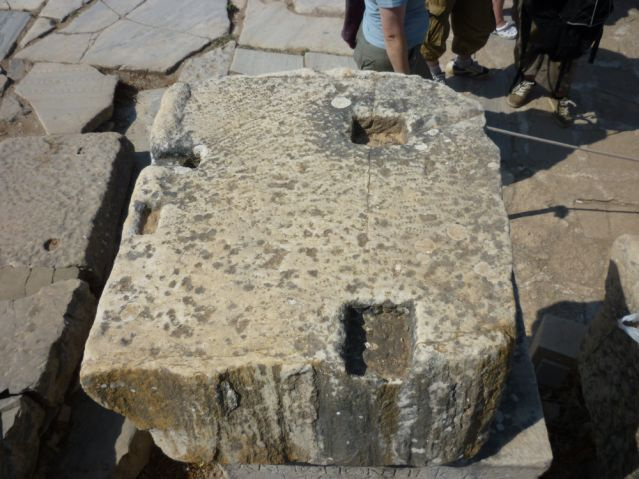
The crown moulding, broken and lost on the left, is probably a reused piece. It has no visible fixings to secure it to the shaft (such as clamps on the side). On its top face, towards the back, there are two large rectangular dowel holes, one with a pouring channel (as well as two much smaller dowel holes at the front). On its right side there is one clamp hole. The placing, size and shape of the dowel holes indicate that they were not made to support a bronze statue, but to secure a stone block above, presumably the plinth of the statue of Damocharis (unless they belong to an earlier phase of use). The clamp hole is also for securing such a plinth. The presence of a marble statue on a separately worked crown moulding is very unusual at Ephesus, where separate crown mouldings are otherwise always associated with bronze statues.
The base moulding, also probably a reused piece, has a tall simple profile, with two small tori at the top. Both crown and base mouldings were probably associated with the shaft only at the time of the dedication to Damocharis (rather than at the time of the dedication to Maximus).
PROVENANCE AND CURRENT LOCATION
The monument was found east of the Nymphaeum Traiani, in debris covering the street (##sketchbook Nr. 2902, Miltner in 1957##). It is today set up close to its find-spot, with the inscription to Damocharis facing the street.
HONORAND, AWARDER AND DATE
Damocharis, the honorand, was governor (proconsul - ἀνθύπατον, line 4) of Asia. The epigram uses a variety of standard motifs to celebrate his virtues and skills: justice (εὐνομίῃ, line 2), the cardinal virtue of high ranking magistrates (often simply referred to as judges); his achievements in learning (σοφίῃ, line 1); his familiarity with the arts (ἀοιδῇ, line 2). Moreover, Damocharis is of noble birth (ἐξ ἀγαθῶν πατέρων line 3), a property the authors of encomiastic deliveries were determined to point out if possible. He is also described as prytanis (πρύτανιν, line 4), which possibly refers to high civic office. He was almost certainly the same man as a Damocharis who received a statue in Smyrna, and had carried out work of repair within the city (LSA-2588).
The inscription was set up by the money-changers of Ephesus, poetically styled the 'Ionian' money-changers in our inscription. The dedication by a professional rather than a civic body is unusual, and was almost certainly related to some specific benefit the money-changers received from Damocharis.
The reference to 'song' (ἀοιδῇ) in line 2 has been taken as an argument to identify our honorand with the poet Damocharis of the mid 6th century, and therefore to suggest a very late date for our base (Cameron & Cameron 1966). However, in our opinion this is putting too much weight on a single motif in the inscription, which can more easily be seen as a generic reference to our Damocharis' cultured upbringing. We therefore agree with McCail 1969, who argued against the identification of our man with the poet (who is not known to have held any office). Verse dedications to governors of this type were set up through the 4th and 5th centuries, though statues to governors in provincial cities become increasingly unlikely after the mid 5th century.
On balance, we think Damocharis' base is datable to the period between 300 and 500, with the likelihood that it predates 450; but the possibility that it is 6th-century of course remains.
FURTHER DISCUSSION
The inscription, very unusually at Ephesus, specifies that it was for a marble statue (στήλῃ λαϊνέῃ in lines 7-8), a specification that is otherwise only found on the base to Stephanus (LSA-732). Near our base was found the body of a himation statue (LSA-728) of high imperial times, which, with reworked head (now lost), could well have served as the statue of Damocharis (and possibly even of Maximus before him). However the plinth of this statue is lost, so it is impossible to prove the association (by showing that the dowel holes and clamp holes on our crown moulding line up with others on the statue's plinth).
Discussion references
- Auinger, J. 'Zum Umgang mit Statuen hoher Würdenträger in spätantiker und nachantiker Zeit entlang der Kurenstrasse in Ephesos', Vienna 2009, 35, fig. 11
- Cameron, A. & A. D. E. Cameron, The Cycle of Agathias, Journal of Hellenic Studies 86, 1966, 6-25, p. 11
- Malcus, B. 'Die Prokonsuln von Asien von Diokletian bis Theodosius II', Opuscula Atheniensa, 7 (1967) 91-154, 132
- Martindale, J. R., The Prosopography of the Later Roman Empire. Vol. II A.D. 395-527, Cambridge 1980
- McCail, R. C., The cycle of Agathias: new identifications scrutinised, Journal of Hellenic Studies 89, 1969, 87-96, p. 89
- Slootjes, D., The governor and his subjects in the later Roman empire , Leiden 2006
Cite: Last Statues of Antiquity, LSA-727 (A. Sokolicek and Ulrich Gehn).