
LSA-728
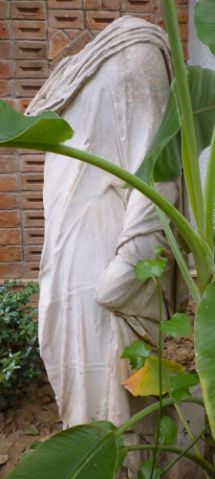
Himation statue re-used for Lucius Artorius Pius Maximus (LSA-724) or Damocharis (LSA-727). Ephesus. Late third and/or mid fifth century
Record details
Photographs
Bibliography
- Miltner, F. '22. Vorläufiger Bericht über die Ausgrabungen in Ephesos', Jahreshefte des Österreichischen Archäologischen Institutes in Wien 44, 243-314, Vienna 1959, 348-349, fig. 187, 189, 190
Discussion
DESCRIPTION (Object)
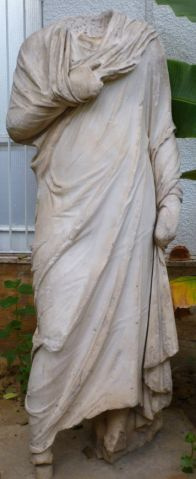
Overlife size himation-statue, H 186 cm. Coarse-grained, white marble.
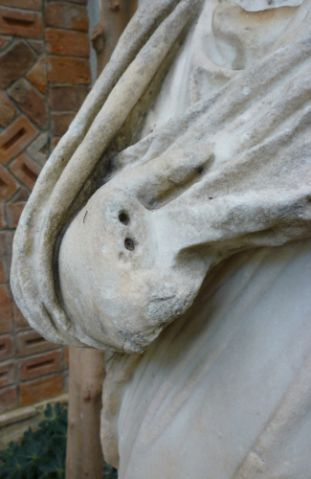
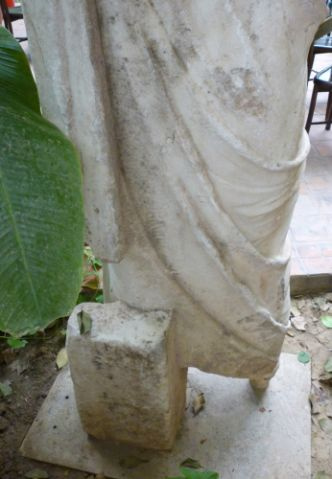
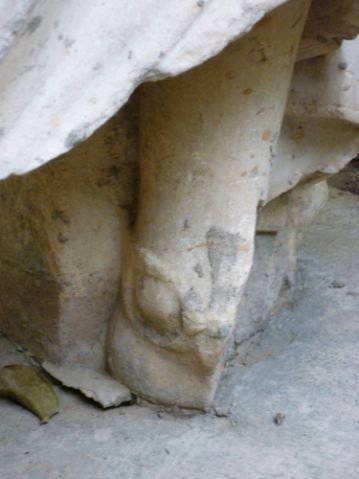
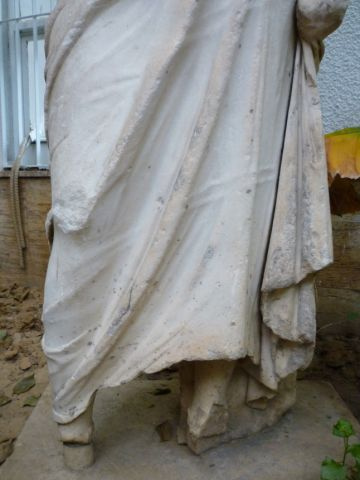
Head missing. Feet with plinth broken off and missing too. Two fingers of the right hand broken off, in the break two fixing holes. Some folds and minor chips here and there.
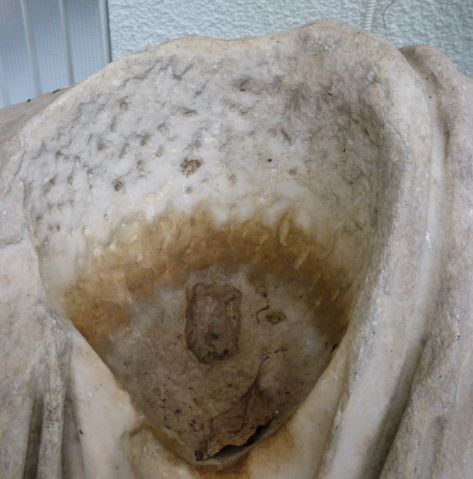
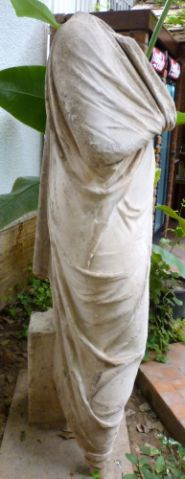
Deep socket (very rough chiseled) to insert the neck with a dowel-hole in the mid into the torso. A little use of the drill for the folds. On the back the main folds are worked out, surface smoothed.
PROVENANCE
The statue was unearthed in 1957 at the northern side of the Embolos, east of the Nymphaeum Traiani. Close to it a base carrying an inscription to Artorius LSA-724 and Damocharis LSA-727 was found.
DESCRIPTION (Subject)
Statue of a man wearing a tunica and a himation. The tunica is visible in front of the neck, the himation covers the whole body. He wears sandals.
He is standing with the weight over his left leg, the right arm in a loop in front of the body, the left arm held down along the side. The left hand is hidden in the himation and holding back the drapery. A cubic support is standing behind his left leg.
At an unknown time some fingers of the right hand were repaired.
DATE
Miltner who found the ensemble (statue and base) decided a date for the statue contemporary with the inscription of Damocharis LSA-727 at the end of the fourth and beginning of the fifth century. Polaschek was the first scholar dating the statue much earlier in Tiberian time. She compared the statue with an other himation-statue in Kopenhagen (Grimani). Fleischer gave him a much broader date in early high imperial time.
Discussion references
- Auinger, J. 'Zum Umgang mit Statuen hoher Würdenträger in spätantiker und nachantiker Zeit entlang der Kuretenstrasse in Ephesos', Neue Forschungen zur Kuretenstrasse von Ephesos : Akten des Symposiums für Hilke Thür vom 13. Dezember 2006 an der Österreichischen Akademie der Wissenschaften, Vienna 2009, 35, fig. 12-14
- Bammer, A., R. Fleischer, and D. Knibbe , Führer durch das Archäologische Museum in Selçuk-Ephesos, Vienna 1974, 166-7
Cite: Last Statues of Antiquity, LSA-728 (J. Auinger).